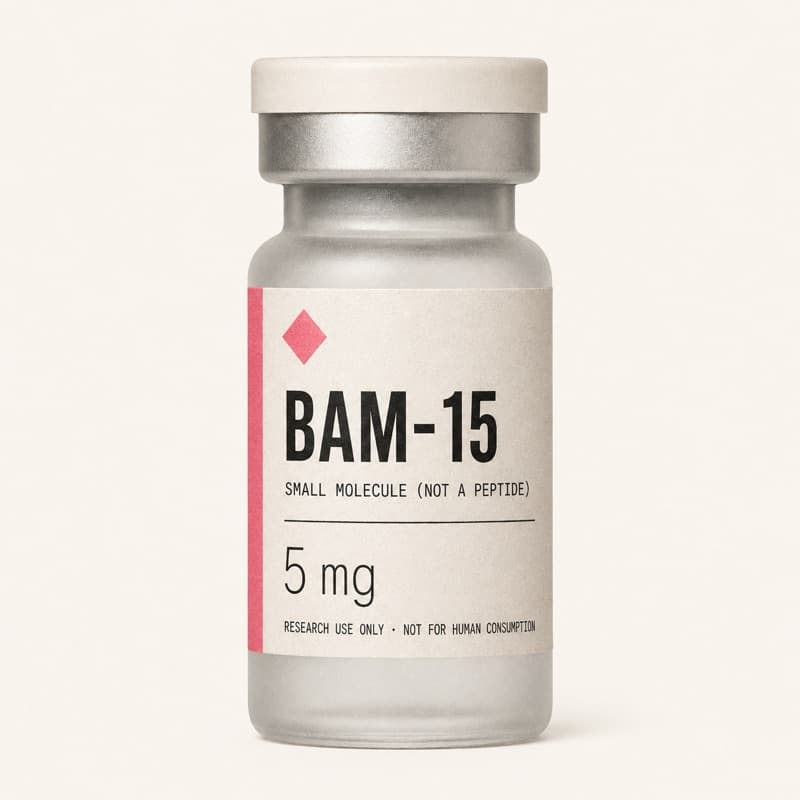
BAM-15
Mitochondrial Uncoupler · Metabolic Enhancer
Synthetic mitochondrial uncoupler that has come forward as a promising research compound for obesity and metabolic disorders. Older uncouplers such as DNP carry serious toxicity concerns; BAM-15's safety profile is superior, and it raises energy expenditure and fat oxidation effectively. Mice given BAM-15 lose body fat with food intake, lean mass, and body temperature unaffected. Potency runs roughly 7-fold above DNP, and the dangerous hyperthermia of the older uncouplers does not follow. Note: BAM-15 is a small molecule compound rather than a peptide, though it is commonly sold alongside peptide products.
Overview
Synthetic mitochondrial uncoupler that has come forward as a promising research compound for obesity and metabolic disorders. Older uncouplers such as DNP carry serious toxicity concerns; BAM-15's safety profile is superior, and it raises energy expenditure and fat oxidation effectively. Mice given BAM-15 lose body fat with food intake, lean mass, and body temperature unaffected. Potency runs roughly 7-fold above DNP, and the dangerous hyperthermia of the older uncouplers does not follow. Note: BAM-15 is a small molecule compound rather than a peptide, though it is commonly sold alongside peptide products.
The inner mitochondrial membrane is where BAM-15 acts: proton permeability rises and the proton gradient dissipates. Electron transport is thereby uncoupled from ATP synthesis, which forces mitochondria into higher respiration, burning more substrate — fat in particular — to hold energy production up. Depletion of ATP brings AMP-activated protein kinase (AMPK) into play, and with it glucose uptake and fatty acid oxidation. PGC-1α (peroxisome proliferator-activated receptor gamma coactivator 1-alpha) is activated as well, which enhances mitochondrial biogenesis. Neither depolarization of plasma membranes nor apoptosis follows at effective concentrations, unlike DNP or FCCP, and that is the explanation offered for the improved safety profile.
Research indications
What the compound has been studied for, grouped by body system. Effect size is the reported magnitude where it was measured — not a recommendation.
2024 research reports greater metabolic benefit from BAM-15 paired with semaglutide than from either compound on its own, the pairing countering metabolic adaptation.
Plateaus in weight loss may be overcome through prevention of metabolic adaptation/efficiency.
Body fat drops as energy expenditure and fat oxidation climb, with food intake unreduced.
In mouse models, research reports diet-induced insulin resistance reversed.
Several components of metabolic syndrome are addressed at once, by way of raised energy expenditure.
Treated animals showed lower triglyceride levels in the liver.
Research models showed better glucose tolerance.
- Class
- Small molecule (not a peptide)
- Research status
- Moderate research
- Molecular weight
- 326.28 Da
- Half-life
- ~1.7 h
- Typical dose
- 25–50 mg oral
- Frequency
- Once or twice daily with meals
- Cycle length
- 4–8 weeks based on research protocols
- Storage
- Room temperature, protect from light and moisture
Molecular data
- Type
- Small molecule (not a peptide)
- Molecular weight
- 326.28 Da
- Half-life
- 102 min
Levels in single-dose multiples. A shape, not a pharmacokinetic prediction.
Dosing reference
Doses reported in the literature and by suppliers. These are a record of what has been used in research — reference, never instruction.
| Context | Route | Amount | Frequency |
|---|---|---|---|
| Metabolic enhancement | Oral | 25-50 mg | Once or twice daily |
| Research protocol (mouse equivalent) | Oral gavage | ~10 mg/kg | Daily |
Interactions
Metabolic adaptation limits GLP-1 efficacy; 2024 research reports the combination countering that adaptation, for stronger metabolic benefit.
The expected synergy is similar to semaglutide's; it assists in overcoming weight loss plateaus.
Not to be combined with any other mitochondrial uncoupler; additive effects can be dangerous.
Metabolic rate rises with each, so the combination calls for careful monitoring.
Mitochondrial function is affected by both, by way of different mechanisms.
What to expect
Safety
Mechanistic flags — properties of the pathway, not observed adverse events.
- Body temperature may rise mildly (less than DNP)
- Tolerated well overall in research
- Significant hyperthermia/overheating
- Excessive sweating
- Rapid heart rate
- Difficulty breathing
- Hyperthyroidism or thyroid disorders
- Heart conditions
- Pregnancy or breastfeeding
- Fever or active infection
- Other mitochondrial uncouplers in use (DNP, FCCP)
Quality checklist
What to confirm before trusting a batch of research material. A verification aid — not an endorsement of any supplier.
- Third-party Certificate of AnalysisIndependent lab · dated · lot-matched.
- HPLC purity ≥ 98%Reverse-phase trace included.
- Mass-spec confirms 326.28 g/molMALDI-TOF or ESI-MS.
- Counterion stated (acetate ≫ TFA)TFA salts can confound bioassays.
- Endotoxin / sterility statementRelevant once reconstituted.
- Lyophilised · cold-chain shippedStored −20 °C, shipped on ice.
- Labelled “research use only”No therapeutic or dosing claims.
Recorded signals for this compound · 9
- ✓Reputable supplier
- ✓Powder or tablets, white through off-white
- ✓Purity >98% stated on a certificate of analysis
- ✓Correct packaging, shielded from light
- !Unclear sourcing
- !Third-party testing unavailable
- ×Discolored product
- ×No purity information
- ×Unknown origin
FAQ
Why does BAM-15 not produce the dangerous hyperthermia DNP does?
Potency sits approximately 7-fold above DNP's, and yet the dangerous, uncontrollable hyperthermia DNP causes does not follow. Mitochondrial proton permeability is raised selectively, leaving plasma membranes undepolarized and systemic heat production untriggered. In place of metabolic chaos, the compensatory AMPK and PGC-1α pathways are activated.
Does BAM-15 produce fat loss where diet and exercise are absent?
Mouse research recorded reduced body fat with no effect on food intake or body temperature, but the animals were sedentary rodents. Efficacy in humans requires an unclear interaction with actual behavior, diet, and exercise. Caloric deficit and training are the likely enhancers of the result, which is not achieved passively.
What makes BAM-15 work better with semaglutide in 2024 research?
Pairing BAM-15, a mitochondrial uncoupler, with semaglutide, a GLP-1 agonist, yields metabolic benefit past what either delivers alone, and metabolic adaptation is what the pairing counters. Appetite suppression from semaglutide reaches a plateau as the body adapts; the boost to energy expenditure from BAM-15 prevents that adaptation, so weight loss is sustained.
References
- 1Mitochondrial uncoupler BAM15 reverses diet-induced obesity and insulin resistance in miceNature Communications · 2020
BAM15 is orally bioavailable, increases nutrient oxidation, decreases body fat mass without altering food intake, lean mass, body temperature, or markers of toxicity.
Animal in vivo · inferredSource ↗ - 2BAM15-mediated mitochondrial uncoupling protects against obesity and improves glycemic controlEMBO Molecular Medicine · 2020
BAM15 is 7-fold more potent than DNP, does not depolarize plasma membranes, and does not induce apoptosis at effective doses.
Review · inferredSource ↗ - 3BAM15 as a mitochondrial uncoupler: a promising therapeutic agent for diverse diseasesPMC Review · 2023
Comprehensive review of BAM15 mechanisms including AMPK and PGC-1α activation pathways.
Review · inferredSource ↗ - 4Beneficial effects of simultaneously targeting calorie intake and calorie efficiency in diet-induced obese miceClinical Science · 2024
Combining semaglutide and BAM15 produces stronger metabolic benefits than either alone; helps overcome metabolic adaptation.
Animal in vivo · inferredSource ↗