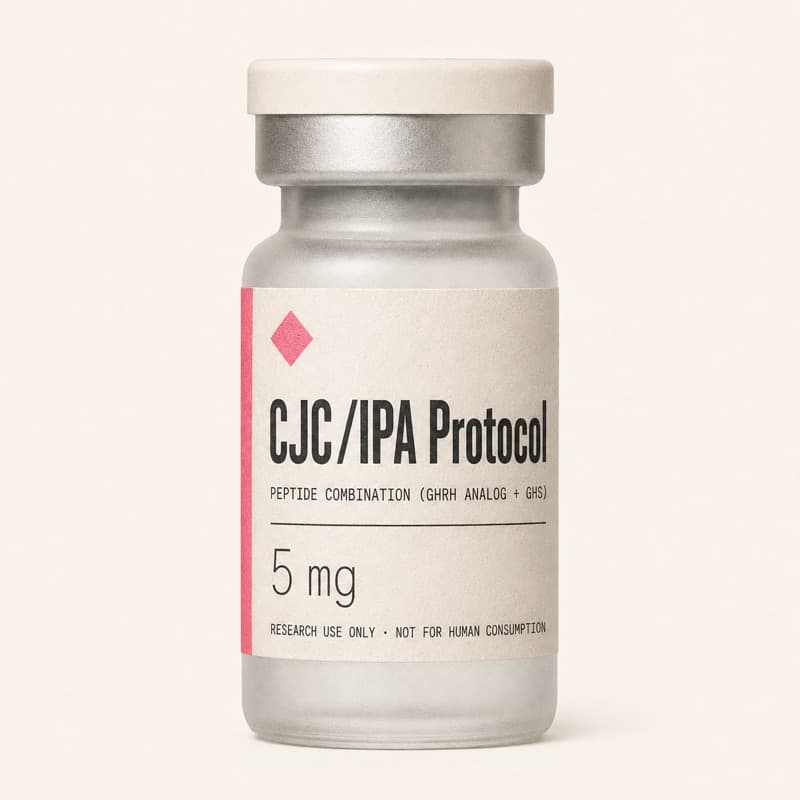
CJC/IPA Protocol
GHRH/GHRP Combination · Growth Hormone Optimization
Dual-pathway protocol pairing CJC-1295 with Ipamorelin, aimed at growth hormone secretion through mechanisms that complement one another. CJC-1295 shows GH increases of 2–10 fold lasting 6–8 days, while Ipamorelin releases GH selectively, with no cortisol elevation.
Overview
Dual-pathway protocol pairing CJC-1295 with Ipamorelin, aimed at growth hormone secretion through mechanisms that complement one another. CJC-1295 shows GH increases of 2–10 fold lasting 6–8 days, while Ipamorelin releases GH selectively, with no cortisol elevation.
GHRH receptors are the target of CJC-1295, reached through albumin-binding DAC technology, and the elevation it produces is sustained. Ipamorelin acts selectively at ghrelin receptors (GHSR1a); ACTH/cortisol are untouched, so the natural pulsatile GH pattern is preserved.
Research indications
What the compound has been studied for, grouped by body system. Effect size is the reported magnitude where it was measured — not a recommendation.
Sustained elevation of GH supports connective tissue health, and skin elasticity.
GH peaks in the evening line up with sleep that is deeper and more restorative.
Support for tissue repair and for recovery after exercise or injury comes from growth hormone.
Integrity of joints and connective tissue rests on enhanced collagen synthesis.
Elevated growth hormone supports nitrogen retention and muscle protein synthesis through training.
Repair of muscle between exercise sessions may accelerate where GH patterns are sustained.
Optimized GH assists maintenance of muscle through caloric restriction or aging.
Lipolysis is promoted by growth hormone, with lean tissue maintenance supported at the same time.
Utilization of glucose and fat may improve where GH patterns are enhanced.
- Class
- Peptide combination (GHRH analog + GHS)
- Research status
- Well studied
- Typical dose
- 200–300 µg of each peptide (CJC-1295 and Ipamorelin)
- Frequency
- Once daily, typically evening
- Cycle length
- 8–12 weeks on
- Storage
- Lyophilized: 2-8°C refrigerated; Reconstituted: 2-8°C refrigerated, use within 30 days
Molecular data
- Type
- Peptide combination (GHRH analog + GHS)
Dosing reference
Doses reported in the literature and by suppliers. These are a record of what has been used in research — reference, never instruction.
| Context | Route | Amount | Frequency |
|---|---|---|---|
| General Health Optimization | SubQ | 200mcg each (0.2mL if 1mg/mL) | Once daily |
| Performance Enhancement | SubQ | 250mcg each (0.25mL if 1mg/mL) | Once daily |
| Recovery Optimization | SubQ | 300mcg each (0.3mL if 1mg/mL) | Once daily |
| Conservative Approach | SubQ | 150mcg each (0.15mL if 1mg/mL) | 5 days per week |
Interactions
Insulin sensitivity shifts under GH; glucose monitoring and insulin adjustments are required for diabetic users.
GH pathways are affected by both; excessive GH elevation and changes in insulin sensitivity warrant monitoring.
No interactions known; mechanisms differ — GH optimization against tissue-repair signaling.
The mechanisms overlap; what may result is excessive GH suppression of the natural pulsatile release.
A 4+ hour gap from GH secretagogues is indicated, given absorption and metabolic interactions.
The GH response may be blunted, so higher doses may be necessary, or alternative timing.
What to expect
Safety
Mechanistic flags — properties of the pathway, not observed adverse events.
- Joint swelling and water retention
- Carpal tunnel syndrome (tingling/numbness)
- Blood glucose mildly elevated
- Irritation at the injection site where rotation is improper
- Joint pain or swelling that persists, indicating fluid retention
- Marked changes in blood glucose, or problems with diabetic control
- Atypical fatigue, lethargy, or deteriorating mood
- Infections at the injection site, or reactions that persist
- Tingling or numbness in the hands/feet
- Where cancer history exists, signs of tumor growth accelerating
- Active malignancy, or a cancer history
- Diabetes severe enough to require tight glucose control
- Carpal tunnel syndrome, or disorders of nerve compression
Quality checklist
What to confirm before trusting a batch of research material. A verification aid — not an endorsement of any supplier.
- Third-party Certificate of AnalysisIndependent lab · dated · lot-matched.
- HPLC purity ≥ 98%Reverse-phase trace included.
- Mass-spec identity confirmedMALDI-TOF or ESI-MS.
- Counterion stated (acetate ≫ TFA)TFA salts can confound bioassays.
- Endotoxin / sterility statementRelevant once reconstituted.
- Lyophilised · cold-chain shippedStored −20 °C, shipped on ice.
- Labelled “research use only”No therapeutic or dosing claims.
Recorded signals for this compound · 11
- ✓Labeling that follows the standard format, for instance '10mg total: 5mg CJC-1295 + 5mg Ipamorelin'
- ✓A 1:1 ratio held between the two peptides for optimal effects
- ✓Reconstitution clear, with no cloudiness or particles
- ✓A Certificate of Analysis listing purity for each peptide individually
- ✓Cold packs and immediate refrigeration, indicating a properly maintained cold chain
- !Choice of format: separate vials are preferred by beginners for tolerance testing
- !The blended format is convenient, though dose adjustment is limited
- !Peer-reviewed clinical validation is missing for combination protocols
- ×Packaging damaged, or refrigeration missing
- ×Exposure to heat in shipping
- ×No Certificate of Analysis documentation
FAQ
What is the rationale for combining CJC-1295 and Ipamorelin rather than running them separately?
The two reach GH secretion by complementary routes — GHRH receptors for CJC-1295, ghrelin receptors for Ipamorelin — and together the effect is synergistic, larger than either peptide on its own. Cortisol elevation is uniquely absent with Ipamorelin, which makes the pairing both effective and tolerable.
Is the CJC/IPA protocol appropriate where there is a history of diabetes?
Caution applies to CJC/IPA combinations where diabetes history exists, because GH is insulin-antagonistic. Growth hormone rises with both peptides, and glucose tolerance can suffer as a result. Before starting, medical supervision and regular blood glucose monitoring are essential — the more so given the continuous GH elevation this protocol produces.
Where does Ipamorelin hold an advantage over GHRP-6 in this combination?
Selectivity for GH release is the point: cortisol and prolactin do not rise with Ipamorelin, even at high doses, whereas GHRP-6 brings significant appetite stimulation and potential cortisol elevation. Within the CJC/IPA protocol that makes Ipamorelin the cleaner GH stimulus, without the side effects the broader GHRP peptides carry.
Should CJC/IPA be given as one injection or as two separate ones?
Either approach works. Blended vials hold both peptides at a 1:1 ratio; the alternative is separate injections, at one site or at different ones. Convenience favors the blend, at the cost of flexibility in adjusting each peptide's dose, while separate vials leave the ratio open to customization where that is wanted.
References
- 1Ipamorelin, the first selective growth hormone secretagogueRaun K, Hansen BS, Johansen NL, et al. · European Journal of Endocrinology · 1998
Ipamorelin is the first GHRP-receptor agonist with selectivity for GH release similar to GHRH; does not release ACTH or cortisol even at doses over 200-fold the ED50 for GH.
Animal in vivoPubMed 9849822 ↗ - 2Ghrelin and growth hormone secretagogues potentiate GH-releasing hormone-induced cAMP production in cells expressing transfected GHRH and GH secretagogue receptorsCunha SR, Mayo KE · Endocrinology · 2002
GHS potentiate GHRH-induced cAMP in a dose-dependent manner requiring co-expression of both receptors, providing the cellular basis for GHRH/GHRP synergy.
Review · inferredPubMed 12446584 ↗ - 3Prolonged Stimulation of Growth Hormone (GH) and Insulin-Like Growth Factor I Secretion by CJC-1295, a Long-Acting Analog of GH-Releasing Hormone, in Healthy AdultsTeichman SL, Neale A, Lawrence B, Gagnon C, Castaigne JP, Bhore R · Journal of Clinical Endocrinology & Metabolism · 2006
Subcutaneous CJC-1295 produced sustained, dose-dependent increases in GH and IGF-1 in healthy adults. Half-life of ~8 days. Cumulative effect after multiple doses with well-preserved GH pulsatility.
Human RCTPubMed 16352683 ↗ - 4Pulsatile Secretion of Growth Hormone (GH) Persists During Continuous Stimulation by CJC-1295, a Long-Acting GH-Releasing Hormone AnalogIonescu M, Frohman LA · Journal of Clinical Endocrinology & Metabolism · 2006
Basal (trough) GH levels increased 7.5-fold. Mean GH levels increased 46% and IGF-1 levels increased 45%. Pulsatile GH secretion preserved despite continuous GHRH receptor stimulation.
Human pilotPubMed 17018654 ↗
Tesamorelin, a GHRH analogue, reduced fat in the viscera and liver among people with HIV on integrase inhibitor regimens, indicating the GHRH pathway remains a viable target.
Pooling five randomised controlled trials of tesamorelin in HIV-associated lipodystrophy, this meta-analysis found a significant fall in visceral adipose tissue, an outcome attributed to the GHRH signalling axis that CJC-1295 also engages.