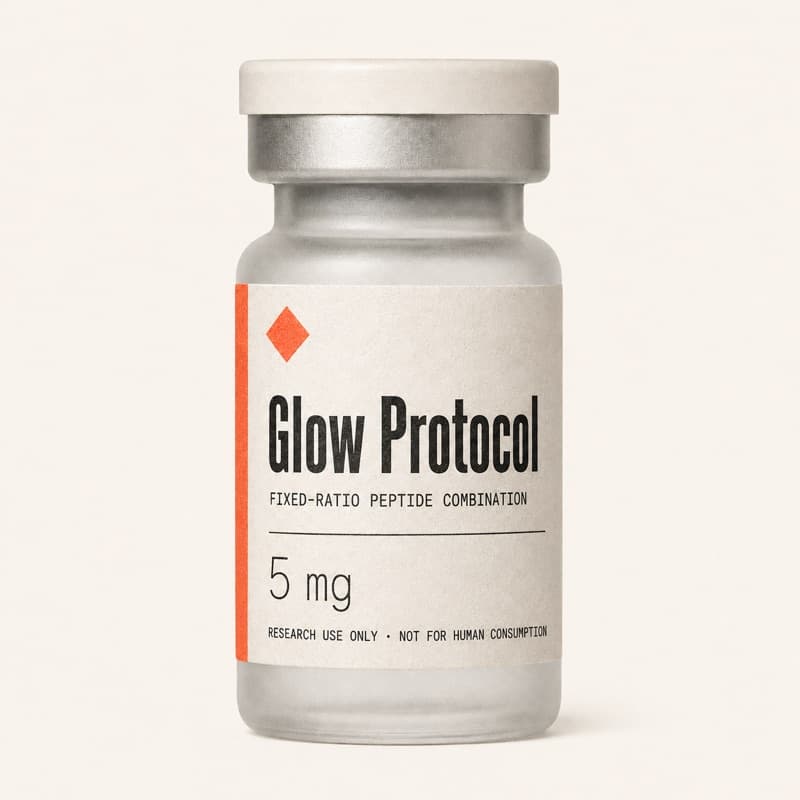
Glow Protocol
Multi-Peptide Skin Rejuvenation Complex
Combination marketed for anti-aging and skin rejuvenation, built from GHK-Cu, TB-500, and BPC-157. Research supports the components taken individually; dosing the combination calls for care so that therapeutic ranges are not exceeded.
Overview
Combination marketed for anti-aging and skin rejuvenation, built from GHK-Cu, TB-500, and BPC-157. Research supports the components taken individually; dosing the combination calls for care so that therapeutic ranges are not exceeded.
Each component contributes: anti-inflammatory action from BPC-157, angiogenic support from TB-500, stimulated collagen production from GHK-Cu. Because the ratio is fixed, individual peptides may land outside their optimal therapeutic ranges.
Research indications
What the compound has been studied for, grouped by body system. Effect size is the reported magnitude where it was measured — not a recommendation.
Synergy is theoretical; formal studies of the combination are limited
Tissue regeneration is supported by the BPC-157 and TB-500 components
Collagen production is stimulated by GHK-Cu
- Class
- Fixed-ratio peptide combination
- Research status
- Limited research
- Typical dose
- Typically 50 mg GHK-Cu, 10 mg TB-500, 10 mg BPC-157 per dose
- Frequency
- Once daily
- Cycle length
- 8–12 weeks
- Storage
- Lyophilized: 2-8°C refrigerated; Reconstituted: 2-8°C refrigerated immediately after mixing
Molecular data
- Type
- Fixed-ratio peptide combination
Dosing reference
Doses reported in the literature and by suppliers. These are a record of what has been used in research — reference, never instruction.
| Context | Route | Amount | Frequency |
|---|---|---|---|
| Standard protocol | Subcutaneous | Per formulation instructions | Once daily |
Interactions
Mechanisms differ and may complement support for cellular energy
Antioxidant support sits compatibly with the peptide effects
Skin sensitivity may increase; irritation warrants monitoring
Combining products risks a copper overdose
Daily intake in total may run past therapeutic ranges
What to expect
Safety
Mechanistic flags — properties of the pathway, not observed adverse events.
- Injection site reactions
- Blue-green discoloration that is temporary (GHK-Cu)
- Severe reactions at the injection site, or infection
- Allergic reactions, with rash or difficulty breathing
- Copper toxicity signs: nausea, jaundice
Quality checklist
What to confirm before trusting a batch of research material. A verification aid — not an endorsement of any supplier.
- Third-party Certificate of AnalysisIndependent lab · dated · lot-matched.
- HPLC purity ≥ 98%Reverse-phase trace included.
- Mass-spec identity confirmedMALDI-TOF or ESI-MS.
- Counterion stated (acetate ≫ TFA)TFA salts can confound bioassays.
- Endotoxin / sterility statementRelevant once reconstituted.
- Lyophilised · cold-chain shippedStored −20 °C, shipped on ice.
- Labelled “research use only”No therapeutic or dosing claims.
Recorded signals for this compound · 6
- ✓A clear solution, no particles
- ✓Packaging that properly states the individual peptide amounts
- !Peptide content verified against supplier specifications
- !Individual peptide doses calculated before starting
- ×Individual peptide amounts excessive, past the recommended ranges
- ×Solution cloudy or discolored
FAQ
Is the Glow Protocol proven as a combination, or experimental?
Marketing presents it as a skin rejuvenation combination, but no peer-reviewed study has examined the three-peptide blend as a unit. Every piece of evidence is extrapolated from research on BPC-157, TB-500, and GHK-Cu individually. As a combination it stays experimental and theoretical, not clinically validated.
What does combining three peptides into one product risk?
A fixed ratio can place individual peptides outside their optimal therapeutic ranges. Take a blend carrying 5 mg GHK-Cu where the injectable dose needed is only 1–3 mg: the copper is then overdosed. Dose customization is possible with separate peptides, whereas a combination trades flexibility for convenience.
When do visible skin improvements show on the Glow Protocol?
The timeline typically tracks those of the individual peptides: a healing response in week 1–2, visible skin improvement by weeks 2–4, noticeable collagen effects by weeks 4–8, rejuvenation effects peaking by weeks 8–12. Peptide quality, dosing accuracy, and baseline skin condition make results vary from person to person.
References
- 1Gastric pentadecapeptide BPC 157 accelerates healing of transected rat Achilles tendon and in vitro stimulates tendocytes growthStaresinic, M., et al. · Journal of Orthopaedic Research · 2003
Superior tendon healing with improved biomechanical properties (increased load of failure and Young's modulus), enhanced tendon-to-bone integration, and stimulated tendocyte growth in rat models.
Animal in vivoPubMed 14554208 ↗ - 2Regenerative and Protective Actions of the GHK-Cu Peptide in the Light of the New Gene DataPickart, L., Margolina, A. · International Journal of Molecular Sciences · 2018
Broad regenerative potential demonstrated across skin, lung, bone, liver, and stomach tissue; cell protective actions including anti-cancer, anti-inflammatory, DNA repair, and proteasome activation via gene modulation.
ReviewPubMed 29986520 ↗ - 3A first-in-human, randomized, double-blind, single- and multiple-dose, phase I study of recombinant human thymosin β4 in healthy Chinese volunteersWang X, Liu L, Qi L, et al. · Journal of Cellular and Molecular Medicine · 2021
Phase I trial in 54 healthy subjects demonstrated recombinant thymosin β4 was well tolerated and safe across ascending IV doses up to 25 μg/kg with no significant accumulation.
Human RCTPubMed 34346165 ↗
A pilot trial, the first to give BPC157 intravenously to people, recorded no adverse effects in healthy adults at doses reaching 20 mg and no changes in cardiac, hepatic, renal, thyroid, or glucose biomarkers.
Across 36 studies, this systematic review reported that BPC-157 raises GH receptor expression and promotes angiogenesis, with functional and biomechanical measures improving in musculoskeletal injury models.
This review covers the tissue-regenerative and collagen-stimulating actions of GHK, finding the preclinical record strong while no formal clinical trials exist for topical anti-wrinkle use.