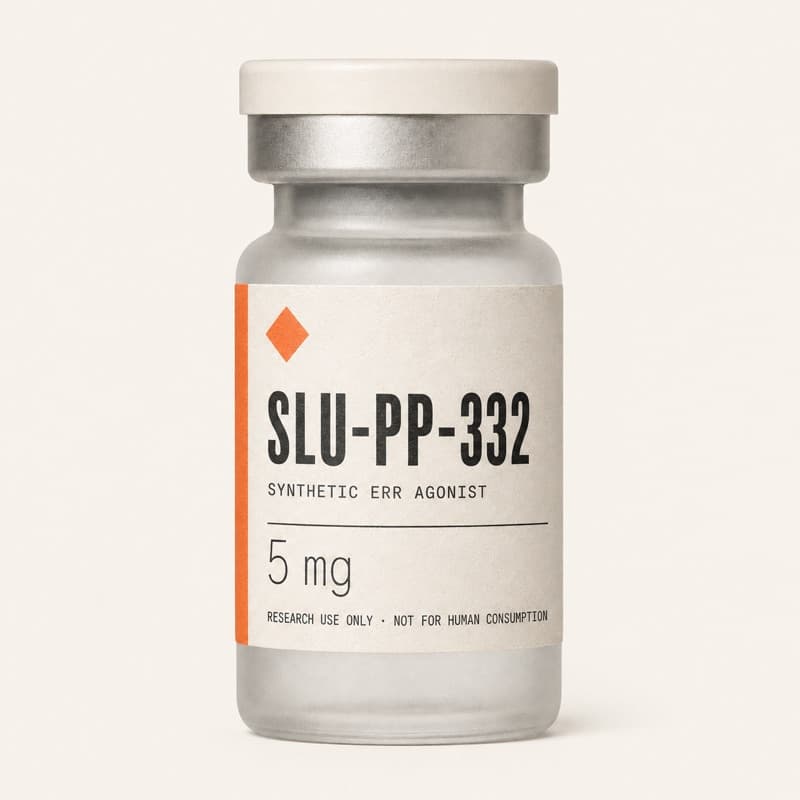
SLU-PP-332
Synthetic Pan-ERR Agonist · Exercise Mimetic & Metabolic Modulator
Synthetic compound out of Saint Louis University, a pan-estrogen-related receptor agonist with preferential activity at ERRα. It switches on the metabolic pathways that physical exercise engages, and no physical activity is required.
Overview
Synthetic compound out of Saint Louis University, a pan-estrogen-related receptor agonist with preferential activity at ERRα. It switches on the metabolic pathways that physical exercise engages, and no physical activity is required.
ERRα/β/γ are bound and activated; these regulate gene expression for energy metabolism. Downstream, PGC-1α — the master regulator of mitochondrial biogenesis — is upregulated, the AMPK pathway activated, mitochondrial density raised to 1.8-fold, and oxidative phosphorylation and ATP production enhanced.
Research indications
What the compound has been studied for, grouped by body system. Effect size is the reported magnitude where it was measured — not a recommendation.
Body weight fell 12% over 28 days with no appetite suppression. Fat mass gain was <0.5g against ~5g in controls.
Obese mice showed significantly improved glucose tolerance, with fasting glucose and insulin both lower.
Resting energy expenditure rises 25% toward fatty acid oxidation inside 2 hours.
Hepatic steatosis reduced, hepatic triglycerides down, hepatic fatty acid oxidation enhanced.
Preclinical models gained 70% in running time and 45% in running distance.
Type IIa oxidative skeletal muscle fibers increased, their oxidative capacity enhanced.
Heart failure models showed improved ejection fraction and reduced cardiac fibrosis.
The first compound to reverse the mitochondrial dysfunction of aging, seen in mice at 21 months.
In elderly mice the age-related rise in albuminuria was reversed and podocyte loss prevented.
- Class
- Synthetic ERR agonist
- Research status
- Emerging
- Molecular weight
- 290.32 Da
- Typical dose
- No human dose established. Animal studies used 50 mg/kg IP.
- Frequency
- Research only; not approved for human use
- Cycle length
- No human protocols established
- Storage
- 2-8°C refrigerated for research use
Molecular data
- Type
- Synthetic ERR agonist
- Molecular weight
- 290.32 Da
Dosing reference
Doses reported in the literature and by suppliers. These are a record of what has been used in research — reference, never instruction.
| Context | Route | Amount | Frequency |
|---|---|---|---|
| Standard Metabolic Protocol | Intraperitoneal injection (IP) | 50 mg/kg (animal dosing) | Twice daily |
| Acute Exercise Enhancement | Intraperitoneal injection (IP) | 50 mg/kg (animal dosing) | Single dose 1 hour pre-exercise |
| Extended Treatment | Intraperitoneal injection (IP) | 50 mg/kg (animal dosing) | Twice daily for 4-8 weeks |
Interactions
Mitochondrial function and AMPK pathways are affected by each, so metabolic effects may be additive. Blood glucose warrants close monitoring.
Insulin sensitivity is enhanced, and a significant dose reduction may be needed to prevent hypoglycemia.
Weight loss and metabolism are reached by different mechanisms; combined, the effects could be additive.
GLP-1 agonism alongside ERR agonism may enhance metabolic effects; the rate of weight loss warrants close monitoring.
ERR agonism against NNMT inhibition — distinct mechanisms, likely complementary, with no known interactions.
Mitochondrial pathways complement: biogenesis is increased by SLU-PP-332, energy production supported by NAD+.
For body composition, GH optimization may complement metabolic enhancement; no interactions are known.
Lean muscle may be preserved through the GH pathway while SLU-PP-332 drives fat loss.
What to expect
Safety
Mechanistic flags — properties of the pathway, not observed adverse events.
- No lean mass loss
- Animal studies found safety favorable; no severe effects arose at doses in the therapeutic range
- Tolerated well by rodents and canines
- Liver, kidney and cardiac toxicity: none documented
- Neither a hormone suppressant nor a stimulant
- Some studies recorded minor changes in plasma cholesterol and liver enzymes
- Neurological symptoms, or severe headaches
- Severe hypoglycemia, especially alongside diabetes medications
- Cardiovascular symptoms of any kind — chest pain, palpitations, shortness of breath
- Liver dysfunction, shown by jaundice, by dark urine, by severe abdominal pain
- Kidney trouble — urination reduced, swelling, severe back pain
- Rash, hives, difficulty breathing, swelling — allergic reactions
- Not for human use — no human dose is approved
- Human clinical trials have not been conducted
- Interaction with diabetes medications is possible
Quality checklist
What to confirm before trusting a batch of research material. A verification aid — not an endorsement of any supplier.
- Third-party Certificate of AnalysisIndependent lab · dated · lot-matched.
- HPLC purity ≥ 98%Reverse-phase trace included.
- Mass-spec confirms 290.32 g/molMALDI-TOF or ESI-MS.
- Counterion stated (acetate ≫ TFA)TFA salts can confound bioassays.
- Endotoxin / sterility statementRelevant once reconstituted.
- Lyophilised · cold-chain shippedStored −20 °C, shipped on ice.
- Labelled “research use only”No therapeutic or dosing claims.
Recorded signals for this compound · 11
- ✓A legitimate research supplier, Certificate of Analysis included
- ✓Suppliers of good repute in chemicals: Sigma-Aldrich, Cayman Chemical
- ✓Labeled properly, 'Research Use Only'
- ✓Purity data, typically >98%, alongside batch numbers
- !For research only; human use is excluded
- !No FDA approval, and no clinical trials in humans
- !Licensed suppliers only, and only for legitimate research
- ×Marketing a product for human consumption is illegal
- ×Purity unknown, or contamination, where there is no lab testing
- ×No proper verification by HPLC or mass spectrometry
- ×Products that carry no 'Research Use Only' label
FAQ
Is SLU-PP-332 a genuine substitute for exercise, or only the sensation of one?
The metabolic pathways exercise uses are the ones activated — mitochondrial biogenesis, PGC-1α upregulation, AMPK activation — yet the substitution is not complete. Endurance rises 70% and weight falls 12% without exercise, while muscle is not built and cardiovascular fitness is not improved the way real training does it. The category is metabolic enhancement rather than replacement for exercise.
Why is SLU-PP-332 so much faster than training, at 12% weight loss in 28 days?
Weeks of training are needed to upregulate mitochondrial genes; SLU-PP-332 activates them inside hours. Mouse studies recorded energy expenditure up 25% within 2 hours, which produced sustained fat oxidation and rapid weight loss. Bypassing the normal training adaptation pathways accounts for the speed, though long-term human data do not exist.
Is long-term use of SLU-PP-332 a liver damage risk?
This reference flags the compound as potentially hepatotoxic. Animal studies nonetheless showed no liver damage at therapeutic doses. The flag stands because long-term human safety is unknown. Under experimental use, liver function tests — ALT, AST, bilirubin — call for regular monitoring.
What is the development status of an oral SLU-PP-332?
Yes. SLU-PP-915, a distinct orally bioavailable ERR pan-agonist, shows efficacy similar to SLU-PP-332 when given by mouth. A 2025 study found aerobic performance enhanced as effectively as by the injectable form. Clinical translation moves forward substantially on that, though human trials have not started.
References
- 1Synthetic ERRα/β/γ Agonist Induces an ERRα-Dependent Acute Aerobic Exercise Response and Enhances Exercise CapacityBillon C, Sitaula S, Banerjee S, Welch R, Elgendy B, Hegazy L, Oh TG, Kazantzis M, Chatterjee A, Chrivia J et al. · ACS Chemical Biology · 2023
Multiple mouse models, 50 mg/kg IP: 70% increase in running time, 45% increase in running distance, increased type IIa oxidative muscle fibers. SLU-PP-332 is a synthetic ERR pan agonist with highest potency for ERRα.
Animal in vivoPubMed 36988910 ↗ - 2Estrogen-Related Receptor Agonism Reverses Mitochondrial Dysfunction and Inflammation in the Aging KidneyWang XX, Myakala K, Libby AE, Krawczyk E, Panov J, Jones BA, Bhasin K, Shults N, Qi Y, Krausz KW et al. · American Journal of Pathology · 2023
21-month-old mice, 8-week treatment with SLU-PP-332: Reversed age-related increases in albuminuria, podocyte loss, mitochondrial dysfunction, and inflammatory cytokines.
Animal in vivo · inferredPubMed 37717940 ↗ - 3A Synthetic ERR Agonist Alleviates Metabolic SyndromeBillon C, Schoepke E, Avdagic A, Chatterjee A, Butler AA, Elgendy B, Walker JK, Burris TP · Journal of Pharmacology and Experimental Therapeutics · 2024
Diet-induced obese mice, 50 mg/kg IP twice daily, 28 days: 12% body weight loss, 25% fatty acid oxidation increase, improved glucose tolerance, reduced hepatic steatosis. SLU-PP-332 mimics exercise-induced metabolic benefits.
Animal in vivoPubMed 37739806 ↗ - 4Novel Pan-ERR Agonists Ameliorate Heart Failure Through Enhancing Cardiac Fatty Acid Metabolism and Mitochondrial FunctionXu W, Billon C, Li H, Wilderman A, Qi L, Graves A, Rideb JRDC, Zhao Y, Hayes M, Yu K et al. · Circulation · 2024
Both SLU-PP-332 and SLU-PP-915 significantly improved ejection fraction, ameliorated fibrosis, and increased survival in pressure overload-induced heart failure without affecting cardiac hypertrophy. Transcriptionally activated fatty acid metabolism and mitochondrial function genes.
Animal in vivoPubMed 37961903 ↗
SLU-PP-915, an orally bioavailable ERR pan-agonist built on a distinct chemical scaffold, improved aerobic exercise capacity to a degree matching injected SLU-PP-332, and retained that effect when dosed by mouth.
A pilot study assessed ERR agonism against age-related muscle atrophy linked to physical inactivity, indicating the pathway is clinically relevant.