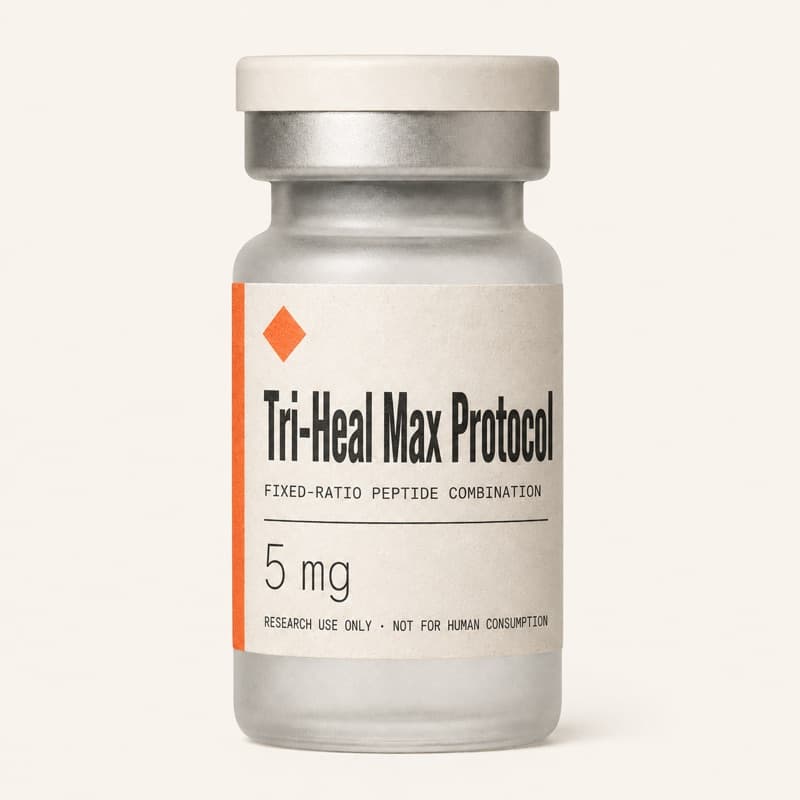
Tri-Heal Max Protocol
High-Dose Three-Peptide Healing Blend
Healing peptide blend at enhanced strength: TB-500 at a higher dose of 25mg, with BPC-157 at 10mg and KPV at 10mg, 45mg per vial in total. The formulation leans on TB-500's tissue repair and cellular migration properties, with BPC-157 contributing growth factor upregulation and KPV anti-inflammatory effects. Against standard healing stacks the TB-500 ratio is higher, at 2.5:1:1, aimed at more significant tissue damage or at accelerated recovery needs.
Overview
Healing peptide blend at enhanced strength: TB-500 at a higher dose of 25mg, with BPC-157 at 10mg and KPV at 10mg, 45mg per vial in total. The formulation leans on TB-500's tissue repair and cellular migration properties, with BPC-157 contributing growth factor upregulation and KPV anti-inflammatory effects. Against standard healing stacks the TB-500 ratio is higher, at 2.5:1:1, aimed at more significant tissue damage or at accelerated recovery needs.
Distinct healing pathways come from each peptide. TB-500 (Thymosin Beta-4) raises cellular migration, promotes the polymerization of actin, and supports blood vessel formation in the service of tissue repair. BPC-157 upregulates growth factors — VEGF and EGF — speeds wound healing, and protects the gastrointestinal tract. KPV, a fragment of alpha-MSH, inhibits the NF-κB inflammatory pathway, lowers pro-inflammatory cytokines, and may make injection sites more tolerable. Taken as a set, the three cover inflammation, tissue regeneration, and cellular repair.
Research indications
What the compound has been studied for, grouped by body system. Effect size is the reported magnitude where it was measured — not a recommendation.
More severe tissue damage, needing enhanced repair, is the target of the higher TB-500 dose.
Repair of muscle fiber and cellular migration are both promoted by TB-500.
Support for collagen combined with upregulation of growth factors.
Recovery from surgical wounds gets multi-modal support.
The post-surgical inflammatory response is reduced by the KPV component.
Scar formation may fall where tissue remodeling is enhanced.
Sports injuries see a faster return to activity.
Aimed at tissue damage accumulated through repetitive stress.
- Class
- Fixed-ratio peptide combination
- Research status
- Limited research
- Typical dose
- 200–500 µg total blend
- Frequency
- Once daily
- Cycle length
- 4–6 weeks for active healing
- Storage
- Reconstituted: 2-8°C, use within 4-6 weeks
Molecular data
- Type
- Fixed-ratio peptide combination
Dosing reference
Doses reported in the literature and by suppliers. These are a record of what has been used in research — reference, never instruction.
| Context | Route | Amount | Frequency |
|---|---|---|---|
| Conservative healing | SubQ | 200-300mcg total blend | Once daily |
| Standard healing protocol | SubQ | 300-500mcg total blend | Once daily |
| Intensive healing (acute injury) | SubQ near injury site | 500mcg total blend | Once daily for first 2 weeks, then reduce |
| Cycling protocol | SubQ | Per standard dosing | 4-6 weeks on, 2-4 weeks off |
Interactions
Already present in Tri-Heal Max: BPC-157 and TB-500. Not to be stacked.
Components overlap — TB-500, BPC-157, KPV — so combination is to be avoided.
Healing mechanisms complement, and copper-peptide benefits come from GHK-Cu.
Several anabolic and healing pathways at once; medical supervision is recommended.
Mechanisms differ; healing may be complemented by GH secretagogues.
Blood vessel formation is affected by TB-500, so monitoring is needed alongside blood thinners.
What to expect
Safety
Mechanistic flags — properties of the pathway, not observed adverse events.
- Mild fatigue during healing
- Reactions where injected, which KPV may help reduce
- Redness at the site of injection, temporary
- Unusual bleeding or bruising
- Underlying conditions that worsen
- Severe reactions where injected, or signs of infection
- Allergic reactions such as rash, swelling, or difficulty breathing
- Pregnancy or breastfeeding
- This three-peptide combination has no clinical trials behind it
- Active cancer — a theoretical concern where peptides promote growth
- Infection active at the injection site
Quality checklist
What to confirm before trusting a batch of research material. A verification aid — not an endorsement of any supplier.
- Third-party Certificate of AnalysisIndependent lab · dated · lot-matched.
- HPLC purity ≥ 98%Reverse-phase trace included.
- Mass-spec identity confirmedMALDI-TOF or ESI-MS.
- Counterion stated (acetate ≫ TFA)TFA salts can confound bioassays.
- Endotoxin / sterility statementRelevant once reconstituted.
- Lyophilised · cold-chain shippedStored −20 °C, shipped on ice.
- Labelled “research use only”No therapeutic or dosing claims.
Recorded signals for this compound · 9
- ✓Reputable research supplier
- ✓Third-party testing that confirms each of the three components
- ✓Ratios verified on the certificate of analysis
- ✓Shipped with a proper cold chain
- !Ratios possibly varying between batches
- !Status is research-only, with no approval for human use
- ×No Certificate of Analysis
- ×Solution discolored or particulate
- ×No way to confirm the TB-500:BPC:KPV ratio
FAQ
What accounts for TB-500 being dosed 2.5x higher here than in the standard Wolverine Stack?
The emphasis falls on TB-500's superior cell migration and angiogenesis properties, at 25mg against the standard 10mg, where tissue damage is more significant. Acute injuries, recovery from major surgery, and chronic tissue damage needing regenerative support beyond standard healing stacks are what the 2.5:1 ratio targets.
Does KPV earn its place, or is Tri-Heal Max effectively TB-500 and BPC-157?
KPV contributes anti-inflammatory effects by inhibiting the NF-κB pathway and lowering pro-inflammatory cytokines, which complements cell migration from TB-500 and growth factor upregulation from BPC-157. Injection site reactions may also be reduced by KPV, leaving the three-peptide blend more tolerable than two-peptide combinations.
How long does a Tri-Heal Max course run, and can cycling continue indefinitely?
The standard protocol runs 4–6 weeks of active healing followed by 2–4 weeks off, during which tissue recovery is assessed. Tolerance is prevented by cycling, and natural healing processes get the chance to consolidate gains. Indefinite long-term use has not been studied; once the acute phase resolves, on/off cycles are rotated or the dose drops to maintenance at 1–2x weekly.
Does cosmetic healing — scars, skin texture — fall in scope, or is this injury recovery only?
In theory the multi-modal healing could support scar reduction and better skin quality by way of enhanced collagen remodeling and angiogenesis. Clinical data, though, stop at musculoskeletal injuries; cosmetic use is experimental and calls for realistic expectations about how much scars improve.