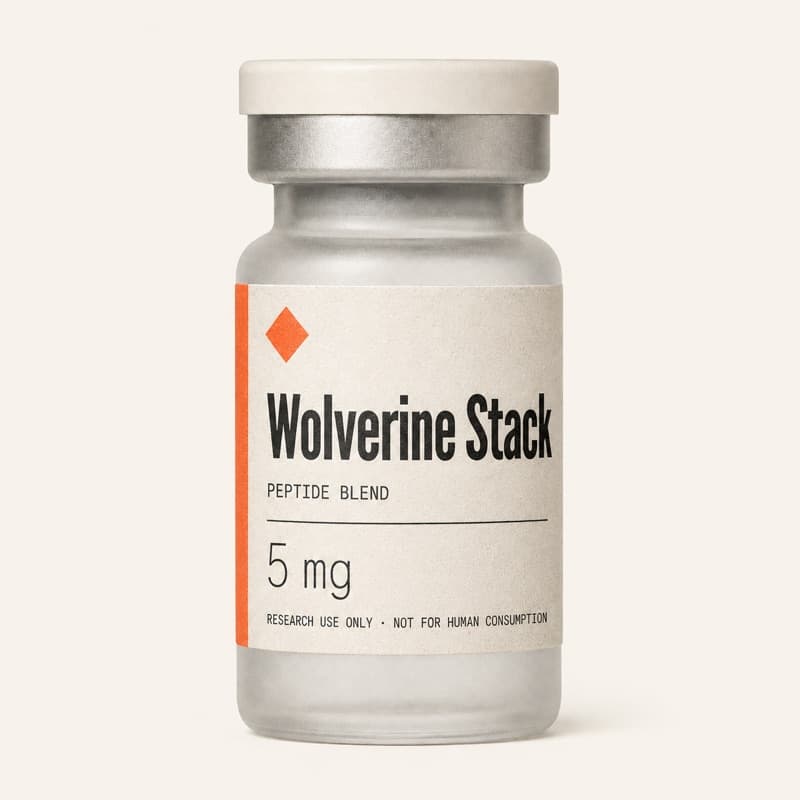
Wolverine Stack
BPC-157 + TB-500 · Tissue Repair & Recovery Protocol
TB-500 combined with BPC-157, giving synergistic repair of tissue and recovery. Knee pain patients improved 87.5% in the 2021 study by Lee & Padgett.
Overview
TB-500 combined with BPC-157, giving synergistic repair of tissue and recovery. Knee pain patients improved 87.5% in the 2021 study by Lee & Padgett.
Actin production rises under BPC-157, which also modulates nitric oxide for vascular effects; TB-500 sequesters actin to drive cell migration. The synergy shows as greater movement of fibroblasts and immune cells toward injury sites.
Research indications
What the compound has been studied for, grouped by body system. Effect size is the reported magnitude where it was measured — not a recommendation.
Muscle regeneration is enhanced by BPC-157; cell migration essential to repair is promoted by TB-500.
In the Lee & Padgett study, 87.5% of knee pain patients improved on the BPC-157/TB4 combination.
Evidence of accelerated repair exists for each; in animal models, Achilles tendon healing improved under BPC-157.
Inflammatory pathways are modulated by each peptide, by different mechanisms.
Phase 2 trials of TB-500 in ulcer patients showed healing roughly one month faster.
- Class
- Peptide blend
- Research status
- Well studied
- Typical dose
- BPC-157: 250–500 µg per dose + TB-500: 2–2.5 mg per dose
- Frequency
- BPC-157: 1–2 times daily; TB-500: twice weekly
- Cycle length
- 4–8 weeks for injury recovery; shorter for maintenance
- Storage
- Lyophilized powder: room temperature acceptable; Reconstituted: 2-8°C refrigerated for both peptides
Molecular data
- Type
- Peptide blend
Dosing reference
Doses reported in the literature and by suppliers. These are a record of what has been used in research — reference, never instruction.
| Context | Route | Amount | Frequency |
|---|---|---|---|
| General Recovery Protocol | SubQ | BPC-157: 250mcg 2x/day + TB-500: 2mg 2x/week | BPC-157 daily, TB-500 twice weekly |
| Intensive Injury Recovery | SubQ near injury site | BPC-157: 500mcg 2x/day + TB-500: 2.5mg 2x/week | BPC-157 daily, TB-500 twice weekly |
| Maintenance/Prevention Protocol | SubQ | BPC-157: 250mcg 1x/day + TB-500: 2mg 1x/week | BPC-157 daily, TB-500 weekly |
| GI Support Protocol | Oral capsule or sublingual | BPC-157: 500mcg-1mg | Once daily on empty stomach |
Interactions
GH receptors are upregulated by BPC-157, and recovery may accelerate in combination.
By raising endogenous growth hormone, GH secretagogues complement the stack.
Satellite cells are activated by MGF; muscle recovery may improve on the combined mechanisms.
Collagen is promoted by the copper peptide, and no negative interactions are expected.
Protection against NSAID-induced damage is shown by BPC-157; long-term effects remain unknown.
Healing may be counteracted by steroids, though models show BPC-157 reversing some steroid-induced damage.
Angiogenesis is promoted by each peptide; bleeding issues warrant monitoring.
Tumor growth could in theory be supported by the promotion of angiogenesis, which contraindicates use with a cancer history.
What to expect
Safety
Mechanistic flags — properties of the pathway, not observed adverse events.
- Human studies document this only sparsely
- Tolerability is generally good across available research
- Unexpected bleeding or bruising
- Any lumps or growths out of the ordinary, or tissue changing rapidly
- Severe reactions or infections at the injection site
- Symptoms of any kind that suggest abnormal growth
- Headaches that persist, or changes in vision
- Signs of an allergic reaction — rash, swelling, or difficulty in breathing
- Pregnancy or breastfeeding
- Cancer history of ANY kind, or suspicious growths
- Malignancy that is active, or chemotherapy running concurrently
Quality checklist
What to confirm before trusting a batch of research material. A verification aid — not an endorsement of any supplier.
- Third-party Certificate of AnalysisIndependent lab · dated · lot-matched.
- HPLC purity ≥ 98%Reverse-phase trace included.
- Mass-spec identity confirmedMALDI-TOF or ESI-MS.
- Counterion stated (acetate ≫ TFA)TFA salts can confound bioassays.
- Endotoxin / sterility statementRelevant once reconstituted.
- Lyophilised · cold-chain shippedStored −20 °C, shipped on ice.
- Labelled “research use only”No therapeutic or dosing claims.
Recorded signals for this compound · 6
- ✓A lyophilized powder cake, white or off-white, indicating the freeze-drying was proper
- ✓Solution crystal clear once reconstituted with bacteriostatic water
- ✓Certificate of Analysis carrying HPLC purity testing at >98%, plus mass spectrometry verification
- !Minor clumping is acceptable where a gentle swirl dissolves it completely
- ×Powder collapsed, yellowed, or stuck to the sides of the vial, which may indicate degradation from heat
- ×Cloudiness that persists, or visible particles, after reconstitution: contamination or degradation is indicated
FAQ
What lies behind the Lee & Padgett 2021 figure of 87.5% knee pain improvement?
Sixteen patients received BPC-157 and TB-500 intra-articularly, injected directly into the knees. Relief reached 87.5% overall (14/16); BPC-157 alone came in at 91.6% (11/12) and the combination at 75% (3/4). Effectiveness is suggested at these small sample sizes, but clinical validation would need larger trials.
Does the stack go in at the injury site, or systemically?
Either works. Local injection near injury sites concentrates effects and may speed healing further. In joint injuries, the intra-articular route used in the Lee & Padgett study may beat systemic SubQ injection. For injuries that cannot be reached, systemic SubQ is the more practical option and supplies whole-body healing support.
What is the timeline for results on the Wolverine Stack?
Weeks 1–2: inflammation may fall, with initial recovery improvement. Weeks 2–4: between-workout recovery improves noticeably and soreness drops. Weeks 4–8: chronic injuries improve significantly and tissue changes structurally. Peak effects typically land at 6–8 weeks where consistency holds.
Does the Wolverine Stack combine with growth hormone secretagogues such as CJC-1295?
Yes. GH secretagogues — CJC-1295, Ipamorelin — complement the stack synergistically. GH receptors are upregulated by BPC-157 while regeneration is enhanced by TB-500, and added endogenous GH amplifies tissue repair effects. Athletic recovery and rehabilitation from serious injury are where the combination is particularly valuable.
References
- 1Thymosin Beta-4 Accelerates Wound HealingMalinda KM, Sidhu GS, Mani H, et al. · Journal of Investigative Dermatology · 1999
Rats, full thickness wounds: topical or intraperitoneal thymosin beta-4 increased re-epithelialization by 42% at 4 days and up to 61% at 7 days, with increased collagen deposition and angiogenesis.
Animal in vivoPubMed 10469335 ↗ - 2Gastric pentadecapeptide BPC 157 accelerates healing of transected rat Achilles tendon and in vitro stimulates tendocytes growthStaresinic, M., et al. · Journal of Orthopaedic Research · 2003
Superior tendon healing with improved biomechanical properties (increased load of failure and Young's modulus), enhanced tendon-to-bone integration, and stimulated tendocyte growth in rat models.
Animal in vivoPubMed 14554208 ↗ - 3The regenerative peptide thymosin beta-4 accelerates the rate of dermal healing in preclinical animal models and in patientsTreadwell, T., Kleinman, H.K., Crockford, D., Hardy, M.A., Guarnera, G.T., Goldstein, A.L. · Annals of the New York Academy of Sciences · 2012
In two Phase 2 clinical trials, thymosin beta-4 accelerated healing of chronic pressure ulcers and venous stasis ulcers by almost a month compared to placebo, with confirmed safety and tolerability.
Animal in vivo · inferredPubMed 23050815 ↗ - 4Thymosin Beta-4: A Multi-Functional Regenerative Peptide. Basic Properties and Clinical ApplicationsGoldstein AL, Hannappel E, Sosne G, Kleinman HK · Expert Opinion on Biological Therapy · 2012
Comprehensive review: thymosin beta-4 promotes cell migration, mobilizes stem/progenitor cells, forms new blood vessels, regenerates tissue, and reduces inflammation, apoptosis, and scar formation.
Review · inferredPubMed 22074294 ↗ - 5Intra-Articular Injection of BPC 157 for Multiple Types of Knee PainLee E, Padgett B · Alternative Therapies in Health and Medicine · 2021
16 patients, intra-articular injection: Overall 87.5% (14/16) experienced knee pain relief. BPC-157 alone: 91.6% improvement (11/12). BPC-157 + TB4 combination: 75% improvement (3/4).
Review · inferredPubMed 34324435 ↗ - 6Emerging Use of BPC-157 in Orthopaedic Sports Medicine: A Systematic ReviewVasireddi A, et al. · HSS Journal · 2025
36 articles reviewed (544 screened, 1993-2024). Preclinical models showed improvements in muscle tears, tendon ruptures, ligament tears, and fracture healing. Mechanism involves enhanced GH receptor expression and angiogenesis.
ReviewPubMed 40756949 ↗
A systematic review spanning 36 studies published from 1993 to 2024 found BPC-157 upregulates GH receptor expression and angiogenic pathways, with preclinical benefit across tendon, ligament, bone, and muscle injuries.
A narrative review weighs BPC-157's regenerative capacity against its risks in musculoskeletal healing and notes how far preclinical findings outrun the sparse human clinical evidence.
An updated review of how thymosin beta-4 promotes dermal healing, covering angiogenesis, cell migration and anti-inflammatory activity across wound models and clinical use.