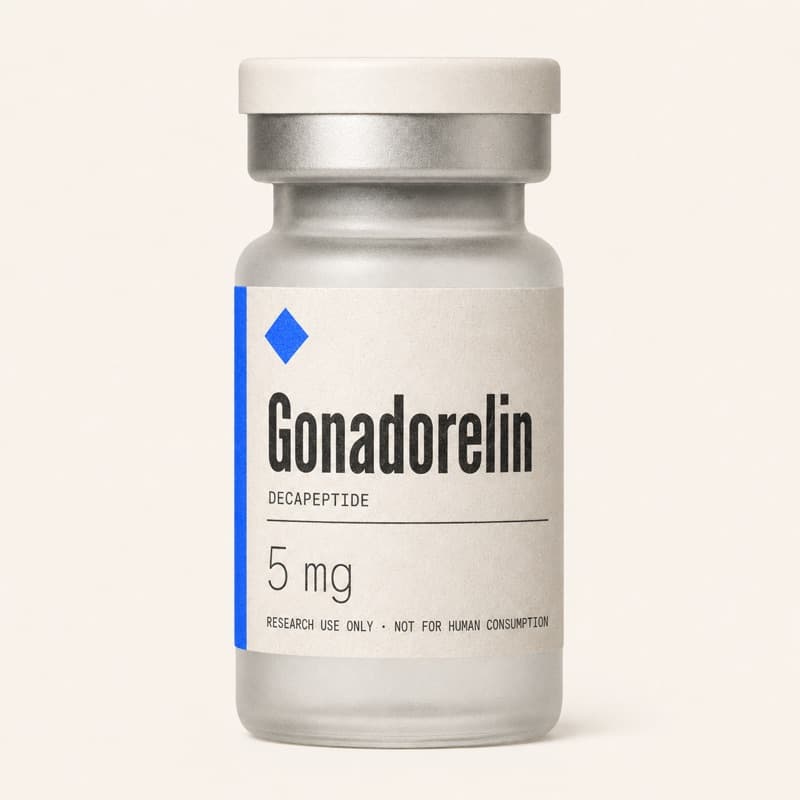
Gonadorelin
Gonadotropin-Releasing Hormone · GnRH Agonist
Synthetic form of GnRH (gonadotropin-releasing hormone), which occurs naturally. It acts on the pituitary gland, which then releases luteinizing hormone (LH) and follicle-stimulating hormone (FSH); those two go on to regulate ovulation in women and testosterone production in men. FDA approval covers fertility treatment and diagnostic testing. GnRH is secreted in pulses, and that pattern is critical to proper reproductive function.
Overview
Synthetic form of GnRH (gonadotropin-releasing hormone), which occurs naturally. It acts on the pituitary gland, which then releases luteinizing hormone (LH) and follicle-stimulating hormone (FSH); those two go on to regulate ovulation in women and testosterone production in men. FDA approval covers fertility treatment and diagnostic testing. GnRH is secreted in pulses, and that pattern is critical to proper reproductive function.
In the anterior pituitary, gonadorelin is an agonist at the GnRH receptor. Delivered in pulses that mimic the natural secretion pattern every 60–120 minutes, it stimulates the release of FSH and LH. LH in turn drives Leydig cells in the testes to produce testosterone, or triggers ovulation in women. Exposure that is continuous does the opposite: receptors downregulate and hormone production is suppressed.
Research indications
What the compound has been studied for, grouped by body system. Effect size is the reported magnitude where it was measured — not a recommendation.
Used against conditions such as Kallmann syndrome, in which GnRH deficiency drives low testosterone and infertility.
Ovulation is induced for women who have hypothalamic amenorrhea and do not ovulate regularly.
Restoring LH/FSH pulsatility stimulates testosterone and sperm production.
Applied to delayed puberty arising from hypothalamic-pituitary dysfunction.
Assessment of hypothalamic-pituitary function, and diagnosis of GnRH deficiency.
Measures the reserve of the pituitary and its responsiveness under GnRH stimulation.
Testicular function and fertility are kept up through testosterone replacement therapy.
Aids the return of natural testosterone production following anabolic steroid use.
Pediatric patients with undescended testes are treated with it.
- Class
- Decapeptide
- Research status
- Extensively studied
- Chain length
- 10 residues
- Molecular weight
- 1182.3 Da
- Half-life
- ~3 min
- Typical dose
- 100–200 µg for single injections; 5–20 µg per pulse for pulsatile therapy
- Frequency
- 2–3 times weekly for fertility/TRT support; every 90–120 minutes for pulsatile therapy; single dose for diagnostic
- Cycle length
- Varies; diagnostic single use, fertility therapy ongoing, TRT support continuous
- Storage
- Lyophilized: 2-8°C refrigerated; Reconstituted: 2-8°C refrigerated, use within 14 days due to short stability
Molecular data
- Type
- Decapeptide
- Molecular weight
- 1182.3 Da
- Chain length
- 10 residues
- Half-life
- 3 min
Levels in single-dose multiples. A shape, not a pharmacokinetic prediction.
Dosing reference
Doses reported in the literature and by suppliers. These are a record of what has been used in research — reference, never instruction.
| Context | Route | Amount | Frequency |
|---|---|---|---|
| Diagnostic testing | SubQ or IV | 100 mcg | Single injection |
| Fertility support | SubQ | 50-100 mcg | 2-3x weekly |
| Pulsatile therapy | SubQ pump | 5-20 mcg per pulse | Every 90-120 min |
| TRT adjunct | SubQ | 100-200 mcg | 2-3x weekly |
| Hormone support | Intranasal | As prescribed | Per protocol |
Interactions
Frequently substituted for hCG when testicular stimulation is wanted during TRT.
Run alongside TRT so testicular function and fertility are maintained.
Combination is possible within fertility and PCT protocols.
GnRH release is stimulated by kisspeptin, and the two can work together toward hormone optimization.
What to expect
Safety
Mechanistic flags — properties of the pathway, not observed adverse events.
- Injection site reactions
- Headache
- Flushing
- Nausea
- Abdominal discomfort
- Severe headaches
- Unusual abdominal pain
- Allergic reaction indicated by rash, difficulty breathing
- Hormone-sensitive tumors
- Pregnancy
- Hypersensitivity to GnRH or to its analogs
- Conditions that sex hormone release worsens
Quality checklist
What to confirm before trusting a batch of research material. A verification aid — not an endorsement of any supplier.
- Third-party Certificate of AnalysisIndependent lab · dated · lot-matched.
- HPLC purity ≥ 98%Reverse-phase trace included.
- Mass-spec confirms 1182.3 g/molMALDI-TOF or ESI-MS.
- Counterion stated (acetate ≫ TFA)TFA salts can confound bioassays.
- Endotoxin / sterility statementRelevant once reconstituted.
- Lyophilised · cold-chain shippedStored −20 °C, shipped on ice.
- Labelled “research use only”No therapeutic or dosing claims.
Recorded signals for this compound · 7
- ✓White lyophilized powder
- ✓Solution clear once reconstituted
- ✓Vacuum seal intact
- !Slight clumping, dissolving readily
- ×Powder discolored
- ×Solution cloudy or with particles
- ×Seal broken
FAQ
What makes pulsatile Gonadorelin dosing critical, and what does continuous dosing do?
Dosing has to arrive in pulses, every 90–120 minutes, so the natural GnRH secretion pattern is mimicked. Continuous exposure works the other way: GnRH receptors desensitize and downregulate, and LH and FSH release is suppressed — the opposite of the effect wanted. Therapeutic success rests on getting the pulsatile timing right.
Which maintains testicular function better during TRT, Gonadorelin or hCG?
Testicular function and fertility are maintained during TRT by either one, on different mechanics. hCG mimics LH directly and carries a 24–36 hour half-life; Gonadorelin stimulates natural LH/FSH release instead, at the cost of requiring pulsatile dosing. Administration is simpler with hCG, while Gonadorelin restores the HPG axis more physiologically.
How fast does testosterone climb after a Gonadorelin injection?
The half-life is extremely short, 2–4 minutes, and LH release is triggered within minutes. Testosterone starts climbing on that LH stimulation within hours, peaking 6–12 hours after the injection. A response that rapid suits diagnostic testing and pulsatile protocols.
Does Gonadorelin suit long-term post-cycle therapy, or only short-term use?
Effectiveness holds for acute diagnostic use and for extended post-cycle protocols of 2–3 weeks alike. Sensitivity to dosing frequency is extreme, though, which makes it less practical over the long term than hCG or clomiphene. The common PCT pattern starts on Gonadorelin and then transitions to other agents for maintenance.