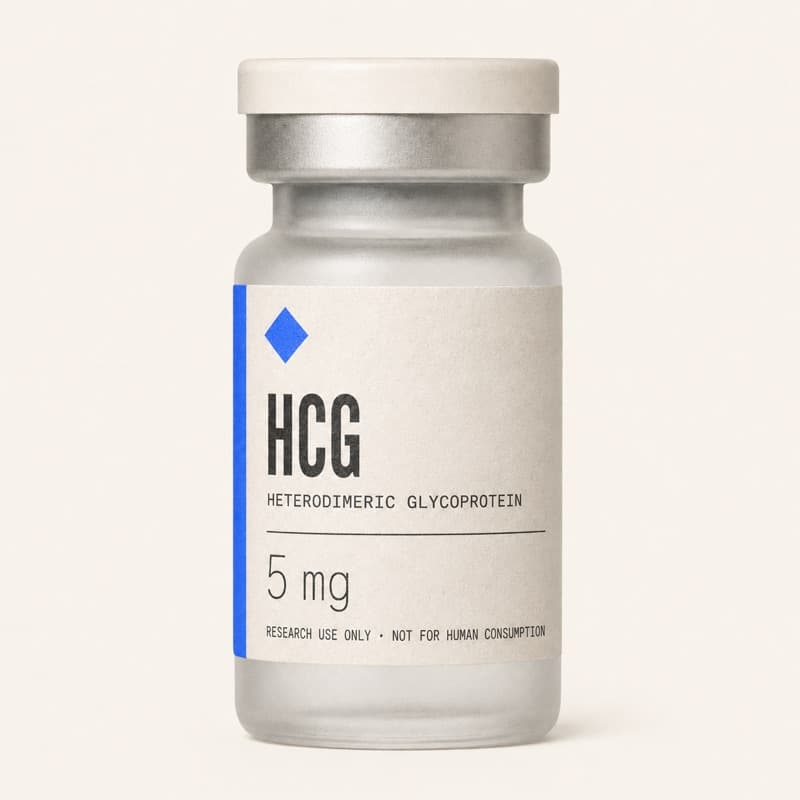
HCG
Human Chorionic Gonadotropin · LH Receptor Agonist
Glycoprotein hormone the placenta produces naturally during pregnancy; binding at LH receptors stimulates biosynthesis of testosterone and estrogen. FDA approval covers cryptorchidism, hypogonadotropic hypogonadism, and ovulation induction.
Overview
Glycoprotein hormone the placenta produces naturally during pregnancy; binding at LH receptors stimulates biosynthesis of testosterone and estrogen. FDA approval covers cryptorchidism, hypogonadotropic hypogonadism, and ovulation induction.
Testicular Leydig cells carry LH receptors, and occupancy of those receptors drives testosterone production. Half-life runs 24–36 hours, with concentrations peaking 6–12 hours after injection. Bioavailability is 40–50% by either the SubQ or the IM route.
Research indications
What the compound has been studied for, grouped by body system. Effect size is the reported magnitude where it was measured — not a recommendation.
Holds intratesticular testosterone at baseline through testosterone therapy; atrophy is prevented and fertility preserved.
Carries FDA approval in secondary hypogonadism; paired with FSH to induce spermatogenesis.
Recovery of testicular function following anabolic steroid cycles.
Approved by the FDA as a follicular-maturation trigger; the pregnancy rate per cycle is 15–25%.
Approved by the FDA for prepubertal undescended testes whose cause is not anatomical obstruction; success rate is ~25%.
- Class
- Heterodimeric glycoprotein
- Research status
- FDA approved
- Chain length
- 237 residues
- Molecular weight
- 36700 Da
- Half-life
- ~30 h
- Typical dose
- 250–1500 IU (lower for TRT adjunct, higher for fertility)
- Frequency
- 2–3 times weekly, or every other day for lower doses
- Cycle length
- Ongoing with TRT or 3–6 months for fertility protocols
- Storage
- Lyophilized: Room temperature. Reconstituted: 2-8°C, use within 30-60 days
Molecular data
- Type
- Heterodimeric glycoprotein
- Molecular weight
- 36700 Da
- Chain length
- 237 residues
- Half-life
- 1800 min
Levels in single-dose multiples. A shape, not a pharmacokinetic prediction.
Dosing reference
Doses reported in the literature and by suppliers. These are a record of what has been used in research — reference, never instruction.
| Context | Route | Amount | Frequency |
|---|---|---|---|
| TRT Adjunct (Low) | SubQ/IM | 250-500 IU | Every other day |
| TRT Adjunct (Standard) | SubQ/IM | 500-1000 IU | Twice weekly |
| HCG Monotherapy | IM | 1500-2000 IU | 2-3x weekly |
| Fertility (with FSH) | IM | 1500-2000 IU | 2-3x weekly |
| Cryptorchidism (Pediatric) | IM | 1000-5000 IU | 2-3x weekly for 3-4 weeks |
| Ovulation Trigger (Female) | IM/SubQ | 5000-10,000 IU | Single dose |
| PCT Protocol | SubQ/IM | 1000-1500 IU | Every other day for 2-3 weeks |
Interactions
A common TRT addition, holding testicular function and preserving fertility.
Sequential use — both act on the HPG axis.
A common pairing; intratesticular aromatase activity rises with HCG.
Combination effects on the gonadotropin axis warrant monitoring.
Fertility synergy, with a 70–90% spermatogenesis induction rate.
Mechanisms that complement in stimulating the HPG axis.
Weak TSH-like activity from HCG; thyroid function warrants monitoring.
The pairing is protective of metabolic health.
What to expect
Safety
Mechanistic flags — properties of the pathway, not observed adverse events.
- Gynecomastia (breast tenderness/swelling) due to increased estrogen
- Headaches, irritability, and mood swings (especially initially)
- Fluid retention and edema
- Potential antibody formation with long-term use
- Signs of gynecomastia (breast tenderness, swelling, nipple sensitivity)
- Severe or persistent headaches
- Signs of blood clots (leg swelling/pain, shortness of breath, chest pain)
- Allergic reactions (rash, hives, difficulty breathing, facial swelling)
- Severe abdominal pain or bloating in women (possible OHSS)
- Testicular pain or swelling beyond normal
- Significant mood changes (depression, aggression, severe irritability)
- Vision changes
- Hormone-sensitive cancers (prostate, breast)
- Pregnancy (except as prescribed)
- Precocious puberty risk in children
Quality checklist
What to confirm before trusting a batch of research material. A verification aid — not an endorsement of any supplier.
- Third-party Certificate of AnalysisIndependent lab · dated · lot-matched.
- HPLC purity ≥ 98%Reverse-phase trace included.
- Mass-spec confirms 36700 g/molMALDI-TOF or ESI-MS.
- Counterion stated (acetate ≫ TFA)TFA salts can confound bioassays.
- Endotoxin / sterility statementRelevant once reconstituted.
- Lyophilised · cold-chain shippedStored −20 °C, shipped on ice.
- Labelled “research use only”No therapeutic or dosing claims.
Recorded signals for this compound · 9
- ✓Lyophilized powder or cake, white to off-white, in a sealed vial
- ✓Cold chain unbroken (recombinant needs refrigeration end to end)
- ✓Solution entirely clear once reconstituted
- ✓Labeling accurate for Pregnyl, Novarel (urinary), and Ovidrel (recombinant)
- ✓Expiration and lot number both clear
- !Quality varies across generic and compounding pharmacy products
- !Compounding pharmacy accredited
- ×Degradation shows as cloudiness, discoloration, or floating particles
- ×Vial seal compromised, or product past expiry
FAQ
What HCG dose preserves fertility on testosterone replacement therapy?
In a landmark clinical study, 250 IU every other day held intratesticular testosterone within 7% of baseline through testosterone therapy, and fertility was preserved. That dose sits far below other protocols; the inference drawn is potency — testicular function holds at minimal doses when the timing is right.
Why would gynecomastia follow from HCG if its action is testosterone stimulation?
Testosterone production rises under HCG, but the testes also express aromatase, the enzyme that converts testosterone to estrogen. More available testosterone, together with heightened intratesticular aromatase activity, leaves estrogen elevated, and the result is breast tenderness and gynecomastia. Aromatase inhibitors help prevent the effect.
Does long-term use raise antibodies to HCG and blunt its effect?
Antibody formation under extended use remains a theoretical concern, and its clinical significance is unclear. Reports from some users describe HCG working less well after months of continuous dosing. Breaks between courses, or rotation onto GnRH analogs, may head off tolerance.
How often does HCG succeed in cryptorchidism (undescended testes)?
Meta-analysis puts the success rate near 24% — modest, though clinically relevant in selected cases. Bilateral cryptorchidism responds better than unilateral. A rate that low is why surgery became the standard treatment in most cases, with HCG still available as a first option.
References
- 1Low-Dose Human Chorionic Gonadotropin Maintains Intratesticular Testosterone in Normal Men with Testosterone-Induced Gonadotropin SuppressionCoviello AD, Matsumoto AM, Bremner WJ, et al. · Journal of Clinical Endocrinology & Metabolism · 2005
29 men randomized to testosterone enanthate plus 125, 250, or 500 IU HCG every other day. 250 IU maintained intratesticular testosterone within 7% of baseline, preserving fertility potential during TRT.
Human RCTPubMed 15713727 ↗ - 2The Effectiveness of hCG and LHRH in Boys with Cryptorchidism: A Meta-Analysis of Randomized Controlled TrialsDefined a, et al. · Asian Journal of Andrology · 2016
Meta-analysis of 13 studies with 872 boys and 1,174 undescended testes. Overall HCG success rate of 24%. Significant effect on bilateral but not unilateral cryptorchidism.
Meta-analysisPubMed 27050251 ↗ - 3Fertility Induction in Hypogonadotropic Hypogonadal MenRastrelli G, Corona G, Mannucci E, Maggi M · Endocrine Reviews · 2018
Combined HCG and FSH therapy induces spermatogenesis in 86% (95% CI 82-91%) of men with hypogonadotropic hypogonadism. HCG alone achieves 40% (95% CI 25-56%).
Human observationalPubMed 30194850 ↗ - 4Efficacy and Safety of Human Chorionic Gonadotropin for Treatment of Cryptorchidism: A Meta-Analysis of Randomised Controlled TrialsDefined a, et al. · Journal of Pediatric Surgery · 2018
Confirmed ~25% success rate for HCG in cryptorchidism treatment. All side effects were transitory and not severe.
Meta-analysisPubMed 29655188 ↗ - 5Human Chorionic Gonadotropin Monotherapy for the Treatment of Hypogonadal Symptoms in Men with Total Testosterone >300 ng/dLAlder NJ, Waguih WI, et al. · International Journal of Impotence Research · 2019
HCG monotherapy safe and efficacious for hypogonadal symptoms. Erectile dysfunction improved in 86% (19/22), libido in 80% (20/25). No thromboembolic events.
Human observationalPubMed 31408289 ↗
Among 77 men whose infertility followed testosterone use, 74% showed higher sperm concentrations on HCG plus FSH, and continuing testosterone did not block recovery.
A review of treatment options in testosterone deficiency notes that hCG sustains sperm production despite complete gonadotropin suppression by testosterone replacement, and that AUA guidance endorses hCG where fertility must be preserved.