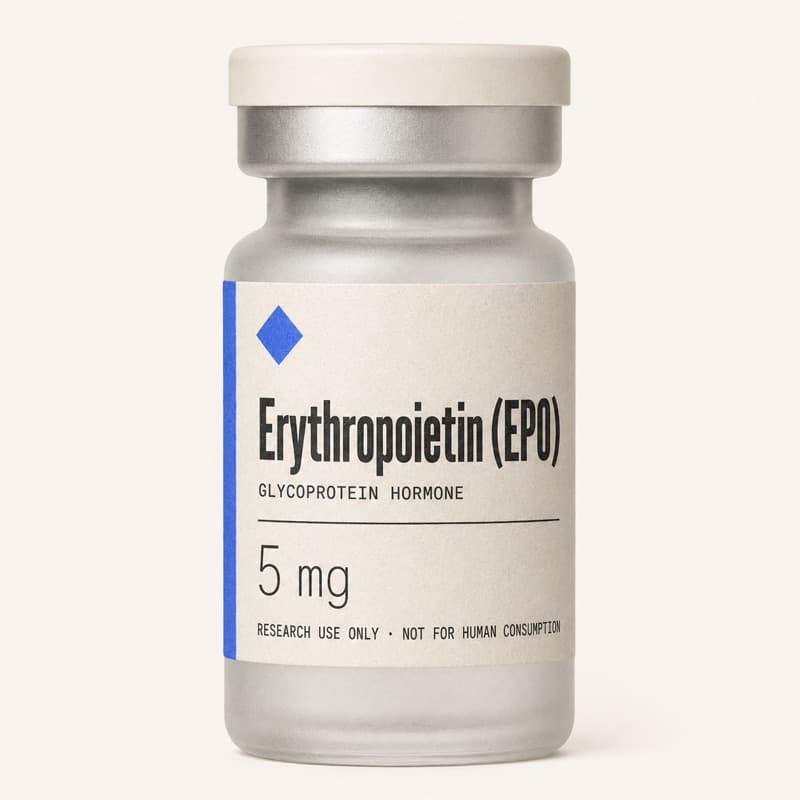
Erythropoietin (EPO)
EPO · Red Blood Cell Stimulating Hormone
Glycoprotein hormone, essential, that drives red blood cell production. The kidneys make it in response to low oxygen; the recombinant human form carries FDA approval for anemia in chronic kidney disease and in chemotherapy patients. Binding at receptors on bone marrow cells promotes survival and maturation of red blood cell precursors, which raises oxygen-carrying capacity. Competitive sports ban it for its performance-enhancing effects.
Overview
Glycoprotein hormone, essential, that drives red blood cell production. The kidneys make it in response to low oxygen; the recombinant human form carries FDA approval for anemia in chronic kidney disease and in chemotherapy patients. Binding at receptors on bone marrow cells promotes survival and maturation of red blood cell precursors, which raises oxygen-carrying capacity. Competitive sports ban it for its performance-enhancing effects.
Erythropoietin receptors (EPOR) on erythroid progenitor cells in bone marrow are the binding target, and occupancy switches on three interconnected signaling pathways: JAK2/STAT5, PI3K/AKT, and RAS/MAPK. Red blood cell precursors are then shielded from apoptosis and survive on that protection, erythroid proliferation and differentiation run faster, and hemoglobin production rises. Hypoxic stress can drive endogenous EPO production as much as 1000-fold higher, which is the oxygen-sensing regulatory system on display.
Research indications
What the compound has been studied for, grouped by body system. Effect size is the reported magnitude where it was measured — not a recommendation.
Anemia arising from chronic kidney disease is the primary FDA-approved indication.
Carries FDA approval for anemia in cancer patients on chemotherapy.
Applied in certain surgical settings to lower the need for blood transfusions.
Oxygen delivery to muscle rises and endurance capacity improves with it. WADA prohibits it.
Adaptation to high altitude may come faster as red blood cell mass rises.
- Class
- Glycoprotein hormone
- Research status
- Extensively studied
- Chain length
- 165 residues
- Molecular weight
- 30400 Da
- Half-life
- ~25 h
- Typical dose
- 50–300 IU/kg based on medical indication
- Frequency
- 1–3 times weekly depending on response
- Cycle length
- Variable; ongoing medical therapy adjusted based on hemoglobin levels
- Storage
- 2-8°C refrigerated; do not freeze; do not shake vials or syringes
Molecular data
- Type
- Glycoprotein hormone
- Molecular weight
- 30400 Da
- Chain length
- 165 residues
- Half-life
- 1500 min
Levels in single-dose multiples. A shape, not a pharmacokinetic prediction.
Dosing reference
Doses reported in the literature and by suppliers. These are a record of what has been used in research — reference, never instruction.
| Context | Route | Amount | Frequency |
|---|---|---|---|
| CKD Anemia (medical) | SubQ or IV | 50-100 IU/kg | 3x weekly |
| Chemotherapy Anemia (medical) | SubQ | 150-300 IU/kg | 3x weekly |
| Maintenance (medical) | SubQ | Individualized | 1-3x weekly |
Interactions
Hemoglobin production requires iron, which is often given alongside EPO therapy.
Mechanisms differ; no interactions known.
The mechanisms differ, and no interactions are known.
What to expect
Safety
Mechanistic flags — properties of the pathway, not observed adverse events.
- Injection site reactions
- Headache
- Hypertension
- Joint pain
- Flu-like symptoms
- Pain in the chest, or shortness of breath
- Blood clot signs — swelling in a leg, pain
- Response to EPO abruptly lost
- Severe headache, or a change in vision
- Uncontrolled hypertension
- Prior pure red cell aplasia
- Hemoglobin over 12 g/dL — cardiovascular risk rises
- Malignancy that is active; a relative contraindication
Quality checklist
What to confirm before trusting a batch of research material. A verification aid — not an endorsement of any supplier.
- Third-party Certificate of AnalysisIndependent lab · dated · lot-matched.
- HPLC purity ≥ 98%Reverse-phase trace included.
- Mass-spec confirms 30400 g/molMALDI-TOF or ESI-MS.
- Counterion stated (acetate ≫ TFA)TFA salts can confound bioassays.
- Endotoxin / sterility statementRelevant once reconstituted.
- Lyophilised · cold-chain shippedStored −20 °C, shipped on ice.
- Labelled “research use only”No therapeutic or dosing claims.
Recorded signals for this compound · 9
- ✓Clear, colorless solution
- ✓Pharmaceutical grade product
- ✓Seals and packaging intact
- ✓Cold chain properly maintained
- !Potency may be affected by temperature excursions
- !Quality assurance is absent from research-grade products
- ×Held at room temperature
- ×Visible particulates
- ×Solution cloudy or discolored
FAQ
Why does sport ban EPO when it holds FDA approval as a medicine?
FDA approval covers anemia in kidney disease and in chemotherapy patients, and nothing wider — the indications are narrow. The ban in sport follows from oxygen delivery being pushed far past medical therapeutic levels, which hands over an unfair endurance advantage. Doses taken by athletes produce performance effects vastly beyond anything used medically.
Which hemoglobin level makes EPO dangerous?
Guidelines hold hemoglobin under 11–12 g/dL during EPO therapy, since anything higher raises cardiovascular risk significantly — blood clots, stroke, heart attack. The ceiling is there because oxygen-carrying capacity turns harmful in excess, driving blood viscosity to dangerous levels.
Does the endurance gain from EPO come free of side effects?
Endurance capacity does improve, on greater red blood cell production and oxygen delivery. Water retention, joint pain, headaches, and hypertension are common alongside it. Of greater concern are thromboembolic events (blood clots) and a theoretical risk of tumor progression at the higher doses used for performance enhancement.
How long do the benefits last once EPO is stopped?
Effects start to fade as soon as injections stop, red blood cells having a natural 120-day lifespan. Within 2–3 weeks of discontinuation hemoglobin heads back toward baseline. Most of the performance benefit goes quickly, so sustained effect requires continued use, which is why athletes in endurance sport met testing challenges.