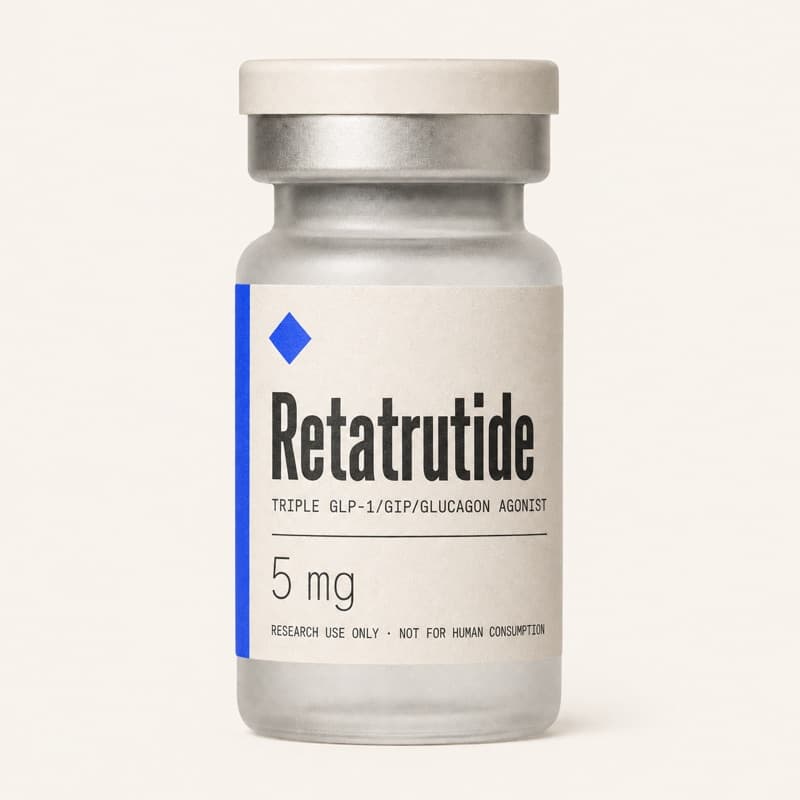
Retatrutide
Triple GLP-1/GIP/Glucagon Agonist · Weight Loss & Diabetes
Triple hormone receptor agonist whose targets are the glucagon, GIP, and GLP-1 receptors. At 48 weeks, phase II trials recorded weight loss of 24.2%, the highest yet recorded for obesity medications.
Overview
Triple hormone receptor agonist whose targets are the glucagon, GIP, and GLP-1 receptors. At 48 weeks, phase II trials recorded weight loss of 24.2%, the highest yet recorded for obesity medications.
Three receptors are engaged at once: GLP-1 to suppress appetite, GIP to improve insulin sensitivity, and glucagon to raise energy expenditure and drive hepatic fat oxidation.
Research indications
What the compound has been studied for, grouped by body system. Effect size is the reported magnitude where it was measured — not a recommendation.
Weight loss reached 17.5% by week 24 in clinical trials, and 24.2% by week 48.
Obesity is met on three fronts — suppressed appetite, energy expenditure, metabolic efficiency.
No plateau appeared at 48 weeks; weight loss continued, which suggests greater long-term potential.
HbA1c fell by as much as 2.16%; 82% reached the target below 6.5%.
Glycemic control is balanced, and hypoglycemia risk minimal.
Sensitivity improves markedly, with exogenous insulin requirements potentially reduced.
Reductions reached 26.9% for non-HDL cholesterol and 40.6% for triglycerides.
Across trials, both systolic and diastolic blood pressure decreased consistently.
Liver fat fell by as much as 82%, normalizing in 90% of participants.
- Class
- Triple GLP-1/GIP/glucagon agonist
- Research status
- Extensively studied
- Chain length
- 39 residues
- Molecular weight
- 4731.33 Da
- Half-life
- ~144 h
- Typical dose
- 0.5 mg starting; titrated to 8–12 mg weekly
- Frequency
- Once weekly (same day each week)
- Cycle length
- Continuous therapy as prescribed
- Storage
- Reconstituted: 2-8°C, use within 28 days
Molecular data
- Type
- Triple GLP-1/GIP/glucagon agonist
- Molecular weight
- 4731.33 Da
- Chain length
- 39 residues
- Half-life
- 8640 min
Levels in single-dose multiples. A shape, not a pharmacokinetic prediction.
Dosing reference
Doses reported in the literature and by suppliers. These are a record of what has been used in research — reference, never instruction.
| Context | Route | Amount | Frequency |
|---|---|---|---|
| Starting Dose (Week 1-4) | SubQ | 0.5mg | Once weekly |
| Low Maintenance (Week 4-8) | SubQ | 1mg | Once weekly |
| Escalation (Week 8-12) | SubQ | 2mg | Once weekly |
| Moderate (Week 12-16) | SubQ | 4mg | Once weekly |
| Advanced (Week 16-20) | SubQ | 8mg | Once weekly |
| Maximum Efficacy (Week 20+) | SubQ | 12mg | Once weekly |
Interactions
Other dual or triple agonists are not to be combined: severe hypoglycemia and excessive GI effects are the risk.
Not to be combined; GLP-1 agonist mechanisms overlap, raising the risk of severe hypoglycemia.
Significant GI effects arise from each. Without specialist supervision the combination is not recommended.
Insulin requirements may fall significantly. Blood glucose warrants monitoring, with insulin doses adjusted to match.
Clinical trials have tested this combination and found it safe. The mechanisms differ and complement each other for glucose control.
SGLT2 inhibitors were present in clinical trials without safety concerns arising.
A safe pairing; BPC-157 may add GI protection over the course of retatrutide use.
Gastric emptying is delayed, so oral contraceptives are spaced 1 hour ahead of retatrutide.
What to expect
Safety
Mechanistic flags — properties of the pathway, not observed adverse events.
- Appetite suppression
- Mild dehydration
- Raised heart rate — common, and especially so over the first 24 weeks
- Nausea, vomiting, diarrhea — gastrointestinal effects, usually mild to moderate
- Nausea or vomiting, severe and persistent, that prevents adequate nutrition
- Pancreatitis indicated by severe abdominal pain that radiates to the back
- Symptoms of severe hypoglycemia — confusion, dizziness, sweating
- Weight loss that is excessive: consistently >3 lbs per week, or >25% of total body weight
- Gallbladder trouble, presenting as severe right upper abdominal pain
- MEN2 syndrome
- Severe renal impairment
- Medullary thyroid carcinoma in the individual, or in family history
Quality checklist
What to confirm before trusting a batch of research material. A verification aid — not an endorsement of any supplier.
- Third-party Certificate of AnalysisIndependent lab · dated · lot-matched.
- HPLC purity ≥ 98%Reverse-phase trace included.
- Mass-spec confirms 4731.33 g/molMALDI-TOF or ESI-MS.
- Counterion stated (acetate ≫ TFA)TFA salts can confound bioassays.
- Endotoxin / sterility statementRelevant once reconstituted.
- Lyophilised · cold-chain shippedStored −20 °C, shipped on ice.
- Labelled “research use only”No therapeutic or dosing claims.
Recorded signals for this compound · 7
- ✓White powder of pharmaceutical grade, uniform in texture
- ✓Cold chain held throughout, refrigerated at 2–8°C
- ✓Reconstituted solution colorless and clear, no particles present
- ✓Extended half-life effects stable — appetite suppression consistent between doses
- !Verifying the source is critical: investigational status means counterfeits circulate
- ×A product that has degraded, or a counterfeit, is suggested by rapid tolerance or loss of effect
- ×Contamination may be indicated by an unusual side effect profile
FAQ
Why does retatrutide reach 24.2% weight loss where semaglutide reaches 15-20%?
As a triple agonist, retatrutide hits GLP-1, GIP, and glucagon receptors at the same time. Appetite is suppressed by GLP-1, insulin sensitivity improved by GIP, energy expenditure and fat oxidation raised by glucagon. GLP-1 alone is what semaglutide activates. Obesity is therefore approached down three distinct pathways, which accounts for the superior result.
Is the liver fat reduction specific, or a by-product of overall fat loss?
Liver fat is targeted specifically. In clinical trials, liver fat fell by up to 82% and normalized completely in 90% of participants at 24 weeks. What is happening is preferential hepatic fat oxidation rather than general weight loss, which puts potential value in NAFLD/MASH as well as obesity.
Why do gastrointestinal side effects occur more readily with retatrutide?
Triple agonism carries triple GI effects. Gastric emptying is slowed and GI motility affected by GLP-1, GIP, and glucagon alike. Stacking the three mechanisms produces more nausea, diarrhea, and vomiting, particularly through dose escalation. Most tolerate it by week 4–8 as the body adapts, however.
Can retatrutide be stopped eventually, or is it indefinite?
Not known. The phase 2 trials ran 48 weeks, enough to reach 24% weight loss but not to study discontinuation. Semaglutide's clinical experience suggests weight returns once treatment stops. Data on maintenance therapy versus indefinite use should come from the phase 3 TRIUMPH trials, with results expected in 2026.
References
- 1Triple-Hormone-Receptor Agonist Retatrutide for Obesity — A Phase 2 TrialJastreboff, A.M., et al. · New England Journal of Medicine · 2023
Landmark phase 2 RCT showing dose-dependent weight loss: 24.2% at 48 weeks with 12mg dose — the highest recorded for any obesity medication at the time. Weight reduction of ≥15% achieved in 83% of 12mg recipients.
Human RCTPubMed 37366315 ↗ - 2Retatrutide, a GIP, GLP-1 and glucagon receptor agonist, for people with type 2 diabetes: a phase 2 trialRosenstock, J., et al. · The Lancet · 2023
Phase 2 trial in type 2 diabetes demonstrating clinically meaningful HbA1c reductions and robust weight loss of up to 16.9% at 36 weeks, with safety profile consistent with GLP-1 receptor agonists.
Human RCTPubMed 37385280 ↗ - 3Triple hormone receptor agonist retatrutide for metabolic dysfunction-associated steatotic liver disease: a randomized phase 2a trialSanyal, A.J., et al. · Nature Medicine · 2024
Dose-dependent liver fat reduction: 82.4% at 12mg dose. Normal liver fat (<5%) achieved in 86% of 12mg recipients vs 0% placebo at 24 weeks. Improvements linked to changes in body weight, abdominal fat, and insulin sensitivity.
Human RCTPubMed 38858523 ↗ - 4Structural insights into the triple agonism at GLP-1R, GIPR and GCGR manifested by retatrutideLi, W., et al. · Cell Discovery · 2024
Cryo-EM structures reveal how retatrutide simultaneously activates GLP-1R, GIPR, and GCGR through distinct receptor-binding modes, explaining the molecular basis for its triple agonist activity and superior clinical efficacy.
Review · inferredPubMed 39019866 ↗ - 5TRIUMPH registrational clinical trials: Rationale and designAronne, L.J., et al. · Obesity · 2025
Phase 3 TRIUMPH program design: four multicenter, randomized, double-blind studies assessing weekly retatrutide for obesity, obstructive sleep apnea, knee osteoarthritis, and weight management in cardiovascular disease populations.
Human RCT · inferredPubMed 41090431 ↗ - 6Effects of retatrutide on body composition in people with type 2 diabetes: a phase 2 substudyRosenstock, J., et al. · The Lancet Diabetes & Endocrinology · 2025
Substudy demonstrating significant total body fat mass reduction with retatrutide vs placebo and dulaglutide. Proportion of lean mass loss to total weight loss was similar to other obesity treatments.
Human RCTPubMed 40609566 ↗
The design and rationale for four registrational Phase 3 TRIUMPH trials have been published; more than 5,800 participants are enrolled across obesity, sleep apnoea, osteoarthritis, and cardiovascular disease cohorts, with results due in 2026.
A phase 2 substudy published by Lancet Diabetes & Endocrinology examined body composition in participants who have type 2 diabetes; retatrutide significantly cut total body fat mass, and at the 8mg dose the reduction reached 26.1%.
Phase 2a MASLD data in Nature Medicine reported liver fat falling by as much as 82.4% on retatrutide 12 mg, and 86% of participants reached normal liver fat at 24 weeks.