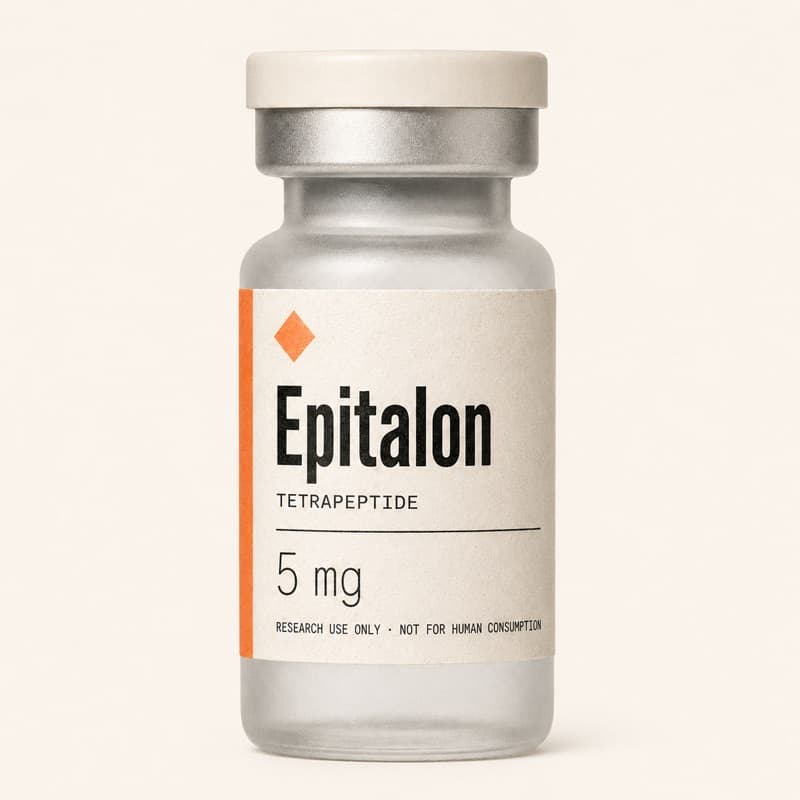
Epitalon
Synthetic Pineal Tetrapeptide · Telomerase Activator
Synthetic tetrapeptide from the Russian scientist Vladimir Khavinson, with more than 35 years of research behind it. Telomerase is activated at extremely low concentrations, holding telomere length; melatonin production is stimulated; gene expression is modulated by epigenetic mechanisms.
Overview
Synthetic tetrapeptide from the Russian scientist Vladimir Khavinson, with more than 35 years of research behind it. Telomerase is activated at extremely low concentrations, holding telomere length; melatonin production is stimulated; gene expression is modulated by epigenetic mechanisms.
Telomerase activation occurs at extremely low concentrations (10⁻¹⁷ to 10⁻¹⁵ M), holding telomere length; melatonin production from the pineal gland is stimulated; and gene expression is modulated by epigenetic mechanisms.
Research indications
What the compound has been studied for, grouped by body system. Effect size is the reported magnitude where it was measured — not a recommendation.
In the elderly, function of the pineal gland is restored, as is the circadian melatonin rhythm.
At nanogram concentrations, formation of new neurons is supported.
Retinal degeneration showed a 90% response rate, dosing at 5µg per eye.
Immune surveillance enhanced, immunosenescence countered.
Thymus gland regeneration is supported, improving immune function.
Microgram doses activate telomerase, extending telomeres and cellular replicative lifespan.
Aging markers reverse and mitochondrial function improves at the cellular level.
In animal studies, doses of 30–40µg/kg produced lifespan increases of 25–33%.
- Class
- Tetrapeptide
- Research status
- Well studied
- Chain length
- 4 residues
- Molecular weight
- 390.35 Da
- Typical dose
- 100–500 µg per injection
- Frequency
- Once daily for 10–20 consecutive days
- Cycle length
- 10–20 days per cycle
- Storage
- Lyophilized: 2-8°C refrigerated; Reconstituted: 2-8°C refrigerated, use within 30 days
Molecular data
- Type
- Tetrapeptide
- Molecular weight
- 390.35 Da
- Chain length
- 4 residues
AEDGDosing reference
Doses reported in the literature and by suppliers. These are a record of what has been used in research — reference, never instruction.
| Context | Route | Amount | Frequency |
|---|---|---|---|
| Standard anti-aging | SubQ | 200-500mcg | 1x daily for 10-20 days |
| Conservative start | SubQ | 100mcg | 1x daily for 10-20 days |
| Russian clinical equivalent | SubQ | 300mcg | 1x daily for 10-20 days |
| Ultra-low dose | SubQ | 50mcg | 1x daily for 10-20 days |
| Nasal administration | Nasal spray | 1-2mg daily (corrected from traditional 5mg) | 1x daily for 10-20 days |
| Oral administration | Oral | 2-3mg | 2x daily for 10-20 days |
Interactions
Pineal pathways serve both; circadian rhythm effects may be enhanced.
Immunomodulation is enhanced; Russian protocols commonly combine the two.
Anti-aging pathways differ; the mechanisms complement.
A different axis is activated; no interactions known.
Regenerative mechanisms differ.
Neuroprotection comes from both; cumulative effects warrant monitoring.
The neurocognitive focus differs.
In theory telomerase activation may affect malignancy; active cancer is a reason to avoid.
What to expect
Safety
Mechanistic flags — properties of the pathway, not observed adverse events.
- Vivid dreams, a melatonin-related effect
- Mild digestive upset possible on the oral route
- Tolerated well overall, with side effects minimal
- Mild reactions at the injection site
- Signs of allergic reaction
- Unusual fatigue or weakness
- Injection site inflammation that persists
- Moles new or changing (skin monitoring)
- A cancer diagnosis — immediate discontinuation
- Known peptide allergies
- Pregnancy or breastfeeding
- Malignancy that is active (concern over telomerase activation)
- Sinusitis, chronic (nasal route)
Quality checklist
What to confirm before trusting a batch of research material. A verification aid — not an endorsement of any supplier.
- Third-party Certificate of AnalysisIndependent lab · dated · lot-matched.
- HPLC purity ≥ 98%Reverse-phase trace included.
- Mass-spec confirms 390.35 g/molMALDI-TOF or ESI-MS.
- Counterion stated (acetate ≫ TFA)TFA salts can confound bioassays.
- Endotoxin / sterility statementRelevant once reconstituted.
- Lyophilised · cold-chain shippedStored −20 °C, shipped on ice.
- Labelled “research use only”No therapeutic or dosing claims.
Recorded signals for this compound · 12
- ✓A certificate of analysis on hand, purity >98%
- ✓Pharmaceutical appearance, medical grade
- ✓When reconstituted, solution clear and colorless
- ✓Cold-chain shipping done properly
- ✓Lyophilized powder, white to off-white
- !Dosing misinformation is widespread
- !Translation errors underlie the 5–10mg many sources recommend
- !Microgram efficacy is what the original research demonstrates
- !Supplier credentials carefully verified
- ×Powder yellow or discolored (degradation)
- ×Solution cloudy once mixed (contamination)
- ×Sourcing documentation missing or questionable
FAQ
Which Epitalon dosage is correct, and why do some sources recommend 5-10mg against 0.5-1mg?
Efficacy at 0.5-1mg daily is what peer-reviewed human clinical trials show, while the 5-10mg figure in many community protocols traces to what appear to be translation errors from animal studies. Telomerase activation at microgram level is what the original research demonstrates, so the lower doses are the research-supported ones. Higher doses have no human validation and cost significantly more.
Does Epitalon extend lifespan, or is that confined to animal studies?
Animal studies give 25-33% lifespan extension, and a 6-8 year clinical trial in 266 elderly subjects found mortality reduced 1.6-1.8 fold with Epithalamin. Impressive as that is, human lifespan extension remains a theoretical claim. Markers of cellular aging such as telomere length are better documented than longevity itself in humans.
How much cancer risk does telomerase activation carry with Epitalon?
A theoretical cancer risk attaches to telomerase activation, and that is the reason for the contraindication in active malignancy. Against it, 35+ years of research shows no rise in cancer incidence across clinical trials. The distinction that matters: telomerase is activated in normal cells, whereas cancer cells already have it — the mechanism looks selective for aging cells.
How long do the benefits of an Epitalon cycle last?
Months of persistence follow a 10-20 day cycle, on the strength of epigenetic changes in gene expression and sustained telomerase activity. Cycles are repeated 2-3 times a year by many users, with 4-6 month breaks, which holds the benefit from each cycle while continuous stimulation is avoided.
References
- 1Synthetic tetrapeptide epitalon restores disturbed neuroendocrine regulation in senescent monkeysKhavinson VKh, Goncharova ND, Lapin BA · Neuroendocrinology Letters · 2001
Epitalon significantly stimulated melatonin synthesis in senescent monkeys during evening hours, normalizing circadian rhythm of cortisol secretion and restoring neuroendocrine regulation.
Animal in vivoPubMed 11524632 ↗ - 2Pineal-regulating tetrapeptide epitalon improves eye retina condition in retinitis pigmentosaKhavinson VKh, Razumovsky MI, Trofimova SV, Grigoryan RA, Kharitonova OA · Neuroendocrinology Letters · 2002
Epitalon therapy in patients with degenerative retinal lesions resulted in positive clinical effect in 90% of cases, intensifying bioelectric and functional activity of retina due to preservation of morphological structure.
Human RCTPubMed 12195242 ↗ - 3Epithalon peptide induces telomerase activity and telomere elongation in human somatic cellsKhavinson VKh, Bondarev IE, Butyugov AA · Bulletin of Experimental Biology and Medicine · 2003
Addition of epithalon to telomerase-negative human fetal fibroblast culture induced expression of catalytic subunit (hTERT), enzymatic activity of telomerase, and telomere elongation. Extended replicative lifespan of cells.
In vitro · inferredPubMed 12937682 ↗ - 4Peptides of pineal gland and thymus prolong human lifeKhavinson VKh, Morozov VG · Neuroendocrinology Letters · 2003
Clinical trial of 266 elderly subjects over 6-8 years: Epithalamin reduced mortality 1.6-1.8 fold. Combined Thymalin + Epithalamin treatment for 6 years reduced mortality 4.1-fold vs control with improved cardiovascular and immune parameters.
Human RCTPubMed 14523363 ↗ - 5Effect of Epitalon on biomarkers of aging, life span and spontaneous tumor incidence in female Swiss-derived SHR miceAnisimov VN, Khavinson VKh, Popovich IG, Zabezhinski MA, Alimova IN, Rosenfeld SV, Zavarzina NY, Semenchenko AV, Yashin AI · Biogerontology · 2003
Epitalon injected from 3 months until natural death increased maximum lifespan by 12.3% and last 10% survivors by 13.3%. Slowed age-related estrous function decline and reduced chromosome aberrations by 17.1%. Inhibited leukemia development 6-fold.
Animal in vivoPubMed 14501183 ↗ - 6AEDG Peptide (Epitalon) Stimulates Gene Expression and Protein Synthesis during Neurogenesis: Possible Epigenetic MechanismKhavinson VKh, Diomede F, Mironova E, Linkova N, Trofimova S, Trubiani O, Marconi GD, Paiushina O · Molecules · 2020
AEDG peptide increased neurogenic differentiation markers (Nestin, GAP43, β-Tubulin III, Doublecortin) 1.6-1.8 fold in human gingival mesenchymal stem cells. Molecular modelling showed preferential binding with H1/6 and H1/3 histones, suggesting epigenetic regulation.
Review · inferredPubMed 32019204 ↗
Epitalon lengthened telomeres in several human cell lines by two routes, raised telomerase activity and the ALT (alternative lengthening of telomeres) pathway, with colocalisation at PML bodies confirming ALT involvement.
Drawing on more than 25 years of work, this review sets out the geroprotective and neuroendocrine profile of the pineal tetrapeptide epitalon, including antimutagenic, antioxidant, and neuroprotective actions, and confirms direct effects on melatonin synthesis, telomerase activity, and levels of IL-2 mRNA.
In an in vitro diabetic retinopathy model, the antioxidant tetrapeptide epitalon restored retinal wound healing that had been impaired by hyperglycaemia.