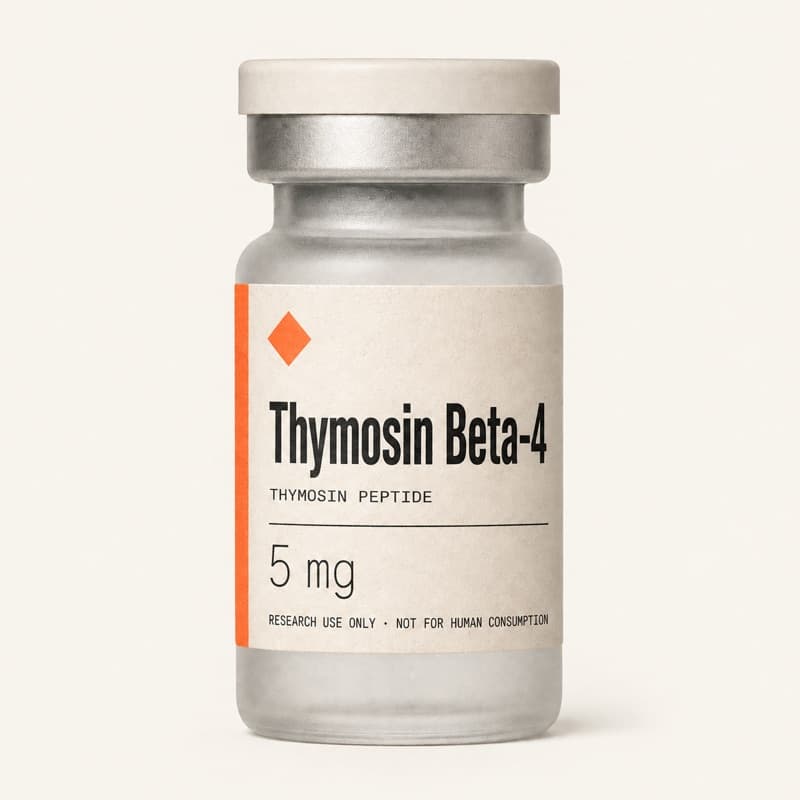
Thymosin Beta-4
43-Amino Acid Regenerative Peptide · Tissue Repair & Healing
Peptide of 43 amino acids, naturally occurring, central to tissue repair, wound healing, and cellular regeneration. It drives angiogenesis, lowers inflammation, and supports the migration and differentiation of cells.
Overview
Peptide of 43 amino acids, naturally occurring, central to tissue repair, wound healing, and cellular regeneration. It drives angiogenesis, lowers inflammation, and supports the migration and differentiation of cells.
Bioavailability and tissue distribution are best under direct systemic delivery, which supports the full regenerative range: angiogenesis, cell migration, and differentiation.
Research indications
What the compound has been studied for, grouped by body system. Effect size is the reported magnitude where it was measured — not a recommendation.
In surgical wounds, healing time fell and tissue regeneration increased.
Injuries to muscle, tendon, and ligament recovered faster.
In pressure ulcers, clinical trials report complete healing at 67% against 25% on placebo.
Infarct size dropped 43% in Phase 2b trials where dosing occurred within 6 hours.
Animal models report better functional recovery and neurological outcomes.
- Class
- Thymosin peptide
- Research status
- Well studied
- Chain length
- 43 residues
- Molecular weight
- 4963.44 Da
- Typical dose
- 2–6 mg per injection (varies by protocol and severity)
- Frequency
- Daily for acute healing, twice weekly for maintenance/chronic conditions
- Cycle length
- 2–12 weeks depending on healing needs
- Storage
- Reconstituted: 2-8°C, use within 14 days
Molecular data
- Type
- Thymosin peptide
- Molecular weight
- 4963.44 Da
- Chain length
- 43 residues
Dosing reference
Doses reported in the literature and by suppliers. These are a record of what has been used in research — reference, never instruction.
| Context | Route | Amount | Frequency |
|---|---|---|---|
| Acute Wound Healing | SubQ | 1.6mg | Daily |
| Cardiac Protection | IV bolus within 6 hours of MI | 42mg | Single dose |
| Chronic Tissue Repair | SubQ | 6mg | Twice weekly |
| Neurological Recovery | IV infusion | 30mg | Three times over 72 hours |
| General Regeneration | SubQ | 2-5mg | Daily or every other day |
| Pressure Ulcer Healing | Direct topical application to wound bed | 1% gel | Once daily |
| Corneal Healing | Topical ophthalmic application | 0.1% drops | 4 times daily |
| Chronic Wound Care | Applied to cleaned wound surface | 0.5% cream | Twice daily |
Interactions
The bioactive fragment of Thymosin β4 is TB-500. Running both gives the benefits of the full-length peptide alongside concentrated bioactive effects.
Healing mechanisms complement: Tβ4 drives cell migration and angiogenesis, BPC-157 strengthens gastric protection.
Nothing reported by way of direct interaction; tissue repair is promoted by each, through a different pathway.
Growth factor effects that complement, with no direct interaction.
Effectiveness may fall with steroids, which inhibit the inflammatory responses optimal healing requires.
Angiogenesis is promoted by Tβ4, and bleeding risk may be affected. Coagulation parameters warrant monitoring.
In cancer patients the promotion of angiogenesis is a theoretical concern. Not to be used during active chemotherapy.
What to expect
Safety
- Injection sites inflamed locally
- Mild reactions at the injection site
- Systemic allergic reaction showing as rash or breathing difficulty
- Cardiovascular symptoms arising unexpectedly during treatment
- Infection of any kind at an injection site
- Persistent inflammation, or severe injection-site reactions
- Active chemotherapy treatment
- Peptide allergies that are systemic and severe
Quality checklist
What to confirm before trusting a batch of research material. A verification aid — not an endorsement of any supplier.
- Third-party Certificate of AnalysisIndependent lab · dated · lot-matched.
- HPLC purity ≥ 98%Reverse-phase trace included.
- Mass-spec confirms 4963.44 g/molMALDI-TOF or ESI-MS.
- Counterion stated (acetate ≫ TFA)TFA salts can confound bioassays.
- Endotoxin / sterility statementRelevant once reconstituted.
- Lyophilised · cold-chain shippedStored −20 °C, shipped on ice.
- Labelled “research use only”No therapeutic or dosing claims.
Recorded signals for this compound · 7
- ✓When reconstituted, solution clear and colorless
- ✓Purity >98% documented on the certificate of analysis
- ✓Sterile packaging correct, seals unbroken
- ✓Molecular weight appropriate, verified by HPLC/MS
- !Claims of room-temperature storage; after reconstitution a legitimate product needs refrigeration
- ×Solution cloudy or discolored, a sign of degradation
- ×Crystals forming once reconstituted, which suggests storage was improper
FAQ
Is there dry eye evidence, or is Thymosin Beta-4 confined to wounds?
Phase 2 work on eye drops (0.1% RGN-259) found efficacy in severe dry eye, with significant symptom improvement that held 28 days after treatment. In neurotrophic keratopathy, Phase 3 trials produced corneal healing and better comfort. Efficacy therefore extends past general wound healing.
Does Thymosin Beta-4 apply to post-surgical muscle recovery?
Yes. In pressure and venous ulcers, clinical trials found post-surgical wound healing accelerated by roughly one month. That acceleration carries over to post-surgical tissue repair, which makes the peptide relevant both to speeding recovery from surgical trauma and to improving biomechanical tissue properties.
What argues for Thymosin Beta-4 over the TB-500 fragment in healing?
At its full 43 amino acids, Thymosin Beta-4 delivers comprehensive regenerative effects and proven clinical efficacy. The 7-amino-acid fragment, TB-500, is cheaper and more stable. Phase 2 clinical data are more robust for the full-length peptide; cost efficiency belongs to the fragment. Both work, and selection turns on budget and evidence requirements.
What is known about Thymosin Beta-4 and cardiac function after a heart attack?
Where administration fell within 6 hours, Phase 2b trials recorded a 43% reduction in heart attack infarct size. Cardiomyocyte migration and survival are promoted and coronary vasculogenesis stimulated, which points to potential for cardiac protection. Clinical approval would require larger trials.