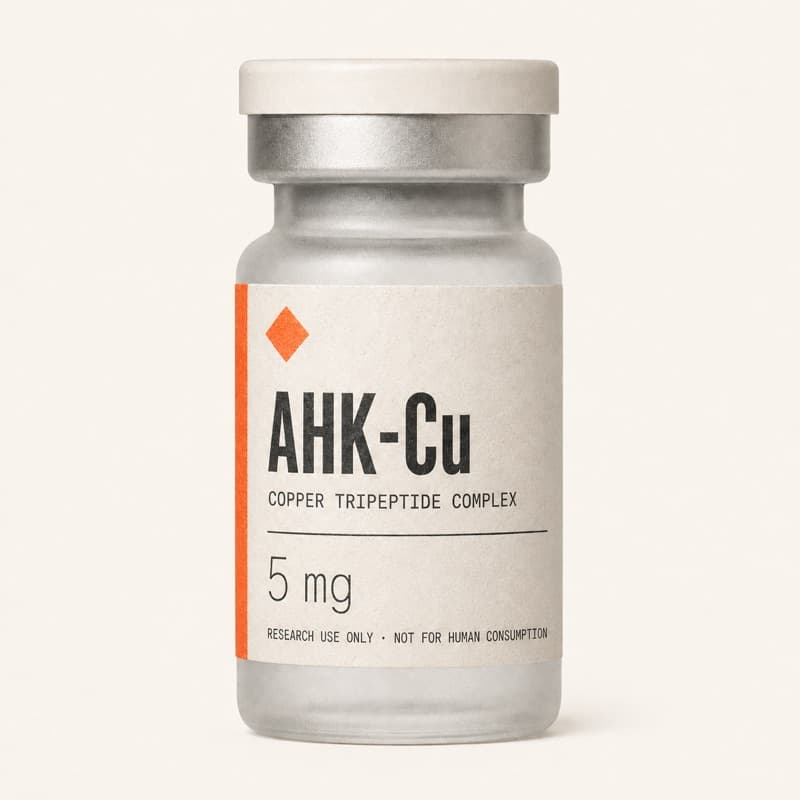
AHK-Cu
Hair Growth Copper Peptide · Dermal Papilla Stimulator
Copper-binding tripeptide, synthetic, aimed at dermal papilla cells and hair follicles. Hair follicles elongate, cells proliferate, VEGF production rises, and TGF-β1 is inhibited. Skin regeneration is supported by way of fibroblast activation and collagen synthesis.
Overview
Copper-binding tripeptide, synthetic, aimed at dermal papilla cells and hair follicles. Hair follicles elongate, cells proliferate, VEGF production rises, and TGF-β1 is inhibited. Skin regeneration is supported by way of fibroblast activation and collagen synthesis.
Penetration of the scalp puts copper directly into dermal papilla cells. From there: proliferation pathways are activated, the Bcl-2/Bax ratio rises (anti-apoptotic), VEGF increases for blood flow, TGF-β1 drops, and SOD production is promoted to reduce oxidative stress.
Research indications
What the compound has been studied for, grouped by body system. Effect size is the reported magnitude where it was measured — not a recommendation.
Human hair follicle elongation is stimulated at concentrations down to 10⁻¹² M in ex vivo studies, with the anagen phase lengthened.
Dermal papilla cells proliferate more — these being the key regulatory cells behind hair follicle cycling and hair growth.
Production of vascular endothelial growth factor is boosted, improving nutrient delivery and blood flow to the hair follicles.
TGF-β1 secretion falls, and oxidative stress with it (via SOD) — both contributors to DHT-induced follicle miniaturization.
Fibroblast proliferation and collagen synthesis are activated, improving wound healing and skin structure.
The Bcl-2/Bax ratio is elevated and caspase-3 activation reduced, which protects cells against programmed death.
Deposition of collagen and ECM components is promoted, serving tissue renewal and repair.
- Class
- Copper tripeptide complex
- Research status
- Well studied
- Chain length
- 3 residues
- Molecular weight
- 416.9 Da
- Typical dose
- 0.5–1% topical solution/serum
- Frequency
- Once or twice daily application
- Cycle length
- 12–24 weeks minimum for hair growth, ongoing for maintenance
- Storage
- Topical preparations: 2-8°C refrigerated in dark glass container, use within 30 days. Protect from light and heat
Molecular data
- Type
- Copper tripeptide complex
- Molecular weight
- 416.9 Da
- Chain length
- 3 residues
Dosing reference
Doses reported in the literature and by suppliers. These are a record of what has been used in research — reference, never instruction.
| Context | Route | Amount | Frequency |
|---|---|---|---|
| Hair Growth - Scalp Application | Topical to scalp | 0.5-1% solution/serum | Once or twice daily |
| Hair Growth - Combined Protocol | Topical to scalp | 0.3-0.5% AHK-Cu with minoxidil | Once or twice daily |
| Skin Regeneration | Topical to skin | 0.3-1% in serum/cream | Once or twice daily |
| DIY Formulation | Custom formulation | Add 0.3-1% to water phase | Cool-down phase (<40°C) |
| Mesotherapy - Scalp (Practitioner) | Intradermal microinjections | 0.1-0.5 mg per injection site | Weekly sessions |
| Research Protocol | SubQ | 1-5 mg | 2-3 times weekly |
Interactions
Two copper peptides that complement, aimed at different aspects of tissue regeneration. Skin repair is where GHK-Cu excels; hair follicles are the AHK-Cu target.
Hair growth is promoted by both, by different mechanisms: potassium channel opening and vasodilation for minoxidil, dermal papilla stimulation for AHK-Cu.
DHT production is blocked by 5-alpha reductase inhibitors; AHK-Cu may help counter what DHT does to follicles.
Additional copper sources in combination bring a risk of copper toxicity. Total copper intake bears monitoring.
Two tissue-repair mechanisms: systemic healing from BPC-157, skin and hair from AHK-Cu.
Copper peptides can be destabilized by the low pH of ascorbic acid; the two belong at separate times.
Acidic exfoliants are capable of destabilizing copper peptide complexes; application should fall at different points in the routine.
Two potent actives, each capable of causing irritation. Introduction should be slow, or the two kept apart in time.
An excellent combination: hydration from hyaluronic acid, which also supports peptide penetration.
What to expect
Safety
- Tolerance is generally good, with an excellent safety profile in topical use
- Scalp irritation, rare; a patch test is recommended
- Mild redness possible where skin is sensitive
- Any unexpected adverse reactions
- Scalp irritation, itching, or burning that persists
- Allergic reaction — swelling, hives, rash
- Hair shedding raised and not improving past 4–6 weeks
- Copper sensitivity indicated by metallic taste, nausea
- Skin discoloration where applied
- Not to be used on skin that is broken or infected
- The eye area is to be avoided; irritation may result
- Allergy to copper or peptides rules out use
- Not recommended while acute skin infections are present
Quality checklist
What to confirm before trusting a batch of research material. A verification aid — not an endorsement of any supplier.
- Third-party Certificate of AnalysisIndependent lab · dated · lot-matched.
- HPLC purity ≥ 98%Reverse-phase trace included.
- Mass-spec confirms 416.9 g/molMALDI-TOF or ESI-MS.
- Counterion stated (acetate ≫ TFA)TFA salts can confound bioassays.
- Endotoxin / sterility statementRelevant once reconstituted.
- Lyophilised · cold-chain shippedStored −20 °C, shipped on ice.
- Labelled “research use only”No therapeutic or dosing claims.
Recorded signals for this compound · 7
- ✓Powder light blue, the characteristic color of the copper complex
- ✓Purity 99%+ with COA; pharmaceutical/cosmetic grade
- ✓Copper complexation proper: dissolution gives a clear light blue solution
- ✓Formulation pH-stable, in the 5.5–7.0 range
- !Liposomal delivery is the preference, for stability and enhanced penetration
- ×Appearance discolored or degraded — brown, green, or colorless being indications of degradation
- ×pH under 5.0, which destabilizes the copper peptide complex
FAQ
Is AHK-Cu used alongside vitamin C or other actives in a skincare routine?
No. The copper peptide complex is destabilized by low pH ascorbic acid, so vitamin C belongs at a different time — morning against evening. Acidic AHA/BHA exfoliants destabilize AHK-Cu in the same way, as do retinol/retinoids, potent actives that may cause irritation. Several hours should separate these products.
Does AHK-Cu beat minoxidil for hair growth?
The mechanisms differ: potassium channels opened and vasodilation from minoxidil, dermal papilla cells and VEGF stimulated by AHK-Cu. Clinical studies find positive results from AHK-Cu on its own, and the two are synergistic in combination because the pathways they target differ. Neither holds universal superiority; the best results likely come from combining them.
Are copper supplements taken during topical AHK-Cu use?
No. What AHK-Cu delivers topically is complexed copper, and supplementing further creates a toxicity risk. Total copper intake across all sources, multivitamins included, bears monitoring. Systemic absorption from topical application is minimal, yet pairing it with oral copper supplementation is unnecessary and potentially dangerous.
References
- 1Effects of copper tripeptide on the growth and expression of growth factors by normal and irradiated fibroblastsCanapp SO Jr, Farese JP, Schultz GS, Gowda S, Ishak AM, Swaim SF, Vangilov J, Lee-Ambrose L, Martin FG · Wound Repair and Regeneration · 2005
Copper tripeptide (GHK-Cu) accelerates growth of normal and irradiated fibroblasts. Early increase in bFGF and VEGF production by treated fibroblasts; normal and keloid-producing fibroblasts treated with copper tripeptide secreted less TGF-β1.
In vitro · inferredPubMed 15655171 ↗ - 2The effect of tripeptide-copper complex on human hair growth in vitroPyo HK, Yoo HG, Won CH, Lee SH, Kang YJ, Eun HC, Cho KH, Kim KH · Archives of Pharmaceutical Research · 2007
AHK-Cu (10⁻¹² to 10⁻⁹ M) stimulated human hair follicle elongation ex vivo and dermal papilla cell proliferation in vitro. Elevated Bcl-2/Bax ratio and reduced cleaved caspase-3/PARP levels indicate anti-apoptotic mechanism. Also increased VEGF production and decreased TGF-β1 secretion.
In vitro · inferredPubMed 17703734 ↗ - 3Human skin penetration of a copper tripeptide in vitro as a function of skin layerMazurowska L, Mojski M · Skin Pharmacology and Physiology · 2010
Copper tripeptide permeated through dermatomed skin with coefficient of 2.43 × 10⁻⁴ cm/h. 136.2 μg/cm² copper permeated over 48h while 97 μg/cm² retained as depot, demonstrating therapeutically effective amounts for topical delivery.
In vitro · inferredPubMed 20721598 ↗ - 4Thermodynamically stable ionic liquid microemulsions pioneer pathways for topical delivery and peptide applicationSikorska C et al. · International Journal of Pharmaceutics · 2023
Novel delivery system using thermodynamically stable ionic liquid microemulsions to improve topical delivery and stability of copper tripeptides including AHK-Cu.
Review · inferredPubMed 38026438 ↗
Tattooing a minoxidil, dutasteride and copper peptide preparation over five monthly sessions increased hair regrowth in androgenetic alopecia, with outcomes scored by AI and by blinded evaluators.
A palmitoyl copper peptide complexed with acetyl tyrosine increased melanin output in two cell lines, A375 and B16.