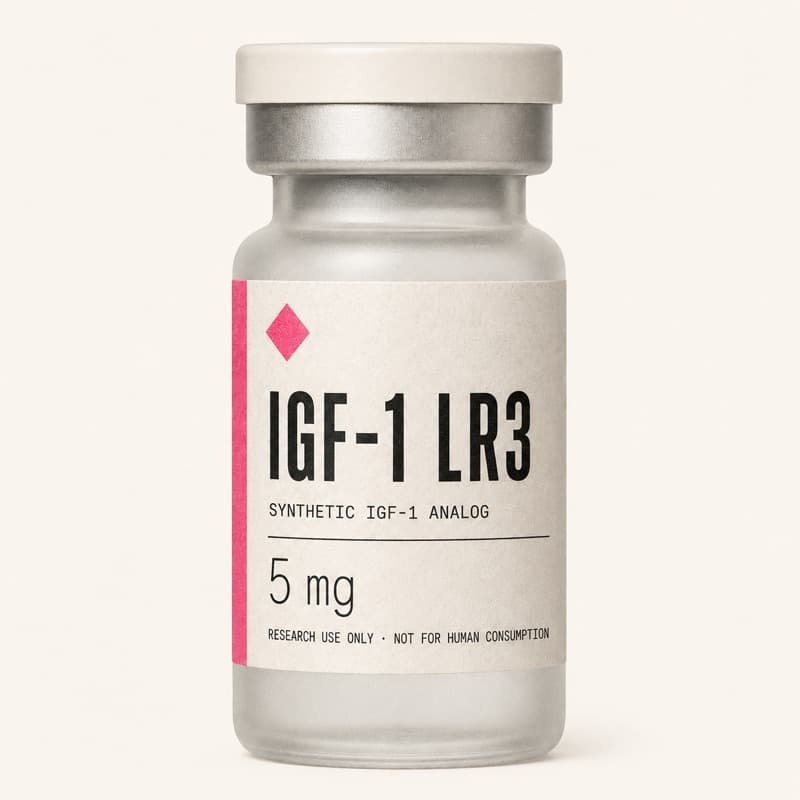
IGF-1 LR3
Modified Growth Factor Analog · Muscle Growth
Synthetic 83-amino acid analog of insulin-like growth factor-1, never approved for human use. An N-terminal extension and the R3 substitution cut interaction with binding proteins, so free circulating levels stay elevated and potency runs about 3x that of native IGF-1.
Overview
Synthetic 83-amino acid analog of insulin-like growth factor-1, never approved for human use. An N-terminal extension and the R3 substitution cut interaction with binding proteins, so free circulating levels stay elevated and potency runs about 3x that of native IGF-1.
A full agonist at the IGF-1 receptor, with the PI3K/Akt/mTOR and MAPK/ERK pathways activated downstream. Protein sequestration is prevented by the modifications, so free circulating levels stay elevated and the anabolic effect runs longer.
Research indications
What the compound has been studied for, grouped by body system. Effect size is the reported magnitude where it was measured — not a recommendation.
Rat studies: lean mass gains of 15–20% over 4 weeks, by satellite cell activation.
In cancer cachexia rats, muscle retained was 30% greater than with placebo.
New muscle fibers arise from satellite cell differentiation.
Wound healing accelerates in animal models.
Connective tissue repair increases.
Nutrients are directed to muscle tissue.
Lipolysis increases via the IGF-1 pathway.
- Class
- Synthetic IGF-1 analog
- Research status
- Limited research
- Chain length
- 83 residues
- Half-life
- ~25 h
- Typical dose
- 20–100 µg daily (initiated at 20–30 µg)
- Frequency
- Once daily, or split AM/PM for higher doses
- Cycle length
- 4–6 weeks maximum
- Storage
- Lyophilized: -20°C to -80°C. Reconstituted in acetic acid: 2-8°C for 1 year. Reconstituted in BAC water: use within 7 days
Molecular data
- Type
- Synthetic IGF-1 analog
- Chain length
- 83 residues
- Half-life
- 1500 min
Levels in single-dose multiples. A shape, not a pharmacokinetic prediction.
Dosing reference
Doses reported in the literature and by suppliers. These are a record of what has been used in research — reference, never instruction.
| Context | Route | Amount | Frequency |
|---|---|---|---|
| Beginner Protocol | SubQ/IM | 20-30mcg | Once daily post-workout |
| Intermediate | SubQ/IM | 40-60mcg | Once daily |
| Advanced | SubQ/IM | 80-100mcg | Once or split AM/PM |
| Women's Protocol | SubQ/IM | 10-20mcg | Once daily |
Interactions
IGF-1 levels run excessive; the combination is to be avoided.
The GH/IGF-1 axis is stimulated by both; caution in combination.
Metabolic effects may compound by way of GH stimulation.
Hypoglycemic effects are synergistic and can threaten life.
Healing mechanisms that complement.
Activation of a different repair pathway.
Effects amplified, risks raised.
Insulin resistance may be mitigated.
Effects on neurotrophic pathways are additive.
What to expect
Safety
Mechanistic flags — properties of the pathway, not observed adverse events.
- Hypoglycemia (lasting up to 30 hours) - CRITICAL
- Water retention
- Joint stiffness
- Muscle soreness
- Increased pump during workouts
- Severe or recurring hypoglycemia despite carbohydrate intake
- Unusual growths, lumps, or rapid mole changes
- Severe joint pain or carpal tunnel symptoms
- Persistent nausea, headaches, or vision changes
- Signs of organ enlargement
- Extreme fatigue or mental fog
- NEVER approved for human use - research chemical only
- Cancer history or undiagnosed growths
- May cause organ hypertrophy (heart, intestines)
- WADA prohibited - causes failed drug tests
Quality checklist
What to confirm before trusting a batch of research material. A verification aid — not an endorsement of any supplier.
- Third-party Certificate of AnalysisIndependent lab · dated · lot-matched.
- HPLC purity ≥ 98%Reverse-phase trace included.
- Mass-spec identity confirmedMALDI-TOF or ESI-MS.
- Counterion stated (acetate ≫ TFA)TFA salts can confound bioassays.
- Endotoxin / sterility statementRelevant once reconstituted.
- Lyophilised · cold-chain shippedStored −20 °C, shipped on ice.
- Labelled “research use only”No therapeutic or dosing claims.
Recorded signals for this compound · 10
- ✓HPLC purity >95%
- ✓Confirmed by mass spectrometry
- ✓Kept in cold storage, lyophilized at -20°C
- ✓Reputable source behind the certificate of analysis
- !Research chemical status; approval for human use has never been granted
- !Human clinical trials number zero
- !Responses vary significantly by species
- ×Severe hypoglycemia risk — low blood sugar that lasts 20–30 hours and can threaten life
- ×Cancer proliferation concern — multiple cancers are linked to elevated IGF-1 in UK Biobank
- ×Quality on the black market varies; oxidized and degraded forms are common
FAQ
Where does the 'long R3' in IGF-1 LR3 come from?
An N-terminal extension plus an R3 (arginine) substitution cut binding to IGF binding proteins, so the peptide circulates freely for 20–30 hours rather than being sequestered. Potency and systemic presence come out roughly 3x those of native IGF-1.
Is IGF-1 LR3 taken together with HGH?
Not recommended. Each is an agonist on the IGF-1 pathway, and together they push IGF-1 levels to excess with amplified side effects: severe hypoglycemia, joint pain, organ enlargement risk, carpal tunnel symptoms.
What is the safe duration of an IGF-1 LR3 course?
The recommended ceiling is a 4–6 week cycle with an equal stretch off. Prolonging it risks receptor desensitization, excessive organ growth, and cumulative hypoglycemia danger. Most users hold to 4–6 week cycles separated by 4–6 weeks off.
What follows a dangerous drop in blood sugar on IGF-1 LR3?
The long half-life means severe hypoglycemia can run 20–30 hours. Fast carbs of 30–60 g go in immediately after injection, with glucose tablets kept within reach. Injection before sleep is never appropriate. Glucagon on hand covers emergency hypoglycemia.
References
- 1Insulin-like growth factor-I (IGF-I) and especially IGF-I variants are anabolic in dexamethasone-treated ratsTomas FM, Knowles SE, Owens PC, Chandler CS, Francis GL, Read LC, Ballard FJ · Biochemical Journal · 1992
Des(1-3) IGF-1 and LR3-IGF-1 were significantly more potent than native IGF-1 in reversing dexamethasone-induced muscle wasting in rats, with truncated and modified variants showing superior anabolic activity.
Animal in vivoPubMed 1371669 ↗ - 2Insulin-like growth factor I preserves host lean tissue mass in cancer cachexiaNg EH, Rock CS, Lazarus DD, Stiaino-Coico L, Moldawer LL, Bhatt GR · American Journal of Physiology · 1992
IGF-1 treatment effectively attenuated host muscle protein and lean tissue depletion in a sarcoma model without stimulating tumor growth. Dose-dependent increases in carcass weight and gastrocnemius muscle protein.
Animal in vivoPubMed 1373040 ↗ - 3Circulating Insulin-like Growth Factor-I Concentrations and Risk of 30 Cancers: Prospective Analyses in UK BiobankMurphy N, Knuppel A, Papadimitriou N, Martin RM, Tsilidis KK, Brennan P et al. · Cancer Research · 2020
Higher circulating IGF-1 associated with increased risks of colorectal, breast, prostate, and thyroid cancers in >395,000 UK Biobank participants, underscoring the cancer risk of sustained IGF-1 pathway activation.
Review · inferredPubMed 32709735 ↗ - 4Attenuated glucose-stimulated insulin secretion during an acute IGF-1 LR3 infusion into fetal sheep does not persist in isolated isletsStremming J, White A, Galan HL, Brown LD · American Journal of Physiology - Regulatory, Integrative and Comparative Physiology · 2023
Fetal plasma insulin concentrations decreased 66% with IGF-1 LR3 infusion during hyperglycemic clamp. Insulin secretion suppression was acute and did not persist in isolated islets.
Animal in vivoPubMed 37114757 ↗
Seven months of intranasal long R3 IGF-1 in male 5XFAD mice improved body composition and cut filamentous plaque burden in the cerebral cortex, yet cognitive function was not preserved, pointing towards combination regimens rather than monotherapy.
One week of IGF-1 LR3 failed to increase growth in late-gestation growth-restricted fetal sheep, and amino acid concentrations fell in the treated animals.