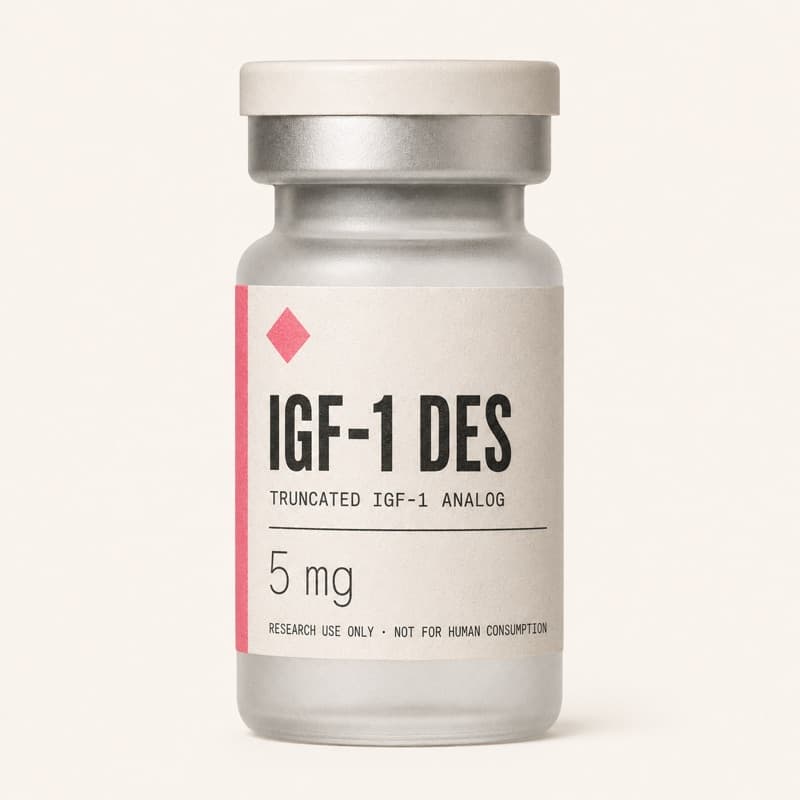
IGF-1 DES
Truncated IGF-1 Analog · Localized Muscle Growth
Analog of insulin-like growth factor-1, truncated: three N-terminal amino acids are absent from the start of the chain. Binding to IGF binding proteins (IGFBPs) is eliminated by that change, so no part of the peptide is sequestered in circulation and 100% stays bioactive. Potency then runs approximately 10x native IGF-1, against a half-life that is extremely short — 20–30 minutes. The short duration is considered a feature, not a limitation: injection can be placed at a specific site in the target muscle immediately after a workout, so growth stays localized and systemic exposure is reduced.
Overview
Analog of insulin-like growth factor-1, truncated: three N-terminal amino acids are absent from the start of the chain. Binding to IGF binding proteins (IGFBPs) is eliminated by that change, so no part of the peptide is sequestered in circulation and 100% stays bioactive. Potency then runs approximately 10x native IGF-1, against a half-life that is extremely short — 20–30 minutes. The short duration is considered a feature, not a limitation: injection can be placed at a specific site in the target muscle immediately after a workout, so growth stays localized and systemic exposure is reduced.
Activation runs through the IGF-1 receptor (IGF-1R) and the downstream PI3K/Akt/mTOR and MAPK/ERK signaling pathways, driving muscle hypertrophy and hyperplasia alike. The tripeptide Gly-Pro-Glu is missing from the N-terminus, so binding to IGFBPs — which normally sequester ~98% of circulating IGF-1 — cannot occur. The whole administered dose therefore stays bioavailable. A very short half-life keeps activity at the local injection site, and there satellite cells proliferate and differentiate, protein synthesis rises, and the targeted muscle tissue takes up nutrients.
Research indications
What the compound has been studied for, grouped by body system. Effect size is the reported magnitude where it was measured — not a recommendation.
Muscle growth confined to the site, by direct intramuscular injection into the target muscle after a workout.
Satellite cells proliferate and differentiate under stimulation, potentially yielding new muscle fibers.
After training, the injected muscle group recovers faster at the tissue level.
IGF-1R activation promotes repair and regeneration where the injection was placed.
- Class
- Truncated IGF-1 analog
- Research status
- Limited research
- Chain length
- 67 residues
- Molecular weight
- 7000 Da
- Half-life
- ~25 min
- Typical dose
- 20–50 µg post-workout (site-specific IM injection)
- Frequency
- Post-workout only, injected into trained muscle
- Cycle length
- 4–6 weeks maximum
- Storage
- Lyophilized: -20C. Reconstituted: 2-8C, use within 7 days (BAC water)
Molecular data
- Type
- Truncated IGF-1 analog
- Molecular weight
- 7000 Da
- Chain length
- 67 residues
- Half-life
- 25 min
Levels in single-dose multiples. A shape, not a pharmacokinetic prediction.
Dosing reference
Doses reported in the literature and by suppliers. These are a record of what has been used in research — reference, never instruction.
| Context | Route | Amount | Frequency |
|---|---|---|---|
| Beginner Protocol | IM (site-specific) | 20-30mcg | Post-workout, injected into trained muscle |
| Intermediate | IM (site-specific) | 30-50mcg | Post-workout, injected into trained muscle |
| Advanced | IM (site-specific) | 50mcg | Post-workout, split across multiple trained muscles |
Interactions
Baseline IGF-1 rises with HGH; IGF-1 DES after a workout then lays a localized anabolic spike over the elevated systemic level. Caution is warranted, and blood glucose bears monitoring.
Not to be stacked with IGF-1 DES. Both are IGF-1 analogs hitting the same receptor. The choice between them turns on whether the effect wanted is systemic (LR3) or localized (DES).
IGF-1 receptor density and satellite cell number both rise with testosterone, which amplifies what IGF-1 DES does locally at the injection site.
Blood glucose falls under either. Hypoglycemia risk rises significantly when IGF-1 DES meets exogenous insulin.
What to expect
Safety
Mechanistic flags — properties of the pathway, not observed adverse events.
- Hypoglycemia -- consume carbohydrates after injection
- Localized swelling and soreness at injection site
- Increased pump in targeted muscles
- Mild lightheadedness shortly after injection
- Severe or recurring hypoglycemia despite carbohydrate intake
- Disproportionate or asymmetric muscle growth
- Unusual growths, lumps, or rapid mole changes
- Persistent pain, redness, or infection at injection site
- Signs of systemic IGF-1 excess (jaw growth, organ enlargement)
- Not approved for human use -- research chemical only
- Cancer history or active malignancy (IGF-1 promotes cell proliferation)
- Diabetes or impaired glucose regulation
- WADA prohibited substance -- causes failed drug tests
Quality checklist
What to confirm before trusting a batch of research material. A verification aid — not an endorsement of any supplier.
- Third-party Certificate of AnalysisIndependent lab · dated · lot-matched.
- HPLC purity ≥ 98%Reverse-phase trace included.
- Mass-spec confirms 7000 g/molMALDI-TOF or ESI-MS.
- Counterion stated (acetate ≫ TFA)TFA salts can confound bioassays.
- Endotoxin / sterility statementRelevant once reconstituted.
- Lyophilised · cold-chain shippedStored −20 °C, shipped on ice.
- Labelled “research use only”No therapeutic or dosing claims.
Recorded signals for this compound · 11
- ✓HPLC purity >95%
- ✓Truncated sequence confirmed by mass spectrometry
- ✓Cold storage held throughout (lyophilized, -20C)
- ✓Reputable source behind the certificate of analysis
- !A research chemical only; human use has never been approved
- !Human clinical trials do not exist
- !Timing must be precise, the half-life being extremely short
- ×Hypoglycemia risk — after injection, blood sugar can fall rapidly
- ×Repeated site-specific use carries potential for disproportionate muscle growth
- ×Quality varies on the black market; degraded product is common
- ×Cancer proliferation concern — cell growth is promoted by elevated IGF-1 activity
FAQ
What makes direct intramuscular injection the route for IGF-1 DES?
Half-life is 20–30 minutes, and IGF binding proteins are not bound, which makes the peptide 10x more potent though short-acting. Injecting straight into the muscle immediately after a workout keeps activity inside the target, so hypertrophy stays localized and systemic IGF-1 does not run to excess.
Does IGF-1 DES bring on hypoglycemia?
Yes. Blood glucose falls, the mechanism being glucose uptake into muscle tissue. Fast carbohydrates of 20–40 g are mandatory immediately after injection. Blood glucose warrants monitoring early in use, and injection before sleep is never appropriate, given the overnight hypoglycemia risk.
Is IGF-1 DES compatible with a ketogenic diet?
Not safely. Ketosis breaks on the carbohydrate intake that injection makes mandatory. Where keto is the goal, alternatives such as GH or ipamorelin serve instead. Post-injection carbohydrate is non-negotiable on safety grounds.
Is there a cancer risk with IGF-1 DES?
Cell proliferation is promoted by IGF-1, and the UK Biobank study links elevated systemic IGF-1 to multiple cancers. Systemic exposure is minimized in DES by the short half-life and local injection, though with any IGF-1 product cancer risk stays a theoretical concern.
References
- 1The isolation and characterization of a naturally occurring truncated form of IGF-I in human brainSara VR, Carlsson-Skwirut C, Andersson C, Hall E, Sjogren B, Holmgren A, Jornvall H · Biochemical and Biophysical Research Communications · 1986
First identification and characterization of Des(1-3) IGF-1 as a naturally occurring truncated form of IGF-1 in human brain tissue, establishing that the N-terminal tripeptide deletion occurs endogenously.
Animal in vivoPubMed 3753607 ↗ - 2Des(1-3)IGF-I: A truncated form of insulin-like growth factor-I that has greatly enhanced activity in promoting growthFrancis GL, Ross M, Ballard FJ, Milner SJ, Senn C, McNeil KA, Wallace JC, King R, Wells JR · Journal of Molecular Endocrinology · 1992
Des(1-3) IGF-1 demonstrated approximately 10-fold greater potency than intact IGF-1 in stimulating protein synthesis and cell proliferation, directly attributable to its inability to bind IGF binding proteins.
Animal in vivoPubMed 1381175 ↗ - 3Insulin-like growth factor-I (IGF-I) and especially IGF-I variants are anabolic in dexamethasone-treated ratsTomas FM, Knowles SE, Owens PC, Chandler CS, Francis GL, Read LC, Ballard FJ · Biochemical Journal · 1992
Des(1-3) IGF-1 and LR3-IGF-1 were significantly more potent than native IGF-1 in reversing dexamethasone-induced muscle wasting in rats, with truncated and modified variants showing superior anabolic activity.
Animal in vivoPubMed 1371669 ↗ - 4Circulating Insulin-like Growth Factor-I Concentrations and Risk of 30 Cancers: Prospective Analyses in UK BiobankMurphy N, Knuppel A, Papadimitriou N, Martin RM, Tsilidis KK, Brennan P et al. · Cancer Research · 2020
Higher circulating IGF-1 associated with increased risks of colorectal, breast, prostate, and thyroid cancers in >395,000 UK Biobank participants, underscoring the cancer risk of sustained IGF-1 pathway activation.
Review · inferredPubMed 32709735 ↗