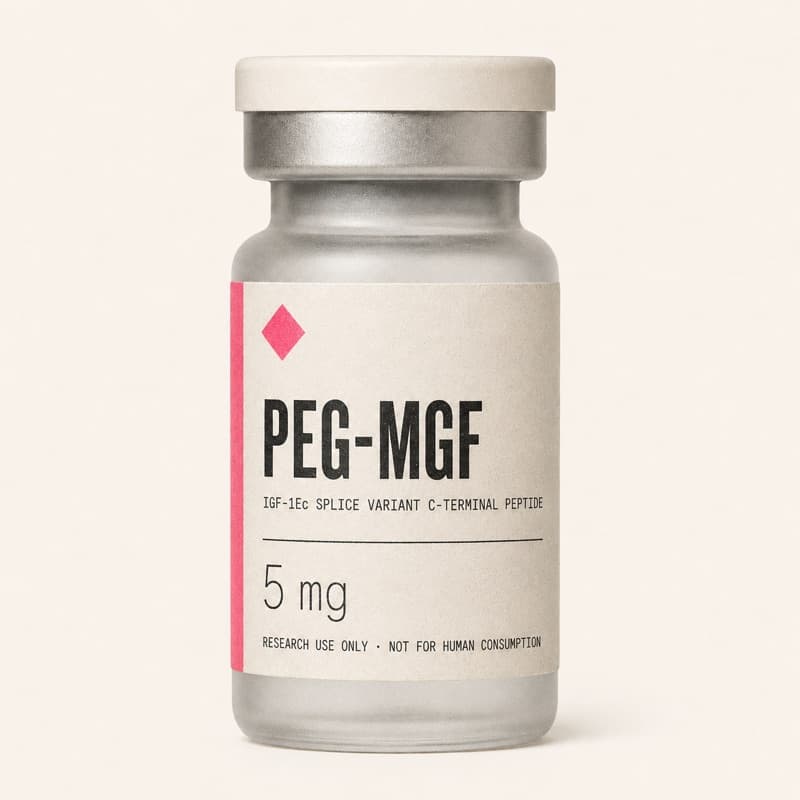
PEG-MGF
Pegylated Mechano Growth Factor · IGF-1 Splice Variant
IGF-1 variant carrying a PEG attachment, which stretches half-life from minutes into hours. Muscle satellite cells are activated after mechanical stress or injury.
Overview
IGF-1 variant carrying a PEG attachment, which stretches half-life from minutes into hours. Muscle satellite cells are activated after mechanical stress or injury.
Receptor binding activates muscle satellite stem cells and stimulates MAPK/ERK signaling. Protein synthesis is enhanced and muscle fiber repair promoted. Activity of the E-peptide domain is distinct from that of mature IGF-1.
Research indications
What the compound has been studied for, grouped by body system. Effect size is the reported magnitude where it was measured — not a recommendation.
Dormant muscle satellite cells are activated as the primary mechanism; those cells fuse to damaged fibers.
Younger muscle progenitor cells gain proliferative lifespan.
Fusion capacity of activated satellite cells increases, which supports repair and hypertrophy.
Better outcomes in Achilles tendon injury are suggested by animal studies.
Healing was faster in rabbit models, by way of osteoblast regulation.
Potential in articular cartilage injury models is indicated by the research.
Targeted tissue repair is supported by injection close to the injury site.
Mechanical stress upregulates it naturally, and supplementation may enhance those processes.
- Class
- IGF-1Ec splice variant C-terminal peptide
- Research status
- Limited research
- Chain length
- 24 residues
- Molecular weight
- 2888 Da
- Half-life
- ~60 h
- Typical dose
- 200–400 µg per injection
- Frequency
- 2–3 times weekly, post-workout
- Cycle length
- 4–8 weeks
- Storage
- Refrigerate at 2-8°C; protect from light
Molecular data
- Type
- IGF-1Ec splice variant C-terminal peptide
- Molecular weight
- 2888 Da
- Chain length
- 24 residues
- Half-life
- 3600 min
Levels in single-dose multiples. A shape, not a pharmacokinetic prediction.
Dosing reference
Doses reported in the literature and by suppliers. These are a record of what has been used in research — reference, never instruction.
| Context | Route | Amount | Frequency |
|---|---|---|---|
| General Recovery | SubQ or IM | 200mcg | 2-3x weekly |
| Targeted Muscle Recovery | IM bilateral near target muscle | 200-400mcg | Post-workout, 2-3x weekly |
| Injury Recovery | IM near injury site | 200-400mcg | 2-3x weekly |
| Conservative Protocol | SubQ | 100-200mcg | 2x weekly |
Interactions
IGF-1 pathways are targeted by both, and a combination risks receptor overstimulation. Doses should be cut significantly when combined.
Endogenous IGF-1/MGF rises under HGH. Effects are amplified in combination, though excessive water retention and joint pain warrant monitoring.
Mechanisms complement: BPC-157 drives angiogenesis, PEG-MGF activates satellite cells. A popular recovery stack.
Inflammation falls and cell migration is promoted by TB-500, while PEG-MGF activates muscle stem cells.
Glucose metabolism is affected by both. Careful blood sugar monitoring is warranted in combination.
Regenerative pathways differ, and tissue repair may be enhanced through multiple mechanisms.
What to expect
Safety
Mechanistic flags — properties of the pathway, not observed adverse events.
- Mild fatigue
- Soreness where injected
- Signs of hypoglycemia
- Unexpected swelling or edema
- Injection site reactions that are severe, beyond normal soreness
- Unusual growths or lumps, or tissue that changes rapidly
- Headaches that persist, or changes in vision
- Pregnancy or breastfeeding
- Diabetes uncontrolled, or severe hyperglycemia
- Any past cancer or neoplastic disease
Quality checklist
What to confirm before trusting a batch of research material. A verification aid — not an endorsement of any supplier.
- Third-party Certificate of AnalysisIndependent lab · dated · lot-matched.
- HPLC purity ≥ 98%Reverse-phase trace included.
- Mass-spec confirms 2888 g/molMALDI-TOF or ESI-MS.
- Counterion stated (acetate ≫ TFA)TFA salts can confound bioassays.
- Endotoxin / sterility statementRelevant once reconstituted.
- Lyophilised · cold-chain shippedStored −20 °C, shipped on ice.
- Labelled “research use only”No therapeutic or dosing claims.
Recorded signals for this compound · 6
- ✓A fluffy cake, white or off-white, indicates proper freeze-drying
- ✓After reconstitution the solution is crystal clear, with no particles
- ✓Certificate of Analysis covering HPLC purity testing, >98%
- !Slight clumping is normal when a gentle swirl dissolves it
- ×Powder that has collapsed or discolored suggests heat degradation
- ×Cloudiness that persists, or visible particles, indicates contamination
FAQ
What does PEGylation change relative to regular MGF for muscle recovery?
Half-life extends from minutes to 48–72 hours, so injection frequency drops and the peptide stays active longer in the body. Regular MGF has a very short half-life, which limits the recovery window. The extended duration of PEG-MGF allows deeper satellite cell activation and sustained muscle repair.
Is PEG-MGF injected into the muscle just trained?
Yes — the optimal placement is localized, near or into the damaged muscle. 'IM bilateral near target muscle' is the listed route for targeted recovery. Timing within 1–2 hours post-workout coincides with natural upregulation of MGF, which makes that the ideal window.
Is PEG-MGF stacked with testosterone for muscle growth?
No direct contraindication exists, though caution applies. Satellite cells (muscle stem cells) are activated by PEG-MGF, while testosterone raises protein synthesis and hormonal signals. Synergy is possible, but excessive water retention and joint pain warrant monitoring, both being possible with combined growth-promoting agents.
Does PEG-MGF suit non-athletes seeking muscle maintenance?
Possibly, though effectiveness peaks where mechanical stress or injury triggers satellite cell activation. Absent a training stimulus or injury, muscle will not be built dramatically. The stronger fit is accelerating post-workout recovery or aiding injury rehabilitation, rather than standalone muscle building.