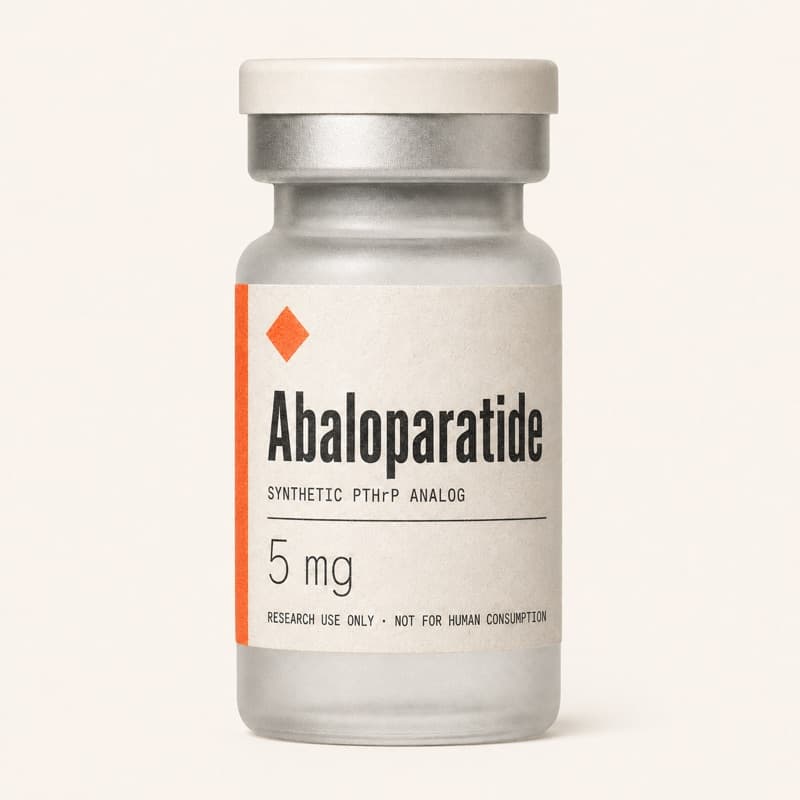
Abaloparatide
PTHrP Analog · Anabolic Bone-Building Agent
Anabolic bone-building agent with FDA approval, a synthetic analog of parathyroid hormone-related protein (PTHrP). Selective activation of the PTH1 receptor stimulates new bone formation while bone resorption stays minimized. The phase III ACTIVE trial recorded BMD increases at the hip greater than those with teriparatide, alongside substantial reduction in fracture risk. Approval followed in the US in 2017 and the EU in 2022, for postmenopausal women and men with osteoporosis at high fracture risk.
Overview
Anabolic bone-building agent with FDA approval, a synthetic analog of parathyroid hormone-related protein (PTHrP). Selective activation of the PTH1 receptor stimulates new bone formation while bone resorption stays minimized. The phase III ACTIVE trial recorded BMD increases at the hip greater than those with teriparatide, alongside substantial reduction in fracture risk. Approval followed in the US in 2017 and the EU in 2022, for postmenopausal women and men with osteoporosis at high fracture risk.
The mechanism is selective activation of the parathyroid hormone 1 receptor (PTH1R), a G protein-coupled receptor carried by osteoblasts and osteocytes. Binding favors the RG (relaxed, G-protein-coupled) conformational state of PTH1R; the downstream cyclic AMP signaling that follows is transient, and it tilts toward anabolic bone formation rather than resorption. Set against native PTH, that binding preference yields more bone-building activity and less hypercalcemic effect. Cortical and trabecular bone gain volume and density, and microarchitecture improves.
Research indications
What the compound has been studied for, grouped by body system. Effect size is the reported magnitude where it was measured — not a recommendation.
FDA approval covers postmenopausal women with osteoporosis who are at high fracture risk, or who have failed other therapies.
In men, FDA approval covers osteoporosis with high fracture risk or intolerance of other treatments.
Phase III trials showed fractures cut substantially, both vertebral and nonvertebral.
ACTIVExtend reported benefit from abaloparatide followed by alendronate, with bone protection maintained.
- Class
- Synthetic PTHrP analog
- Research status
- Extensively studied
- Chain length
- 34 residues
- Molecular weight
- 3960 Da
- Half-life
- ~1.7 h
- Typical dose
- 80 µg
- Frequency
- Once daily
- Cycle length
- Up to 2 years (lifetime maximum)
- Storage
- Refrigerate pre-filled pen at 2-8°C, do not freeze. Discard after 30 days even if medication remains
Molecular data
- Type
- Synthetic PTHrP analog
- Molecular weight
- 3960 Da
- Chain length
- 34 residues
- Half-life
- 102 min
Levels in single-dose multiples. A shape, not a pharmacokinetic prediction.
Dosing reference
Doses reported in the literature and by suppliers. These are a record of what has been used in research — reference, never instruction.
| Context | Route | Amount | Frequency |
|---|---|---|---|
| Osteoporosis treatment | SubQ (periumbilical abdomen) | 80 mcg | Once daily |
Interactions
In the ACTIVExtend trial, abaloparatide followed sequentially by alendronate both maintained bone benefits and extended them.
During therapy, adequate supplementation is recommended — calcium 500–1000 mg, vitamin D 400–800 IU.
Not for concurrent use; both are PTH receptor agonists. One agent alone, or the two in sequence.
The mechanisms are separate; no interactions known.
Mechanisms differ; no interactions known.
What to expect
Safety
Mechanistic flags — properties of the pathway, not observed adverse events.
- Hypercalciuria — calcium high in the urine
- Dizziness
- Nausea
- Headache
- Palpitations
- Fatigue
- Upper abdominal pain
- Vertigo
- Injection site reactions
- Hypercalcemia signs — confusion, excessive thirst, fatigue
- Fainting or severe dizziness
- Allergic reactions
- Bone pain that persists
- Radiation therapy to the skeleton previously, whether external beam or implant
- Paget's disease of bone
- Pre-existing hypercalcemia
- Pregnancy or nursing
- Metastases in bone, or a history of skeletal malignancies
- Lifetime cumulative use beyond 2 years
- Metabolic bone diseases besides osteoporosis
Quality checklist
What to confirm before trusting a batch of research material. A verification aid — not an endorsement of any supplier.
- Third-party Certificate of AnalysisIndependent lab · dated · lot-matched.
- HPLC purity ≥ 98%Reverse-phase trace included.
- Mass-spec confirms 3960 g/molMALDI-TOF or ESI-MS.
- Counterion stated (acetate ≫ TFA)TFA salts can confound bioassays.
- Endotoxin / sterility statementRelevant once reconstituted.
- Lyophilised · cold-chain shippedStored −20 °C, shipped on ice.
- Labelled “research use only”No therapeutic or dosing claims.
Recorded signals for this compound · 11
- ✓Clear, colorless solution
- ✓Pharmaceutical grade (Tymlos/Eladynos)
- ✓Intact pen device
- ✓Within expiration date
- ✓Cold chain properly maintained
- !FDA oversight does not cover research-grade products
- !Potency may be affected by temperature excursions
- ×Damaged pen device
- ×Visible particulates
- ×Exposure to freezing, or to high temperatures
- ×Solution cloudy or discolored
FAQ
What limits abaloparatide to 2 years of use?
The 2-year cap on cumulative lifetime use rests on a theoretical osteosarcoma risk seen in rodent studies at very high doses. It is precautionary, drawn from animal data; ACTIVExtend showed benefits hold when the transition to alendronate comes after 18 months of abaloparatide.
Does abaloparatide outperform teriparatide (Forteo)?
Yes. The phase III ACTIVE trial put abaloparatide ahead of teriparatide on BMD increase at the hip, with substantial reduction in fracture risk. Hypercalcemia risk is also lower than teriparatide's, despite the more potent bone-building activity.
Where do the dizziness and palpitations reported on abaloparatide come from?
A subset of users report dizziness, palpitations, and vertigo; the likely cause is transient hypotension or hemodynamic change following rapid PTH receptor activation. Continued use typically sees these subside as the body adapts. Orthostatic hypotension is the rare but serious warning sign, and it requires discontinuation.
Is abaloparatide used by women still in their reproductive years?
No. The compound is teratogenic, and contraindicated where pregnancy exists or is possible. FDA approval is specific to postmenopausal women and to men with osteoporosis, which places its appropriate use in women beyond reproductive years.