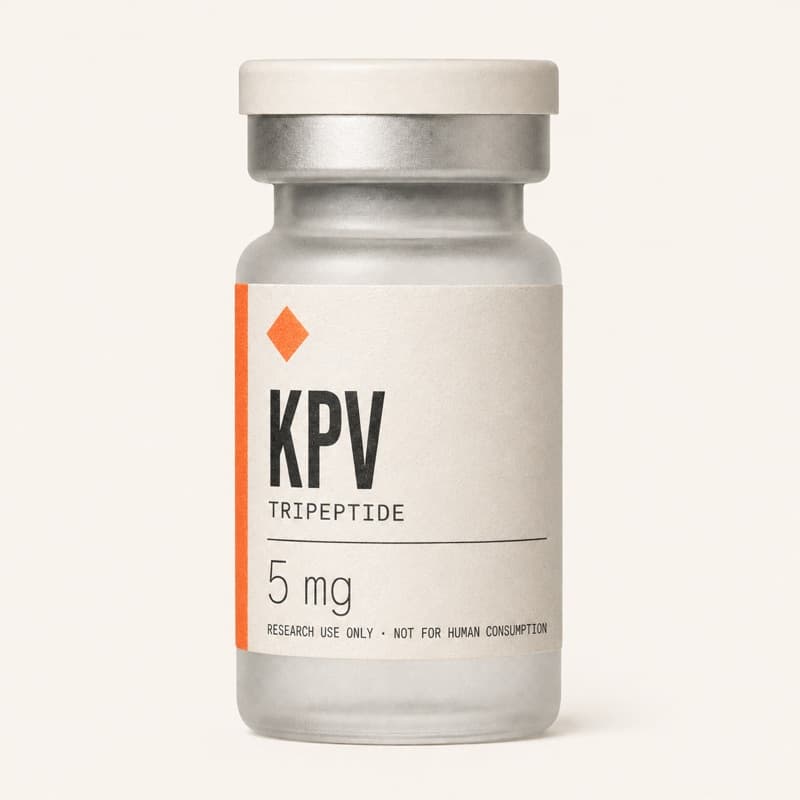
KPV
Anti-Inflammatory Tripeptide · Alpha-MSH Fragment
Tripeptide taken from the C-terminal end of alpha-MSH, potent as an anti-inflammatory. It carries anti-inflammatory and antimicrobial properties but not the pigmentation effects of full α-MSH, which suits it to inflammation management.
Overview
Tripeptide taken from the C-terminal end of alpha-MSH, potent as an anti-inflammatory. It carries anti-inflammatory and antimicrobial properties but not the pigmentation effects of full α-MSH, which suits it to inflammation management.
Cell entry is followed by inhibition of inflammatory pathways at the nuclear level, NF-κB signaling in particular. Pro-inflammatory cytokines (TNF-α, IL-6) fall, and the immunosuppression steroids cause does not occur.
Research indications
What the compound has been studied for, grouped by body system. Effect size is the reported magnitude where it was measured — not a recommendation.
In autoimmune conditions, overactive immune responses may be brought toward balance.
Inhibition of the NF-κB pathway lowers TNF-α and IL-6.
Cytokine reduction gives potential benefit in inflammatory arthritis.
Models of ulcerative colitis and of Crohn's disease showed demonstrated benefit.
Assists in restoring the function of the intestinal barrier.
Antimicrobial activity is selective, leaving beneficial gut bacteria preserved.
Applied topically, KPV cut psoriatic markers 60% and improved the function of the skin barrier.
Inflammatory skin conditions are reduced, with no systemic effects.
- Class
- Tripeptide
- Research status
- Emerging
- Chain length
- 3 residues
- Half-life
- ~1.5 h
- Typical dose
- 200–500 µg per injection
- Frequency
- 1–2 times daily
- Cycle length
- 4–8 weeks
- Storage
- Lyophilized: Room temperature. Reconstituted: 2-8°C, refrigerate immediately
Molecular data
- Type
- Tripeptide
- Chain length
- 3 residues
- Half-life
- 90 min
Levels in single-dose multiples. A shape, not a pharmacokinetic prediction.
Dosing reference
Doses reported in the literature and by suppliers. These are a record of what has been used in research — reference, never instruction.
| Context | Route | Amount | Frequency |
|---|---|---|---|
| General anti-inflammatory | SubQ | 200-300mcg | Once daily |
| Active inflammation | SubQ | 250mcg | Twice daily |
| Autoimmune support | SubQ | 500mcg | Once daily |
| Acute flare-ups | SubQ | 500mcg | 2x daily for 1 week, then reduce |
| Gut health support | Mix in water/juice or enteric capsules | 200-500mcg | 2-3x daily |
| Skin inflammation | Affected skin areas | 0.1-0.5% cream/gel | 2-3x daily |
| Systemic anti-inflammatory | Nasal spray | 100-300mcg | 2-3x daily (1-2 sprays per nostril) |
Interactions
Complementary mechanisms, with more healing in the gut and a stronger anti-inflammatory effect.
The mechanisms differ; safe to combine.
Healing and antimicrobial effects that complement each other.
Immune function is supported by each, along different pathways.
Synergy in regeneration and in skin health.
Each is α-MSH related; pigmentation effects are absent from KPV, though cumulative effects warrant monitoring.
What to expect
Safety
Mechanistic flags — properties of the pathway, not observed adverse events.
- Side effects reported: minimal to none
- Immunosuppression of the sort steroids cause does not occur
- Melanin production and tanning effects absent
- Symptoms related to inflammation may fall temporarily
- Paradoxical inflammation increase
- Allergic reaction symptoms
- Unusual fatigue or weakness
- Infection signs — fever, chills — though very rare
- Severe reactions at the injection site
- Known peptide allergies
- Active severe infections (theoretical)
- Pregnancy or breastfeeding — data are limited
Quality checklist
What to confirm before trusting a batch of research material. A verification aid — not an endorsement of any supplier.
- Third-party Certificate of AnalysisIndependent lab · dated · lot-matched.
- HPLC purity ≥ 98%Reverse-phase trace included.
- Mass-spec identity confirmedMALDI-TOF or ESI-MS.
- Counterion stated (acetate ≫ TFA)TFA salts can confound bioassays.
- Endotoxin / sterility statementRelevant once reconstituted.
- Lyophilised · cold-chain shippedStored −20 °C, shipped on ice.
- Labelled “research use only”No therapeutic or dosing claims.
Recorded signals for this compound · 7
- ✓High purity >98%
- ✓Stable small peptide structure
- ✓Certificate of analysis available
- ✓After reconstitution, solution clear and colorless
- !Optimal stability calls for pH 5.5–7
- ×Contamination/degradation, indicated by visible particles
- ×Oxidation/potency loss showing as yellow coloration
FAQ
Is KPV the same thing as alpha-MSH, or as melanotan?
No. What KPV amounts to is the C-terminal tripeptide fragment of alpha-MSH rather than the whole hormone. Where melanotan differs, KPV delivers anti-inflammatory benefit without producing melanin or tanning: the focus is inflammation, not pigmentation.
Is KPV active taken orally?
Yes. Oral bioavailability has been demonstrated for KPV, which few peptides can claim. Transport into intestinal cells runs through PepT1 transporters, so capsules or dissolved powder stand as viable alternatives to injection where the application is gut health.
How fast does inflammation fall on KPV?
Onset is quick: reduced inflammation is noticed within 1–3 days of starting, in many reports. Noticeable improvement in inflammatory symptoms — joint pain, swelling, gut issues — typically arrives by week 1–2, and the full effect across inflammatory markers by week 4–6.
References
- 1Dissection of the Anti-Inflammatory Effect of the Core and C-Terminal (KPV) Alpha-Melanocyte-Stimulating Hormone PeptidesGetting, S.J., Schiöth, H.B., Perretti, M. · Journal of Pharmacology and Experimental Therapeutics · 2003
Established that KPV exerts anti-inflammatory effects distinct from core MSH peptides, likely through inhibition of IL-1β functions rather than melanocortin receptor signaling.
Animal in vivoPubMed 12750433 ↗ - 2PepT1-mediated tripeptide KPV uptake reduces intestinal inflammationDalmasso G, Charrier-Hisamuddin L, Nguyen HT, et al. · Gastroenterology · 2008
KPV inhibits NF-κB activation and reduces intestinal inflammation via PepT1-mediated transport; demonstrated anti-inflammatory effects in murine IBD models.
Review · inferredPubMed 18061177 ↗ - 3Melanocortin-Derived Tripeptide KPV Has Anti-Inflammatory Potential in Murine Models of Inflammatory Bowel DiseaseKannengiesser, K., et al. · Inflammatory Bowel Diseases · 2008
KPV showed significant anti-inflammatory effects in DSS colitis and CD45RBhi transfer colitis models, reducing weight loss, histological damage, and MPO activity. Effects partially independent of MC1R signaling.
Animal in vivoPubMed 18092346 ↗ - 4Critical Role of PepT1 in Promoting Colitis-Associated Cancer and Therapeutic Benefits of KPVViennois, E., et al. · Cellular and Molecular Gastroenterology and Hepatology · 2016
PepT1 is highly expressed in human colorectal tumors. PepT1-transported KPV prevented colitis-associated carcinogenesis in wild-type mice, with no effect in PepT1-knockout mice, confirming PepT1-dependent therapeutic mechanism.
Animal in vivo · inferredPubMed 27458604 ↗ - 5Orally Targeted Delivery of Tripeptide KPV via Hyaluronic Acid-Functionalized Nanoparticles Efficiently Alleviates Ulcerative ColitisXiao, B., et al. · Molecular Therapy · 2017
HA-functionalized KPV nanoparticles (~272.3 nm) successfully targeted colonic epithelial cells and macrophages, exerting combined mucosal healing and anti-inflammatory effects superior to free KPV in a UC mouse model.
Animal in vivo · inferredPubMed 28143741 ↗
KPV combined with rapamycin forms carrier-free nanoparticles that curbed vascular calcification in mice, acting through autophagy activation and reduced inflammation.
A nanodrug directed at PepT1 pairs the anti-inflammatory peptide KPV with an immunosuppressant, tested against acute and chronic DSS-induced colitis models.
A review of therapeutic peptides for inflammatory bowel disease and the strategies used to deliver them, KPV among the agents discussed, alongside current challenges and future directions.