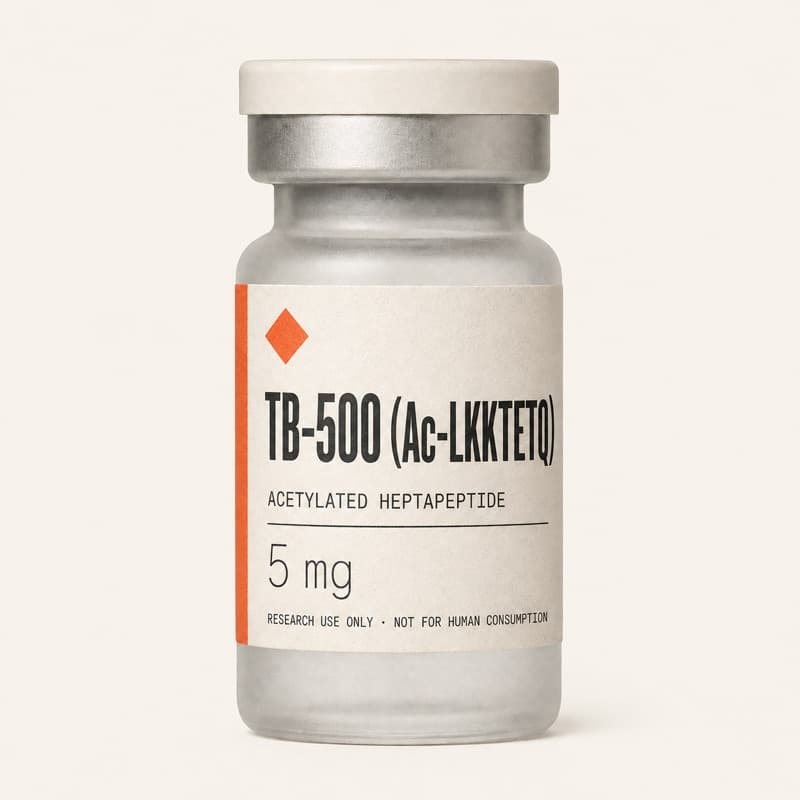
TB-500 (Ac-LKKTETQ)
Thymosin Beta-4 Active Fragment · Healing Peptide
Synthetic derivative of thymosin beta-4, made up of the N-terminal acetylated 17–23 amino acid fragment. Within thymosin beta-4 that sequence is the active site behind actin binding, cell migration, and wound healing. Research reports endothelial cell differentiation, angiogenesis, keratinocyte migration, and collagen deposition all promoted, with inflammation decreased. Acetylation guards the N-terminus against degradation and biological activity is retained.
Overview
Synthetic derivative of thymosin beta-4, made up of the N-terminal acetylated 17–23 amino acid fragment. Within thymosin beta-4 that sequence is the active site behind actin binding, cell migration, and wound healing. Research reports endothelial cell differentiation, angiogenesis, keratinocyte migration, and collagen deposition all promoted, with inflammation decreased. Acetylation guards the N-terminus against degradation and biological activity is retained.
The LKKTETQ sequence carried by TB-500 is the actin-binding motif of thymosin beta-4 at full length. Many properties of the parent protein carry over to this fragment — cell proliferation, differentiation, and migration among them. Angiogenesis is promoted through upregulated VEGF expression and greater endothelial cell sprouting. During metabolism the peptide is cleaved serially at the C-terminus; acetylation at the N-terminus protects against degradation.
Research indications
What the compound has been studied for, grouped by body system. Effect size is the reported magnitude where it was measured — not a recommendation.
The active LKKTETQ sequence drives promotion of dermal wound healing.
Research puts tissue repair support on par with full thymosin beta-4.
Migration of keratinocytes is promoted, as is deposition of collagen.
Differentiation of endothelial cells is promoted, along with formation of new blood vessels.
In damaged tissue, inflammatory responses decrease.
- Class
- Acetylated heptapeptide
- Research status
- Moderate research
- Chain length
- 7 residues
- Molecular weight
- 844 Da
- Typical dose
- 2–2.5 mg per injection
- Frequency
- Twice weekly
- Cycle length
- 4–6 weeks loading phase
- Storage
- Reconstituted: 2-8°C refrigerated
Molecular data
- Type
- Acetylated heptapeptide
- Molecular weight
- 844 Da
- Chain length
- 7 residues
Dosing reference
Doses reported in the literature and by suppliers. These are a record of what has been used in research — reference, never instruction.
| Context | Route | Amount | Frequency |
|---|---|---|---|
| Loading phase | SubQ | 2-2.5 mg | 2x weekly for 4-6 weeks |
| Maintenance | SubQ | 2 mg | Weekly or bi-weekly |
Interactions
Often stacked: the mechanisms differ, and the healing effect is greater.
TB-500 being the active fragment, combining the two may be redundant.
Wound healing and tissue repair are supported by both, on different pathways.
Mechanisms differ; they may complement toward tissue growth.
What to expect
Safety
Mechanistic flags — properties of the pathway, not observed adverse events.
- Injection site reactions
- Mild fatigue
- Head rush (reported)
- Allergic reactions
- Unusual swelling or inflammation
- Active cancer (theoretical concern)
- Pregnancy or breastfeeding
- Medicinal use is not authorized
- Under WADA rules, prohibited in sport
Quality checklist
What to confirm before trusting a batch of research material. A verification aid — not an endorsement of any supplier.
- Third-party Certificate of AnalysisIndependent lab · dated · lot-matched.
- HPLC purity ≥ 98%Reverse-phase trace included.
- Mass-spec confirms 844 g/molMALDI-TOF or ESI-MS.
- Counterion stated (acetate ≫ TFA)TFA salts can confound bioassays.
- Endotoxin / sterility statementRelevant once reconstituted.
- Lyophilised · cold-chain shippedStored −20 °C, shipped on ice.
- Labelled “research use only”No therapeutic or dosing claims.
Recorded signals for this compound · 9
- ✓White lyophilized powder
- ✓High purity (>98%)
- ✓Solution clear once reconstituted
- ✓Vacuum seal intact
- !Research chemical only
- !Human use is not authorized
- ×Discoloration
- ×Cloudy solution
- ×Visible particulates
FAQ
Does the TB-500 fragment (Ac-LKKTETQ) differ from full TB-500?
The fragment is the active 7-amino-acid sequence (LKKTETQ) drawn from the larger 43-amino-acid thymosin beta-4. Wound healing and cell migration are promoted by both. Acetylation at the N-terminus leaves the fragment more stable, and it may prove more cost-effective while retaining the core regenerative properties.
How soon does the TB-500 fragment speed up wound healing?
Wound healing starts to accelerate within 1–7 days. By week 1–2, cell migration and angiogenesis are noticeably enhanced. Improvements in tissue repair become visible over 2–4 weeks, across the loading phase of two injections a week.
Is the TB-500 fragment combined with BPC-157 for better healing?
Yes — the pairing is common, and synergistic. Cell migration and angiogenesis come from the fragment, growth-factor upregulation from BPC-157; between them multiple healing pathways are addressed, better than by either peptide alone.
Does the fragment need its N-terminal acetylation to be effective?
Yes. Degradation at the N-terminus during metabolism is held off by the acetylation, while the active LKKTETQ sequence responsible for wound healing stays intact. Functional lifespan is extended and stability improved relative to non-acetylated versions.