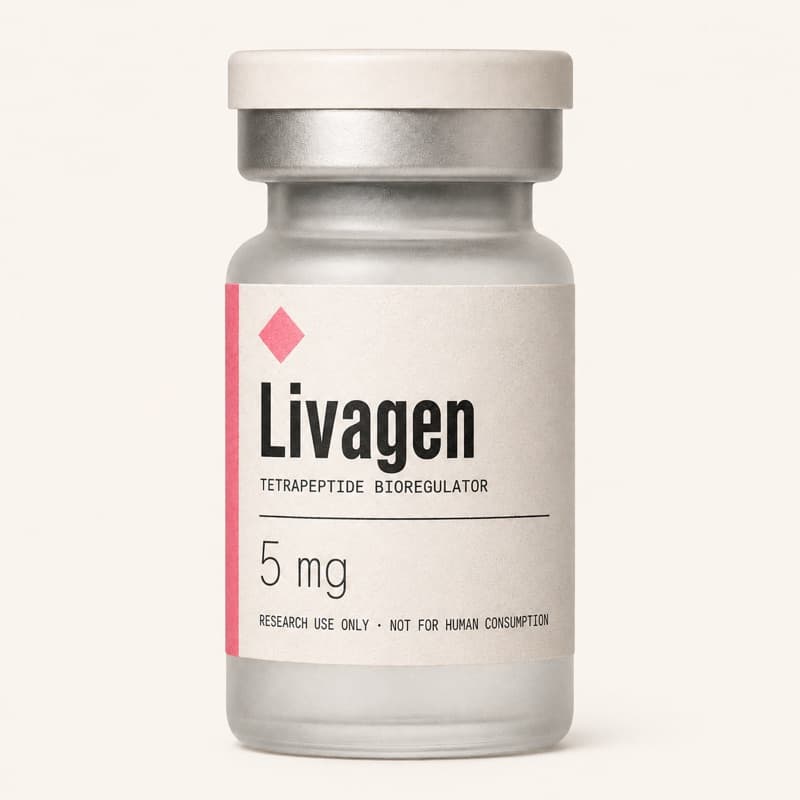
Livagen
KEDA Tetrapeptide · Liver Bioregulator
Tetrapeptide bioregulator (KEDA) of the Khavinson series, immunomodulatory and hepatoprotective to a significant degree. Structurally it is close to Epitalon. Antioxidant and immune status are normalized, and liver function is restored in conditions of hepatitis. Its best-known property is the decondensation of chromatin: silent genes, among them ribosomal genes, switch on, and protein synthesis and cellular activity rise. Aging is when the protective effects peak.
Overview
Tetrapeptide bioregulator (KEDA) of the Khavinson series, immunomodulatory and hepatoprotective to a significant degree. Structurally it is close to Epitalon. Antioxidant and immune status are normalized, and liver function is restored in conditions of hepatitis. Its best-known property is the decondensation of chromatin: silent genes, among them ribosomal genes, switch on, and protein synthesis and cellular activity rise. Aging is when the protective effects peak.
Direct effects on the structure and function of DNA are how Livagen works. Chromatin — DNA in its tightly packed form — is decondensed, expression of certain genes rises, and the 'youthful' profile of the cell improves. In lymphocytes the peptide switches on multiple genes, ribosomal genes among them that had been silent, and protein synthesis and cell activity increase with them. Hepatoprotective effects come by way of normalized immune and antioxidant status in liver tissue.
Research indications
What the compound has been studied for, grouped by body system. Effect size is the reported magnitude where it was measured — not a recommendation.
Protective properties appear in models of liver fibroid induration.
Liver functions are restored in hepatitis models, acute and chronic alike.
Normalization of immune and of antioxidant status is what protects liver tissue.
Decondensation of chromatin restores youthful patterns of gene expression.
Hepatoprotective effects reach their maximum during aging.
Silent genes are switched on, ribosomal genes among them, and protein synthesis improves.
Liver-protective effects arrive alongside normalized immune function.
- Class
- Tetrapeptide bioregulator
- Research status
- Moderate research
- Chain length
- 4 residues
- Molecular weight
- 432 Da
- Typical dose
- 10–20 mg daily
- Frequency
- Daily for 10–20 days per cycle
- Cycle length
- 10–20 days
- Storage
- Oral capsules: Room temperature. Injectable reconstituted: 2-8°C refrigerated
Molecular data
- Type
- Tetrapeptide bioregulator
- Molecular weight
- 432 Da
- Chain length
- 4 residues
KEDADosing reference
Doses reported in the literature and by suppliers. These are a record of what has been used in research — reference, never instruction.
| Context | Route | Amount | Frequency |
|---|---|---|---|
| Standard protocol | Oral capsules | 10-20 mg | Daily for 10-20 days |
| Maintenance | Oral capsules | 10 mg | 2-3 cycles yearly |
| Research protocol | IM or SubQ | 10 mg | Daily for 10 days |
Interactions
Similar in structure; the two are often run together in comprehensive anti-aging protocols.
Liver function and antioxidant status are supported by each.
Liver bioregulators that complement, their sequences different.
Organ targets differ; combination within bioregulator protocols is possible.
What to expect
Safety
Mechanistic flags — properties of the pathway, not observed adverse events.
- Tolerated well overall
- Side effects reported as minimal
- Allergic reactions
- Unusual liver symptoms
- Known hypersensitivity
- Pregnancy or breastfeeding
- Liver emergencies in progress — seek medical care
Quality checklist
What to confirm before trusting a batch of research material. A verification aid — not an endorsement of any supplier.
- Third-party Certificate of AnalysisIndependent lab · dated · lot-matched.
- HPLC purity ≥ 98%Reverse-phase trace included.
- Mass-spec confirms 432 g/molMALDI-TOF or ESI-MS.
- Counterion stated (acetate ≫ TFA)TFA salts can confound bioassays.
- Endotoxin / sterility statementRelevant once reconstituted.
- Lyophilised · cold-chain shippedStored −20 °C, shipped on ice.
- Labelled “research use only”No therapeutic or dosing claims.
Recorded signals for this compound · 7
- ✓White powder or capsules
- ✓If reconstituted, a clear solution
- ✓Packaging and labeling done properly
- !Source or purity unknown
- ×Discoloration
- ×Unusual odor
- ×Damaged packaging
FAQ
What is meant by 'decondensing chromatin'?
Decondensation of chromatin means the loosening of tightly-packed DNA, which leaves previously silent genes accessible for expression. Livagen activates that process, switching on genes tied to protein synthesis and cellular function — genes that typically decrease with age. The result is restoration of more youthful gene expression patterns.
Is Livagen identical to Epitalon?
No, though both are Khavinson bioregulator tetrapeptides of similar structure. Liver function and chromatin remodeling are what Livagen (KEDA) focuses on; the pineal gland is what epitalon targets. The two are often used together in comprehensive anti-aging protocols.
How is a response to Livagen assessed?
Benefits are subtle and accumulate over weeks. Blood work may show liver function markers — transaminases, bilirubin — improving. Systemic effects extend to improved immune markers and energy. Assessment works best through lab work and observation across multiple weeks rather than through immediate symptoms.
Is Livagen run continuously, or cycled?
Traditional protocols recommend a 10–20 day cycle, run 2–3 times a year with breaks in between. That pattern leaves time for the changes to chromatin and the effects on gene expression to take hold, and potential adaptation is avoided. Continuous daily use has not been well studied.