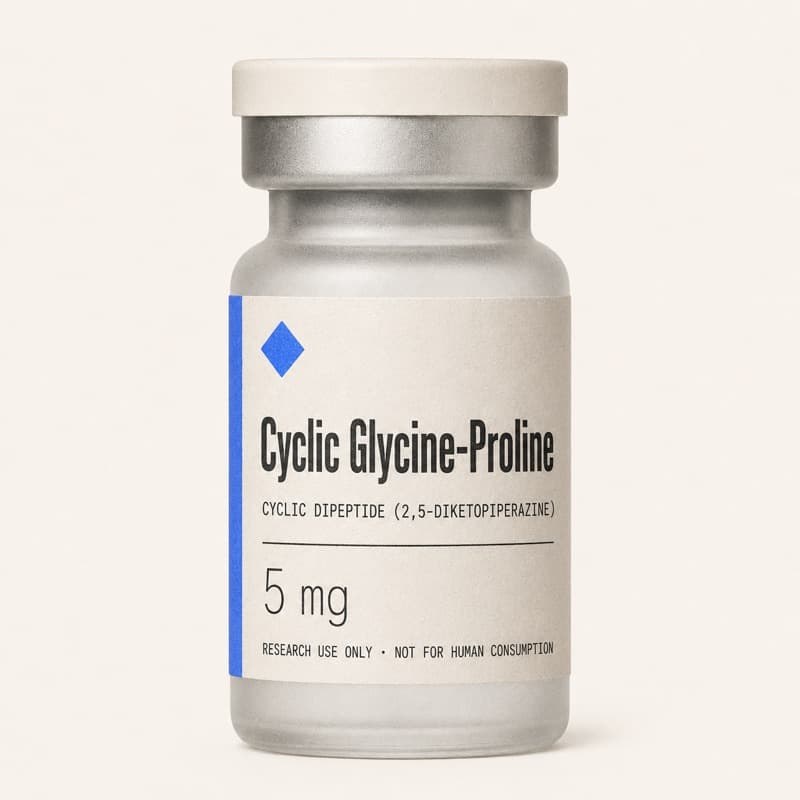
Cyclic Glycine-Proline
IGF-1 Bioavailability Regulator & Neuroprotective Peptide
Cyclic dipeptide of endogenous origin, present in plasma, breast milk, and cerebrospinal fluid. As a metabolite of IGF-1 it governs that hormone's bioavailability by competing for binding at IGFBP-3. Clinical trials back neuroprotective, cognitive-enhancing, and cardioprotective properties.
Overview
Cyclic dipeptide of endogenous origin, present in plasma, breast milk, and cerebrospinal fluid. As a metabolite of IGF-1 it governs that hormone's bioavailability by competing for binding at IGFBP-3. Clinical trials back neuroprotective, cognitive-enhancing, and cardioprotective properties.
Binding to IGFBP-3 is competed for against IGF-1, which normalizes bioavailable IGF-1 levels. At AMPA and GABA-A receptors it works as a positive allosteric modulator. BDNF levels rise through activation of the Akt/MDM2-p53 pathway.
Research indications
What the compound has been studied for, grouped by body system. Effect size is the reported magnitude where it was measured — not a recommendation.
A correlation links higher cGP levels to improved memory retention in elderly populations
Neural stem cells are protected against oxidative stress, with efficacy demonstrated in stroke models
In mouse studies, amyloid plaque load fell and spatial memory improved
In a clinical study, CSF cGP increased and anxiety/depression scores fell
Vascular complications improved in a clinical trial, and HbA1c% normalized
Clinical observations demonstrated a reduction in systolic blood pressure
Favorable clinical outcomes are associated with higher cGP/IGF-1 ratios
Maintenance of the ratios correlates with cognitive function preserved with age
- Class
- Cyclic dipeptide (2,5-diketopiperazine)
- Research status
- Moderate research
- Chain length
- 2 residues
- Molecular weight
- 154.17 Da
- Typical dose
- 20–100 µg daily (or 300 mg blackcurrant extract twice daily)
- Frequency
- Once daily, preferably in the morning
- Cycle length
- 4–12 weeks
- Storage
- Room temperature in sealed container, protected from moisture and light
Molecular data
- Type
- Cyclic dipeptide (2,5-diketopiperazine)
- Molecular weight
- 154.17 Da
- Chain length
- 2 residues
Dosing reference
Doses reported in the literature and by suppliers. These are a record of what has been used in research — reference, never instruction.
| Context | Route | Amount | Frequency |
|---|---|---|---|
| General cognitive support | Oral capsule | 20-40 μg | 1x daily |
| Neuroprotection/anti-aging | Oral capsule | 40-50 μg | 1x daily |
| Metabolic/cardiovascular support | Oral capsule | 40-100 μg | 1x daily |
| Via blackcurrant extract | Oral capsule | 300 mg BCA | 2x daily |
Interactions
A metabolite of IGF-1, cGP regulates bioavailability by competing for IGFBP-3 binding
Separate pathways: tissue repair from BPC-157, IGF-1 modulation from cGP
Neuroprotection and nootropic effects come from both, by distinct pathways
Cognitive effects that complement: anxiety is Selank's target, IGF-1 optimization is cGP's
The growth hormone/IGF-1 axis is affected by both; combined effects on levels warrant monitoring
What to expect
Safety
Mechanistic flags — properties of the pathway, not observed adverse events.
- Unusual fatigue or weakness
- Rash, swelling, or difficulty breathing — allergic reaction
- Blood glucose changing unexpectedly
- Not studied in pregnancy
- Consultation with a healthcare provider where medications for IGF-1 or growth hormone are in use
- Long-term human data remain limited
Quality checklist
What to confirm before trusting a batch of research material. A verification aid — not an endorsement of any supplier.
- Third-party Certificate of AnalysisIndependent lab · dated · lot-matched.
- HPLC purity ≥ 98%Reverse-phase trace included.
- Mass-spec confirms 154.17 g/molMALDI-TOF or ESI-MS.
- Counterion stated (acetate ≫ TFA)TFA salts can confound bioassays.
- Endotoxin / sterility statementRelevant once reconstituted.
- Lyophilised · cold-chain shippedStored −20 °C, shipped on ice.
- Labelled “research use only”No therapeutic or dosing claims.
Recorded signals for this compound · 7
- ✓Tested by a third party for potency and purity
- ✓cGP content labeled clearly, typically as micrograms per serving
- ✓Natural sources derived from New Zealand blackcurrant
- ✓Containers sealed, with protection from light and moisture
- !Products with no clear specification of cGP content
- ×Therapeutic claims at the extreme, unsupported by research
- ×Concentrations described vaguely
FAQ
Does cyclic glycine-proline improve cognition in healthy people, or only in disease states?
Yes. A correlation between higher cGP levels and better memory retention shows up in healthy elderly populations. Clinical trials found cognitive function enhanced in normal aging, which points to preserved mental sharpness as a benefit outside disease treatment, and makes it relevant to anti-aging protocols.
What does blackcurrant extract offer over pure cGP supplements?
Roughly 300mg per serving of cGP arrives in a natural whole-food matrix, where bioavailability may improve and additional antioxidants come along. Pure cGP is dosed in micrograms (20-100µg), so the extract forms deliver higher doses while carrying other compounds alongside the cGP.
Does cGP help in Parkinson's disease, or only in animal models?
In one human clinical study, blackcurrant supplementation — which raises CSF cGP by 74% — lowered anxiety and depression scores among Parkinson's patients. Neuroprotection is more dramatic in animal models; the human evidence still supports benefits to cognition and mood, with larger trials needed.
Can cyclic glycine-proline be run long-term without breaks?
Cycles of 4-12 weeks are what most protocols recommend, and human safety data on continuous long-term use is limited. Since cGP occurs endogenously in cerebrospinal fluid and breast milk, extended use looks relatively safe; cycling still allows individual response to be assessed and heads off potential tolerance.
References
- 1IGF-1 Homeostasis Regulation StudyScientific Reports · 2014
cGP regulates IGF-1 bioavailability through IGFBP-3 competitive binding
Review · inferredSource ↗ - 2Parkinson's Disease Clinical StudyPMC · 2018
Blackcurrant supplementation increased CSF cGP 74%; reduced anxiety/depression
Review · inferredSource ↗ - 3Alzheimer's Mouse Model StudyPMC · 2023
Significantly improved spatial memory; reduced hippocampal plaques 42.3→14.5 per mm²
Animal in vivo · inferredSource ↗ - 4Stroke Recovery & Cognitive Function ReviewPMC · 2023
Higher cGP/IGF-1 ratios associated with favorable stroke outcomes
Review · inferredSource ↗