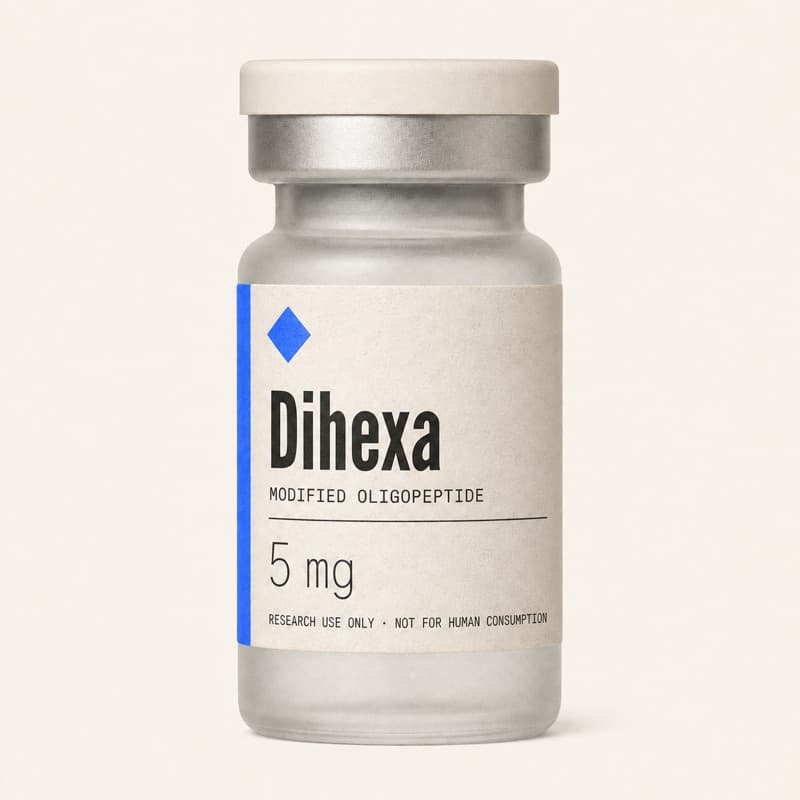
Dihexa
Synaptogenic Peptide · Cognitive Enhancement
Oligopeptide, synthetic, from angiotensin IV; cognitive function is potently enhanced by way of synaptogenesis. Synapse formation runs through HGF/c-Met receptor activation, where potency is 10 million times that of BDNF.
Overview
Oligopeptide, synthetic, from angiotensin IV; cognitive function is potently enhanced by way of synaptogenesis. Synapse formation runs through HGF/c-Met receptor activation, where potency is 10 million times that of BDNF.
Hepatocyte growth factor (HGF) is bound with high affinity (Kd = 65 pM) and its activity at the c-Met receptor potentiated; PI3K/AKT pathways activate and new synaptic connections form, at extraordinary potency.
Research indications
What the compound has been studied for, grouped by body system. Effect size is the reported magnitude where it was measured — not a recommendation.
Impairment models, scopolamine-induced amnesia among them, show restoration.
Across animal models, improvements were demonstrated in spatial, working, and consolidation.
Acquisition enhanced by way of increased synaptic plasticity.
Dendritic spine formation was demonstrated to increase 3-fold.
Expression of BDNF — brain-derived neurotrophic factor — increases.
New blood vessel formation in the brain is promoted.
In Alzheimer's models, amyloid burden was reduced.
Neuroinflammation and glial activation both decreased.
Synapses protected in models of neurodegeneration.
- Class
- Modified oligopeptide
- Research status
- Emerging
- Molecular weight
- 504.7 Da
- Half-life
- ~240 h
- Typical dose
- 8–10 mg oral or 2–5 mg injectable (0.5 mg/kg based on research)
- Frequency
- Once daily in the morning
- Cycle length
- 4–8 weeks on
- Storage
- Oral: room temperature (2 year shelf life); Injectable lyophilized: 2-8°C; Reconstituted: 2-8°C, use within 30 days
Molecular data
- Type
- Modified oligopeptide
- Molecular weight
- 504.7 Da
- Half-life
- 14400 min
Levels in single-dose multiples. A shape, not a pharmacokinetic prediction.
Dosing reference
Doses reported in the literature and by suppliers. These are a record of what has been used in research — reference, never instruction.
| Context | Route | Amount | Frequency |
|---|---|---|---|
| Standard cognitive enhancement | Oral | 8-10mg | 1x daily (morning) |
| Low-dose maintenance | Oral | 5mg | 1x daily |
| Intensive learning protocol | Oral | 10-15mg | 1x daily |
| Research protocol | SubQ/IP | 0.5mg/kg daily | Daily or 3x weekly |
| Standard injectable | SubQ | 2-5mg total | 1x daily |
| Topical application | Inner forearms, shoulders (rotate sites) | 10-20mg cream | 1x daily |
Interactions
Cognitive benefits are enhanced; overstimulation warrants monitoring.
Effects are synergistic; neural overstimulation bears watching.
Mechanisms are unrelated; no negative interactions known.
Neuroplasticity is strongly affected by both; concurrent use is avoided.
Stacking for cognition happens; safety data is limited.
Mechanisms for cellular health that complement.
Potent neuroactivity in both; overstimulation may result.
Targets differ; no interactions are known.
What to expect
Safety
Mechanistic flags — properties of the pathway, not observed adverse events.
- Anxiety or overstimulation
- Headaches — most frequent of the side effects
- Sleep disrupted where dosing falls late in the day
- Increased mental clarity
- Anxiety on the increase, or panic attacks
- Sleep disturbance lasting past 3 days
- Neurological symptoms of concern
- Signs of mania or overstimulation
- Injection site reactions, if the injectable form is used
- Marked change in mood, or depression
- Headaches, severe or persistent
- Pregnancy or breastfeeding
- No FDA approval — a research compound only
- Cancer risk in theory, by way of c-Met activation
- Cancer history — avoided because of the c-Met pathway
- Long-term human safety data does not exist
Quality checklist
What to confirm before trusting a batch of research material. A verification aid — not an endorsement of any supplier.
- Third-party Certificate of AnalysisIndependent lab · dated · lot-matched.
- HPLC purity ≥ 98%Reverse-phase trace included.
- Mass-spec confirms 504.7 g/molMALDI-TOF or ESI-MS.
- Counterion stated (acetate ≫ TFA)TFA salts can confound bioassays.
- Endotoxin / sterility statementRelevant once reconstituted.
- Lyophilised · cold-chain shippedStored −20 °C, shipped on ice.
- Labelled “research use only”No therapeutic or dosing claims.
Recorded signals for this compound · 10
- ✓Pharmaceutical grade, sourced from a licensed compounding pharmacy
- ✓Storage conditions properly maintained
- ✓Capsules uniform, lot numbers and expiration dates clearly marked
- ✓Purity >98% documented on the certificate of analysis
- !Pharmaceutical standards may be absent from research chemical sources
- !Products where third-party testing documentation is missing
- ×Unverified sources
- ×Purity reports or analytical testing absent
- ×Pricing that is suspicious or extremely cheap
- ×Capsules discolored or damaged
FAQ
How does Dihexa's potency for synapse formation compare with BDNF?
At promoting synaptogenesis, potency runs approximately 10 million times that of BDNF. The source of it is picomolar binding affinity for HGF (Kd = 65 pM) together with c-Met receptor activation, which puts profound cognitive effects within reach at very low doses relative to other peptides.
What separates Dihexa from its prodrug Fosgonimeton?
Fosgonimeton is the prodrug form, built for improved pharmacokinetics and for clinical development. Phase I trials in Alzheimer's disease showed efficacy, with P300 latency normalized. Greater stability and bioavailability than raw Dihexa are possible, though the research continues.
Does Dihexa produce headaches or other side effects, as other nootropics do?
Yes — the side effect reported most commonly is headache, above all on the first doses. Anxiety, overstimulation, and disrupted sleep also occur, a consequence of the potent neuroplastic effects. Minimizing them tends to mean a low starting dose (5mg) and timing kept away from bedtime.
Is Dihexa safe in combination with other cognitive-enhancing peptides?
Overstimulation, or neuroplasticity in excess, may follow from combining it with potent nootropics such as Semax or Selank. Human data on combinations is limited. Where a stack is run, the conservative start is standard, with headaches, anxiety, or mood disturbance watched as indicators of neural overstimulation.
References
- 1Evaluation of Metabolically Stabilized Angiotensin IV Analogs as Procognitive/Antidementia AgentsMcCoy AT, Benoist CC, Wright JW, Harding JW · Journal of Pharmacology and Experimental Therapeutics · 2013
Oral dihexa (2 mg/kg) completely reversed scopolamine-induced cognitive deficits in Morris water maze by day 7; produced near 3-fold increase in hippocampal dendritic spines at picomolar concentrations.
Animal in vivoPubMed 23055539 ↗ - 2The Procognitive and Synaptogenic Effects of Angiotensin IV-Derived Peptides Are Dependent on Activation of the Hepatocyte Growth Factor/c-Met SystemBenoist CC, Kawas LH, Zhu M, Bhatt D, Wright JW, Harding JW · Journal of Pharmacology and Experimental Therapeutics · 2014
Dihexa binds HGF with high affinity (Kd = 65 pM), induces c-Met phosphorylation and hippocampal spinogenesis/synaptogenesis similar to HGF; effects blocked by c-Met inhibitor confirming HGF/c-Met dependence.
Review · inferredPubMed 25187433 ↗ - 3The Development of Small Molecule Angiotensin IV Analogs to Treat Alzheimer's and Parkinson's DiseasesWright JW, Harding JW · Progress in Neurobiology · 2015
Comprehensive review establishing dihexa as an orally active, BBB-permeable compound that facilitates compromised memory and motor systems via HGF/c-Met modulation.
ReviewPubMed 25455861 ↗ - 4AngIV-Analog Dihexa Rescues Cognitive Impairment and Recovers Memory in the APP/PS1 Mouse via the PI3K/AKT Signaling PathwayGao Y, Zhang Y, Wang Z, et al. · Brain Research Bulletin · 2021
Dihexa restored spatial learning in APP/PS1 Alzheimer's mice, increased neuronal cells and synaptophysin expression, decreased astrocyte/microglia activation, and reduced IL-1B and TNF-a via PI3K/AKT pathway.
Animal in vivo · inferredPubMed 34827486 ↗
Fosgonimeton, the dihexa prodrug, raised pro-survival ERK/AKT signalling, lowered GSK3B activity, and restored cognition to a significant degree in rats treated with Abeta25-35 to model Alzheimer's disease.
In this phase I randomised trial (NCT03298672), fosgonimeton rapidly normalised ERP P300 latency among Alzheimer's participants, an indication of improved synaptic function, and was tolerated across the doses tested in healthy volunteers and patients.
Fosgonimeton produced neurotrophic and cognition-enhancing effects across several dementia models, with trials in mild-to-moderate Alzheimer's disease ongoing under NCT04488419 and NCT04886063.