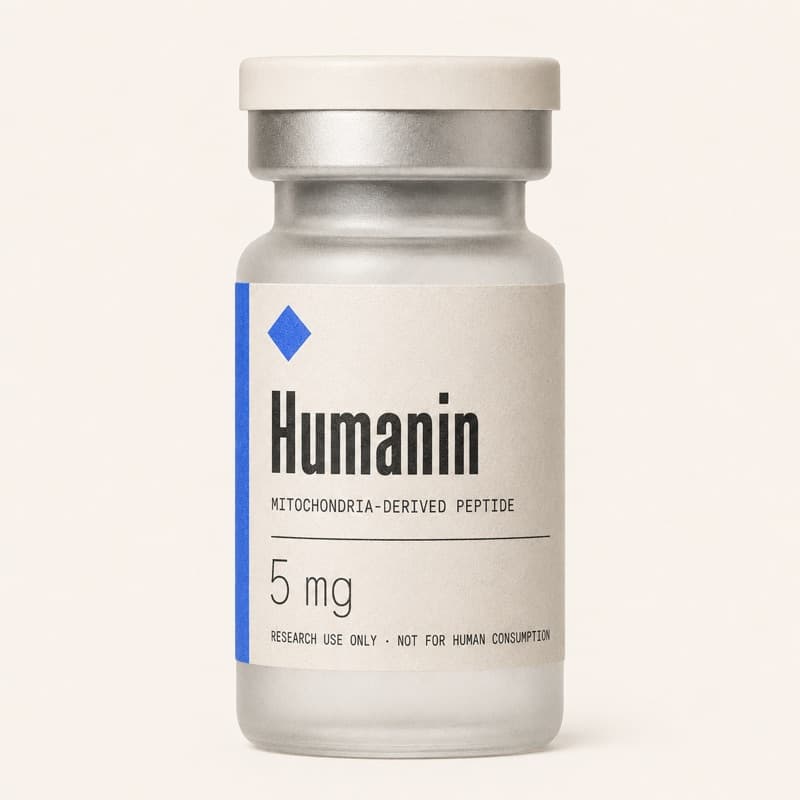
Humanin
Mitochondria-Derived Peptide · HN
First of the mitochondria-derived peptides (MDPs) to be discovered, cloned from the occipital lobe of a patient with Alzheimer's. Its 24 amino acids are encoded within the 16S rRNA region of mitochondrial DNA, and its neuroprotective, cytoprotective, and anti-apoptotic properties are potent. Levels decline with age, research reports, yet hold stable in long-lived species — naked mole-rats among them — and the offspring of centenarians carry significantly higher levels.
Overview
First of the mitochondria-derived peptides (MDPs) to be discovered, cloned from the occipital lobe of a patient with Alzheimer's. Its 24 amino acids are encoded within the 16S rRNA region of mitochondrial DNA, and its neuroprotective, cytoprotective, and anti-apoptotic properties are potent. Levels decline with age, research reports, yet hold stable in long-lived species — naked mole-rats among them — and the offspring of centenarians carry significantly higher levels.
Several mechanisms are at work. Cell surface receptors including FPRL1 and CNTFR are engaged, and PI3K/AKT signaling pathways activate downstream to promote cell survival. Pro-apoptotic proteins such as Bax are blocked, beta-amyloid toxicity in neurons is reduced, oxidative stress is defended against, and mitochondrial biogenesis is promoted. Healthy cellular aging is supported at a fundamental level by that combination.
Research indications
What the compound has been studied for, grouped by body system. Effect size is the reported magnitude where it was measured — not a recommendation.
Neuronal cells protected from amyloid-β toxicity — the original discovery.
In PD models, PI3K/AKT signaling promotes mitochondrial biogenesis.
Neuroprotection is broad across various neurotoxic insults.
In C. elegans, overexpression extends lifespan, with the daf-16/Foxo pathway required.
Metabolic healthspan parameters improve in middle-aged mice given the HNG analog.
Longevity in centenarians and in their offspring is associated with higher levels.
A range of cell types is protected against damage and death from stress.
Pro-apoptotic proteins such as Bax are blocked, and programmed cell death prevented.
Mitochondrial function and biogenesis are both promoted.
- Class
- Mitochondria-derived peptide
- Research status
- Moderate research
- Chain length
- 24 residues
- Molecular weight
- 2687 Da
- Half-life
- ~30 min
- Typical dose
- 1–5 mg per injection (0.5–2 mg for HNG analog)
- Frequency
- 2–3 times weekly for sustained mitochondrial support
- Cycle length
- 8–12 weeks
- Storage
- Lyophilized: Room temperature. Reconstituted: 2-8°C, protect from light
Molecular data
- Type
- Mitochondria-derived peptide
- Molecular weight
- 2687 Da
- Chain length
- 24 residues
- Half-life
- 30 min
MAPRGFSCLLLLTSEIDLPVKRRALevels in single-dose multiples. A shape, not a pharmacokinetic prediction.
Dosing reference
Doses reported in the literature and by suppliers. These are a record of what has been used in research — reference, never instruction.
| Context | Route | Amount | Frequency |
|---|---|---|---|
| Neuroprotection | SubQ | 1-5 mg | 2-3x weekly |
| Longevity/Anti-aging | SubQ | 1-3 mg | 2x weekly |
| HNG analog | SubQ | 0.5-2 mg | 2x weekly |
Interactions
Two mitochondria-derived peptides whose longevity and metabolic benefits complement.
Mitochondrial function is the shared target; benefits for cellular health may be additive.
Mechanisms differ; combination in longevity protocols is possible.
Mitochondrial function and healthy aging are supported by each.
What to expect
Safety
Mechanistic flags — properties of the pathway, not observed adverse events.
- Injection site reactions
- Mild fatigue initially
- Headache (rare)
- Signs of allergic reaction
- Unusual persistent symptoms
- Active cancer (theoretical concern with anti-apoptotic effects)
- Pregnancy or breastfeeding
- Hypersensitivity to peptide components
Quality checklist
What to confirm before trusting a batch of research material. A verification aid — not an endorsement of any supplier.
- Third-party Certificate of AnalysisIndependent lab · dated · lot-matched.
- HPLC purity ≥ 98%Reverse-phase trace included.
- Mass-spec confirms 2687 g/molMALDI-TOF or ESI-MS.
- Counterion stated (acetate ≫ TFA)TFA salts can confound bioassays.
- Endotoxin / sterility statementRelevant once reconstituted.
- Lyophilised · cold-chain shippedStored −20 °C, shipped on ice.
- Labelled “research use only”No therapeutic or dosing claims.
Recorded signals for this compound · 7
- ✓Lyophilized powder, white to off-white
- ✓Solution clear once reconstituted
- ✓Vacuum seal intact
- !Slight clumping, dissolving readily
- ×Powder discolored
- ×Solution cloudy or with particles
- ×Seal broken
FAQ
What separates humanin from the HNG analog?
HNG carries a glycine substitution at position 14 and is roughly 1000-fold more potent than native humanin. The mitochondrial pathways are the same for both; the doses are not — typically 0.5–2 mg for HNG against 1–5 mg for standard humanin.
Are humanin's benefits quick to appear?
No. Action is at the cellular and mitochondrial level, and the benefits build slowly. Effects are noticed over weeks to months by most users, as the peptide accumulates in tissues and supports mitochondrial health. Immediate results are not what this peptide offers.
Does humanin combine with other longevity peptides?
Yes. It pairs well with MOTS-c — also a mitochondrial-derived peptide — along with epitalon and NAD+ precursors. Each complements the others through different pathways, targeting mitochondrial function, cellular aging, and neuroprotection.