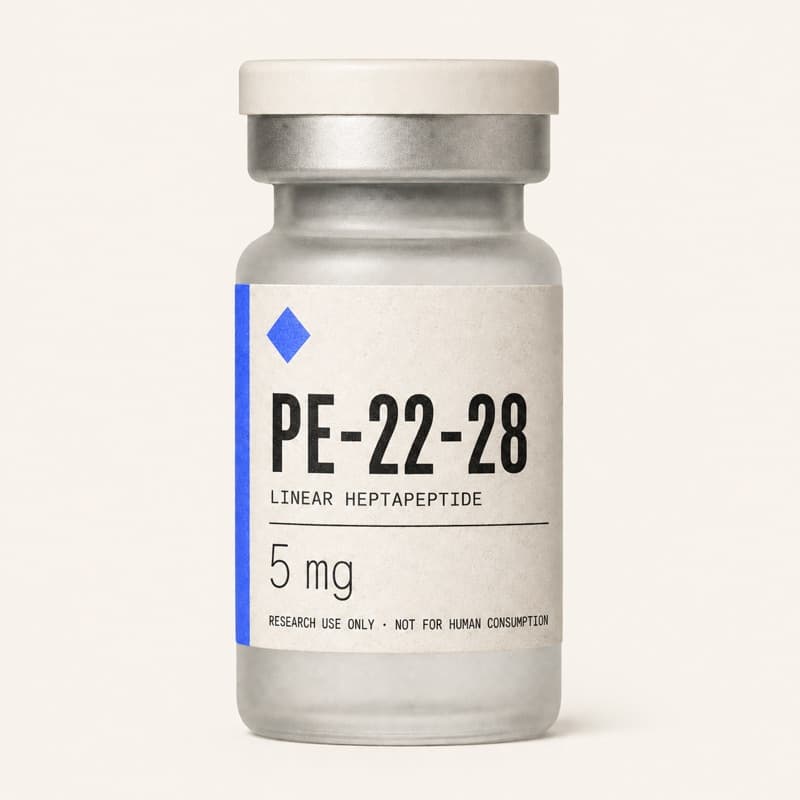
PE-22-28
TREK-1 Channel Blocker · Shortened Spadin Analog
Synthetic heptapeptide drawn from positions 22–28 of Spadin, acting as a potent TREK-1 antagonist with selectivity and duration beyond the parent compound. Rapid antidepressant effects are the primary research focus.
Overview
Synthetic heptapeptide drawn from positions 22–28 of Spadin, acting as a potent TREK-1 antagonist with selectivity and duration beyond the parent compound. Rapid antidepressant effects are the primary research focus.
TREK-1 potassium channels are blocked selectively, with an IC50 of 0.12 nM. Serotonin neurotransmission in the dorsal raphe nucleus is enhanced, and CREB activation with hippocampal neurogenesis follows.
Research indications
What the compound has been studied for, grouped by body system. Effect size is the reported magnitude where it was measured — not a recommendation.
The main focus of the research; behavioral models show rapid effects inside 4 days.
Preclinical anxiety models demonstrate anxiolytic properties.
BrdU-positive cells nearly double following 4 days of treatment.
CREB activation promotes formation of new synapses.
Memory is supported by TREK-1 expression in hippocampus and prefrontal cortex.
Possible protection against ischemia, with support for neuronal survival.
- Class
- Linear heptapeptide
- Research status
- Emerging
- Chain length
- 7 residues
- Molecular weight
- 773.89 Da
- Half-life
- ~23 h
- Typical dose
- 50–200 µg daily
- Frequency
- Once daily
- Cycle length
- 4–8 weeks
- Storage
- Refrigerate at 2-8°C, use within 4-6 weeks
Molecular data
- Type
- Linear heptapeptide
- Molecular weight
- 773.89 Da
- Chain length
- 7 residues
- Half-life
- 1380 min
Levels in single-dose multiples. A shape, not a pharmacokinetic prediction.
Dosing reference
Doses reported in the literature and by suppliers. These are a record of what has been used in research — reference, never instruction.
| Context | Route | Amount | Frequency |
|---|---|---|---|
| Antidepressant Effect | SubQ | 50-200mcg | Once daily |
| Neurogenesis Support | SubQ | 100-200mcg | Once daily |
| General Use | Oral | Higher than injectable (specific dose TBD) | Daily |
| General Use | Intranasal | 100-300mcg (estimated) | Daily |
Interactions
Serotonergic pathways are enhanced by both; watch for excessive activity.
Complementary support for neurogenesis and cognition.
Anxiety and mood support by different mechanisms.
Neuroplasticity pathways that complement.
Separate mechanisms; nothing contraindicated.
Serotonin syndrome risk.
What to expect
Safety
Mechanistic flags — properties of the pathway, not observed adverse events.
- No effects observed on TREK-2, TRAAK or TASK-1 channels
- Preclinical studies showed no cardiac dysfunction and no seizures
- Serotonin syndrome signs
- Cardiac symptoms
- Seizure activity
- Headaches, severe and persistent
- Suicidal ideation, or severe mood changes
- Pregnancy and breastfeeding
- Concurrent MAOI use
Quality checklist
What to confirm before trusting a batch of research material. A verification aid — not an endorsement of any supplier.
- Third-party Certificate of AnalysisIndependent lab · dated · lot-matched.
- HPLC purity ≥ 98%Reverse-phase trace included.
- Mass-spec confirms 773.89 g/molMALDI-TOF or ESI-MS.
- Counterion stated (acetate ≫ TFA)TFA salts can confound bioassays.
- Endotoxin / sterility statementRelevant once reconstituted.
- Lyophilised · cold-chain shippedStored −20 °C, shipped on ice.
- Labelled “research use only”No therapeutic or dosing claims.
Recorded signals for this compound · 8
- ✓Certificate of Analysis showing purity above 98%
- ✓Cold-chain shipping done properly
- ✓Reconstituted solution clear and colorless
- ✓Lyophilized powder, white to off-white
- !Research compound only — no FDA approval
- !Quality differs between suppliers
- ×Appearance cloudy, discolored, or particulate
- ×Powder clumped or sticky, a sign of moisture damage
FAQ
What is PE-22-28's potency relative to full-length Spadin?
Far more potent: roughly 300–500× full-length Spadin. The difference follows from a shortened fragment that mimics the active site more closely. IC50 lands at 0.12 nM for TREK-1 inhibition, against 40–60 nM for Spadin.
Is PE-22-28 a standalone antidepressant, or research-only?
Animal models show rapid antidepressant effects, inside 4 days, but the compound is research-only at present and no human clinical trials have been completed. Therapeutic use is not approved. The preclinical evidence is strong enough that clinical development may follow, given pharmaceutical investment.
How long does the neurogenic effect of PE-22-28 persist?
Preclinical studies put the start of neurogenesis and synaptogenesis establishment at 1–2 weeks into treatment. How long effects persist after discontinuation is unknown, resting on sustained CREB activation and on whether new neurons survive. No duration data exists for human use.