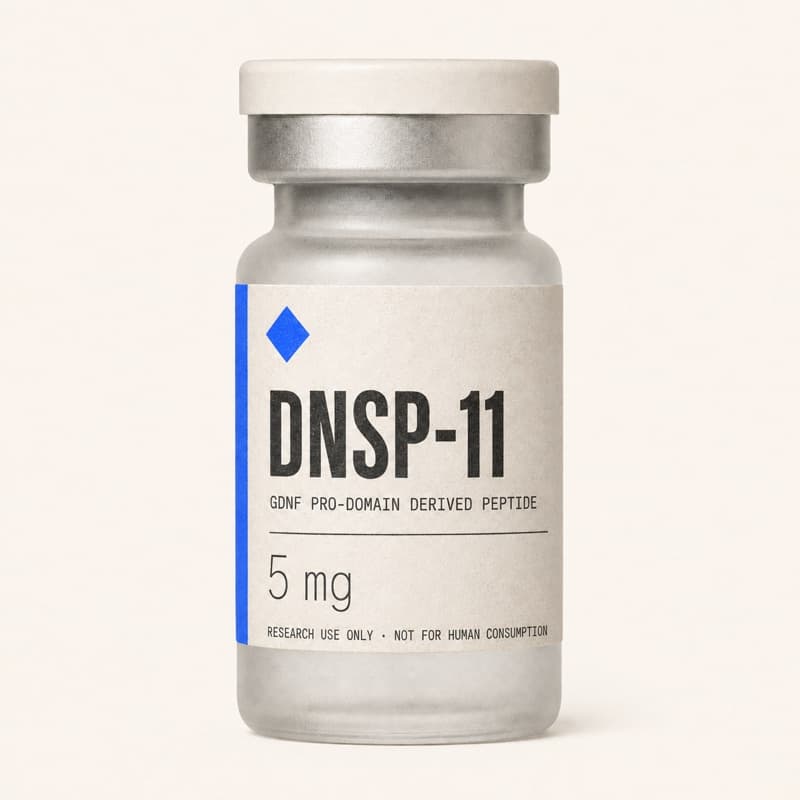
DNSP-11
GDNF-Derived Peptide · Dopaminergic Neuroprotection
Peptide of 11 amino acids, its sequence taken from the pro-domain of GDNF (glial cell line-derived neurotrophic factor). The design was meant to keep GDNF's neuroprotective properties and drop what limits the full-length protein: manufacturing complexity, off-target effects, and weak penetration of the blood-brain barrier. Dopaminergic neurons are protected and stimulated in preclinical research, which is why interest in the compound runs high in Parkinson's disease research, and in biohacking circles concerned with the health of the dopamine system.
Overview
Peptide of 11 amino acids, its sequence taken from the pro-domain of GDNF (glial cell line-derived neurotrophic factor). The design was meant to keep GDNF's neuroprotective properties and drop what limits the full-length protein: manufacturing complexity, off-target effects, and weak penetration of the blood-brain barrier. Dopaminergic neurons are protected and stimulated in preclinical research, which is why interest in the compound runs high in Parkinson's disease research, and in biohacking circles concerned with the health of the dopamine system.
Dopaminergic neurons are the target, reached by mechanisms distinct from those of full-length GDNF. The canonical GFRalpha1/RET receptor complex is not what DNSP-11 binds; alternative signaling pathways appear to be engaged instead, promoting survival of dopaminergic neurons, stimulating dopamine release, and protecting against neurotoxin-induced damage. Tyrosine hydroxylase expression — the rate-limiting enzyme in dopamine synthesis — is enhanced, and mitochondrial function in dopaminergic neurons supported.
Research indications
What the compound has been studied for, grouped by body system. Effect size is the reported magnitude where it was measured — not a recommendation.
Mitochondrial health in dopaminergic neurons — often compromised in neurodegenerative conditions — is supported.
In preclinical Parkinson's disease models, dopamine-producing neurons are protected against neurotoxin-induced damage.
Upregulation of tyrosine hydroxylase expression supports dopamine biosynthesis at its rate-limiting step.
Reports from biohackers suggest baseline motivation and drive improve, which is consistent with support of the dopaminergic system.
Mood stability and emotional baseline improve in anecdotal reports, likely mediated by optimization of the dopamine pathway.
- Class
- GDNF pro-domain derived peptide
- Research status
- Limited research
- Chain length
- 11 residues
- Molecular weight
- 1200 Da
- Typical dose
- 100–200 µg daily
- Frequency
- Once daily, typically morning
- Cycle length
- 4–6 weeks on, followed by a break
- Storage
- Lyophilized: -20C long-term; Reconstituted: 2-8C, use within 4 weeks
Molecular data
- Type
- GDNF pro-domain derived peptide
- Molecular weight
- 1200 Da
- Chain length
- 11 residues
PPEAPAEDRSLDosing reference
Doses reported in the literature and by suppliers. These are a record of what has been used in research — reference, never instruction.
| Context | Route | Amount | Frequency |
|---|---|---|---|
| General neuroprotection | Intranasal spray | 100-200mcg | 1x daily |
| General neuroprotection | SubQ | 100-200mcg | 1x daily |
Interactions
Neurotrophic pathways that complement: BDNF upregulation is Semax's route, while DNSP-11 aims at dopaminergic neuroprotection by GDNF-related mechanisms.
Dopaminergic function is supported by both, through different mechanisms. Tyrosine hydroxylase gene expression is enhanced by Bromantane; neurotrophic support comes from DNSP-11.
Dopaminergic neuron health is the shared target. Dendrite growth and dopamine synthesis are promoted by 9-Me-BC, while DNSP-11 supplies neurotrophic protection.
What to expect
Safety
Mechanistic flags — properties of the pathway, not observed adverse events.
- Irritation of the nose, or a mild burning sensation (intranasal route)
- Reactions at the injection site — redness, swelling — on the subcutaneous route
- Severe or persistent irritation of the nose, or bleeding
- Neurological symptoms out of the ordinary: tremor, involuntary movements
- Marked mood disturbances, or agitation
- Signs of an allergic reaction — rash, swelling, or difficulty in breathing
- Pregnancy or breastfeeding
- Known peptide allergies
- Human safety data is very limited — use is at the user's own risk
- Physician consultation before any combination with dopaminergic medications
Quality checklist
What to confirm before trusting a batch of research material. A verification aid — not an endorsement of any supplier.
- Third-party Certificate of AnalysisIndependent lab · dated · lot-matched.
- HPLC purity ≥ 98%Reverse-phase trace included.
- Mass-spec confirms 1200 g/molMALDI-TOF or ESI-MS.
- Counterion stated (acetate ≫ TFA)TFA salts can confound bioassays.
- Endotoxin / sterility statementRelevant once reconstituted.
- Lyophilised · cold-chain shippedStored −20 °C, shipped on ice.
- Labelled “research use only”No therapeutic or dosing claims.
Recorded signals for this compound · 11
- ✓Purity testing by a third party, target >=95%
- ✓Packaging sealed and sterile
- ✓Shipped with a proper cold chain
- ✓After reconstitution, solution clear and colorless
- ✓Lyophilized powder, white to off-white
- !Commercial availability is very limited
- !Possible reactions at the injection site
- !Potential for nasal irritation
- ×Powder failing to fully dissolve
- ×Particles or precipitate visible
- ×After reconstitution, solution cloudy or discolored
FAQ
Is DNSP-11 easier to work with than the full-length GDNF protein?
Yes. It is an 11-amino acid fragment of GDNF's pro-domain, and several advantages follow over the full-length protein: better blood-brain barrier penetration, off-target effects avoided, simpler manufacturing, and intranasal administration made feasible. The neuroprotective benefits are captured in a more practical form.
In healthy people, does DNSP-11 lift dopamine levels and motivation at baseline?
Biohacker anecdote points to improved baseline motivation, drive, and mood stability in healthy individuals. Support of dopaminergic neurons through tyrosine hydroxylase upregulation is the likely source, but formal human studies of motivation and drive in non-disease populations are lacking.
Which route suits DNSP-11 better — nasal or injectable?
Popularity in biohacking communities sits with the intranasal route, on the potential for direct CNS delivery by olfactory transport, bypassing the blood-brain barrier. Reliable systemic absorption is what subcutaneous injection gives, though it depends on BBB penetration. Convenience favors nasal administration, at the cost of irritation in some users.
How long can DNSP-11 run continuously, and does it call for cycling?
Extremely little human data compares cycling with continuous use. Cycles of 4-6 weeks followed by breaks are what most protocols run, though the neurotrophic mechanism here is unlike that of stimulants which cause tolerance. Cycling is the conservative choice against potential receptor desensitization, and long-term effects remain understudied.
References
- 1DNSP-11 Is a Novel GDNF Pro-Peptide That Protects Dopaminergic Neurons in a Rat Model of Parkinson's DiseaseBradley LH, Fuqua J, Richardson A, et al. · Neuroscience Letters · 2010
DNSP-11 protected dopaminergic neurons in a 6-OHDA rat model of Parkinson's disease, preserving tyrosine hydroxylase-positive neurons and improving motor behavior without the side effects associated with full-length GDNF.
ReviewPubMed 20600597 ↗ - 2Dopamine Neuron Stimulating Peptide-11 (DNSP-11): A Novel, Small Peptide That Provides Long-Term Protection in a Rat Model of Parkinson's DiseaseKelps KA, Turchan-Cholewo J, Bhatt I, et al. · Neuropharmacology · 2011
A single injection of DNSP-11 provided sustained neuroprotection of dopaminergic neurons over multiple weeks in a 6-OHDA Parkinson's model, demonstrating long-lasting neurotrophic effects from the GDNF pro-domain peptide.
Animal in vivoPubMed 21530553 ↗ - 3DNSP-11 Induces Behavioral Recovery and Nigrostriatal Neurochemical Changes in a Unilateral 6-OHDA Rat Model of Parkinson's DiseaseFuqua JL, Littrell OM, Lundblad M, et al. · Society for Neuroscience Abstract · 2012
DNSP-11 improved motor behavior and restored striatal dopamine neurochemistry in a unilateral 6-OHDA lesion model, supporting its potential as a targeted dopaminergic neuroprotective agent.
In vitroPubMed 25419652 ↗ - 4Identification of Two Novel Peptides from the GDNF Pro-Domain That Bind to GFRalpha1Bradley LH, Fuqua JL, Bhatt I, et al. · Analytical Biochemistry · 2012
Identified DNSP-11 and a related peptide from the GDNF pro-domain with binding affinity to GFRalpha1, establishing a potential receptor-level mechanism for dopaminergic neuroprotective effects.
Review · inferredPubMed 22370281 ↗
In rat models of Parkinson's disease, DNSP-11 restored dopamine-related neurochemistry alongside behavioural recovery, extending the preclinical evidence base.