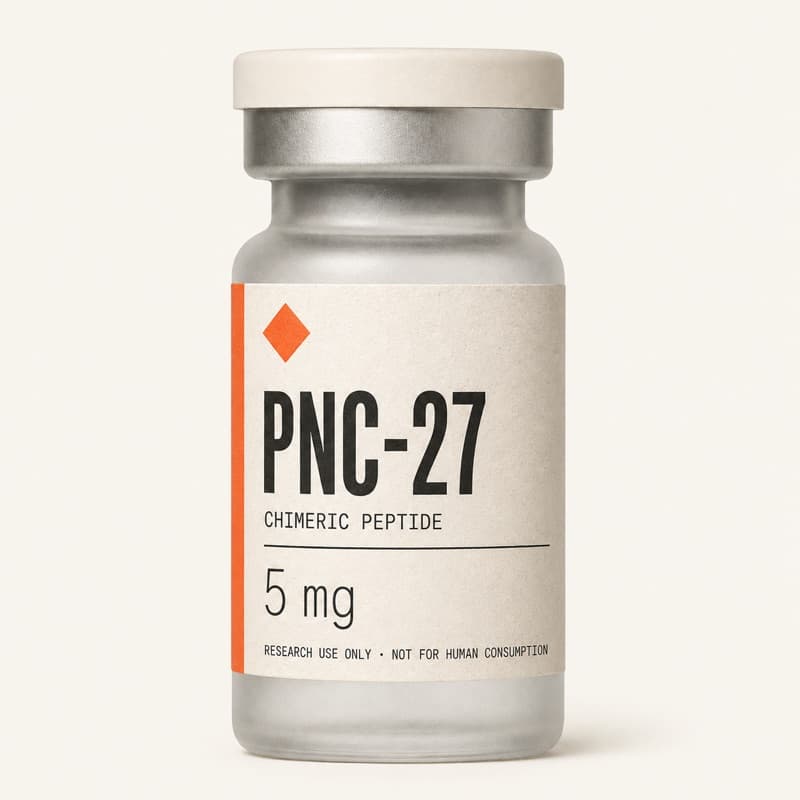
PNC-27
Anti-Cancer Peptide · p53-HDM-2 Disruptor
Anti-cancer peptide at the experimental stage, designed in 2000 by a supercomputer at SUNY Downstate Medical Center. Two parts make it up: a cell-penetrating domain and, from p53, an HDM-2 binding domain (residues 12–26). Killing of cancer cells is selective — the peptide binds HDM-2 (MDM2) expressed on the cancer cell membrane, and the pores that form bring on cell necrosis. Healthy cells express no HDM-2 on their membranes, so normal cells are untouched, which is critical. Effectiveness has been shown against melanoma, leukemia, breast cancer, and pancreatic cancer.
Overview
Anti-cancer peptide at the experimental stage, designed in 2000 by a supercomputer at SUNY Downstate Medical Center. Two parts make it up: a cell-penetrating domain and, from p53, an HDM-2 binding domain (residues 12–26). Killing of cancer cells is selective — the peptide binds HDM-2 (MDM2) expressed on the cancer cell membrane, and the pores that form bring on cell necrosis. Healthy cells express no HDM-2 on their membranes, so normal cells are untouched, which is critical. Effectiveness has been shown against melanoma, leukemia, breast cancer, and pancreatic cancer.
The vulnerability PNC-27 exploits is unique to cancer cells: HDM-2 (human double minute 2, also called MDM2) sits on their cell surface. Its p53 residues take up a conformation that binds membrane-bound HDM-2 directly, and transmembrane pores form. Tumor cell necrosis follows rapidly — necrosis, not apoptosis. PNC-27 also enters cancer cells and disrupts mitochondrial membranes. Surface HDM-2 expression is absent in normal cells, which are spared completely.
Research indications
What the compound has been studied for, grouped by body system. Effect size is the reported magnitude where it was measured — not a recommendation.
In research, PNC-27 is selectively cytotoxic to pancreatic cancer cells.
Effectiveness demonstrated in breast cancer cell lines.
HDM-2 binding induces necrosis in K-562 leukemia cells.
Melanoma cells are targeted selectively.
Effectiveness is greatest in cancers expressing high membrane HDM-2.
A model compound in the study of cancer-selective therapies.
- Class
- Chimeric peptide
- Research status
- Emerging
- Molecular weight
- 3500 Da
- Half-life
- ~12 h
- Typical dose
- Not established; preclinical research only
- Frequency
- Research protocols vary by study
- Cycle length
- Not established; no human clinical trials
- Storage
- Refrigerate at 2-8°C
Molecular data
- Type
- Chimeric peptide
- Molecular weight
- 3500 Da
- Half-life
- 720 min
Levels in single-dose multiples. A shape, not a pharmacokinetic prediction.
Dosing reference
Doses reported in the literature and by suppliers. These are a record of what has been used in research — reference, never instruction.
| Context | Route | Amount | Frequency |
|---|---|---|---|
| Research protocol | IP or direct tumor injection (research) | Variable by study | Research protocols |
Interactions
Combination therapy is under research as a possibility.
No combination studies published to date.
What to expect
Safety
Mechanistic flags — properties of the pathway, not observed adverse events.
- Data are limited; the research is primarily preclinical
- Tolerated well overall in animal studies
- Not applicable — human use is not approved
- Experimental research peptide only
- Response may be absent in cancers lacking membrane HDM-2
- Human use is not approved
Quality checklist
What to confirm before trusting a batch of research material. A verification aid — not an endorsement of any supplier.
- Third-party Certificate of AnalysisIndependent lab · dated · lot-matched.
- HPLC purity ≥ 98%Reverse-phase trace included.
- Mass-spec confirms 3500 g/molMALDI-TOF or ESI-MS.
- Counterion stated (acetate ≫ TFA)TFA salts can confound bioassays.
- Endotoxin / sterility statementRelevant once reconstituted.
- Lyophilised · cold-chain shippedStored −20 °C, shipped on ice.
- Labelled “research use only”No therapeutic or dosing claims.
Recorded signals for this compound · 9
- ✓White lyophilized powder
- ✓High purity (>95%)
- ✓Proper storage conditions
- ✓Solution clear once reconstituted
- !Membrane HDM-2 is not expressed by all cancers
- !A research chemical; quality standards are limited
- ×Discoloration
- ×Cloudy solution
- ×Visible particulates
FAQ
Why is PNC-27 called cancer cell-selective when normal cells also express HDM-2?
Location is what separates them. In normal cells HDM-2 sits intracellularly rather than at the cell surface. Pore formation by PNC-27 requires HDM-2 to be membrane-bound. Only cancer cells carry HDM-2 on the plasma membrane, which leaves them open to attack while normal cells are spared completely. That surface expression is the cancer-specific vulnerability.
Among peptide cancer therapies, is PNC-27 the nearest to clinical trials?
Not yet. The work remains preclinical, with no human clinical trials initiated as of 2025. Study dates back to 2000 without progressing to human testing. Two reasons: cancer drug development is slow, and peptide therapeutics face delivery challenges that remain under active research.
Does PNC-27 act on cancers that lack HDM-2?
No. The whole mechanism rests on binding membrane HDM-2, so cancers without that expression would not respond. It cuts both ways: high selectivity as a strength, dependence on the right cancer type as a limitation. HDM-2 status would be critical to assess before any therapeutic use.